
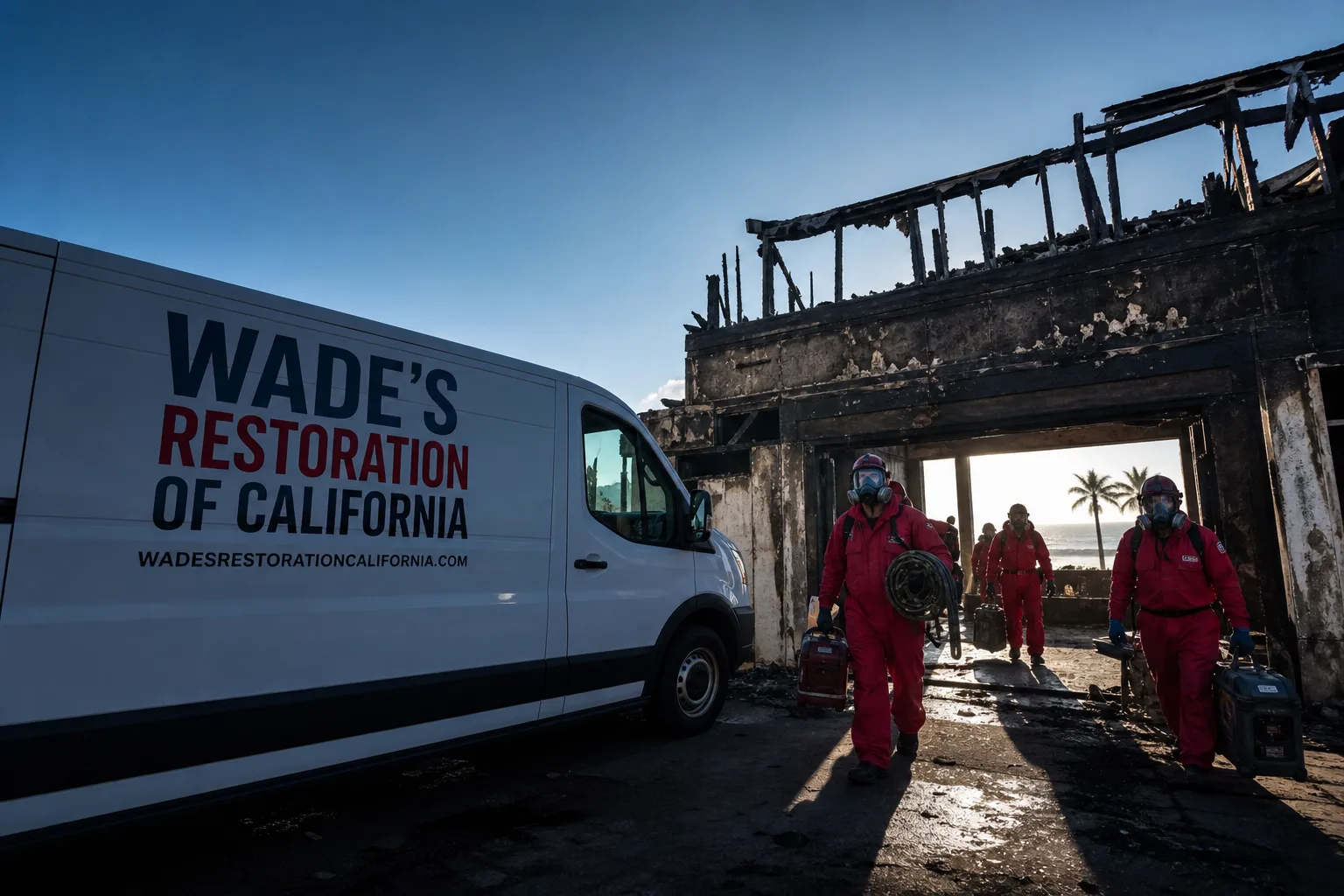
Fast, Reliable Water Damage Restoration Across Hemet
Water damage restoration in Hemet usually costs between $1,800 and $4,500 for a typical room extraction with structural drying, and most jobs here take three to five days to dry fully because of the manufactured-home subfloor systems that hold moisture longer than site-built homes. That’s not a number we pull from a national database. It’s what we see on our own moisture logs week after week in the 92543, 92544, 92545, and 92546 ZIP codes. If you’ve got water where it shouldn’t be right now, call (855) 915-0646. Wade answers his own phone, and he can have a truck headed toward Hemet inside the hour.
We’ve been pulling water out of Hemet homes long enough to know that what looks like a small puddle in a hallway is often hiding something much bigger under the floor. In manufactured homes especially, water travels sideways through belly-board insulation before it ever shows up as a stain on your vinyl plank. That’s why we don’t walk in, set up one fan, and call it a day. We crawl under, we thermally image, and we read moisture levels every single day until the numbers say dry, not until the carpet feels dry.
Why Wade’s Restoration of California Is Hemet’s Preferred Water Damage Restoration Company
Wade’s Restoration has been owner-operated since 2007, and Wade Ferris puts his name, his address, and his license number on every job in Hemet. That matters because you’re going to run into him again at the Stater Bros. on Florida Avenue or grabbing coffee off Sanderson. He lives with his reputation here, not in a call center three states away.
We answer calls live, 24 hours a day. Not an answering service. Not a voicemail that says “we’ll get back to you within one business day.” When your water heater lets go at 2 a.m. in a 1983 double-wide off San Jacinto Street, you get Wade on the phone, and he heads out himself. His crews are background-checked, uniformed, and trained on the equipment he sends with them: Dri-Eaz dehumidifiers, Phoenix axial fans, Injectidry drying mats, XPOWER air movers, B-Air units. The work carries IICRC, RIA, and IFA credentials, and every water job comes with the 90-Day Done Right Promise in writing. If it isn’t done right, we make it right. It’s that simple, and it’s in the contract.
Hemet customers don’t want a national chain that quotes one price over the phone and another at the door. They want someone whose truck they’ll see in their own neighborhood next month. That’s who we are. Ask anyone on your street.
Our Water Damage Restoration Services in Hemet
Emergency Water Extraction
When water is standing in a Hemet home, the clock starts immediately. We arrive with truck-mounted extraction units and portable extractors sized for the narrow doorways and tight hallways common in 1970s and 1980s manufactured homes. We pull standing water fast, then we map the moisture so we know how far it traveled before we start drying. In a stick-built home in Temecula, water stains the drywall and you see the damage footprint in a day or two. In Hemet’s manufactured stock, that same leak can wick fifteen or twenty feet through the underbelly before you smell it. Extraction here means pulling skirting and checking what’s happening below the floor line, not just vacuuming the carpet.
Structural Drying & Dehumidification
This is where Hemet jobs go wrong most often, and it’s where our daily moisture logs earn their keep. Manufactured home subfloors are usually particle board over a belly-board and fiberglass insulation assembly. That sandwich traps moisture against the vapor barrier and keeps it there for weeks unless the drying setup is designed for that specific construction type. We run low-grain refrigerant dehumidifiers longer than a site-built home would need, place air movers to create airflow across the underside of the floor system, and use Injectidry panels on hardwood or laminate where the subfloor can be saved. We hand you the moisture log at the end of the job, with every reading from day one to done. Almost nobody in this trade does that, and in Hemet, it’s the only way to prove the underbelly isn’t still wet and quietly growing mold.
Flood Cleanup
Hemet sits on the San Jacinto Valley floor, ringed by the San Jacinto Mountains. When storm cells drop rain on those slopes, runoff moves fast onto the flat valley, and the manufactured-home lots with minimal slope and shallow drainage swales are the first to take water. Flash flooding near the San Jacinto River corridor and in low-lying spots in the 92543 and 92545 ZIP codes can push muddy water under skirting and into belly-board insulation with almost no warning. Our flood cleanup work in Hemet is different from flood work in Murrieta because the water doesn’t just sit on the floor; it gets forced underneath the home by sheet flow, and that means the job starts with pulling skirting and inspecting the underside before we even set up extraction inside.
Burst Pipe Restoration
Hemet’s water is hard. We don’t mean marginally hard; we mean the kind of hard that leaves scale on every fixture and eats slowly at polybutylene supply lines from the inside. A lot of Hemet’s 1970s through 1990s stick-built tract homes and a good share of the manufactured stock still have polybutylene pipe. It fails suddenly, and it fails catastrophically. When we restore after a burst pipe in Hemet, we don’t just dry the affected room and walk away. We check the condition of the adjacent supply lines, look at the fittings for signs of the same corrosion that caused the first failure, and flag it before you get a second burst six months later. The restoration is the immediate priority; the pipe assessment is why you don’t have to call us twice.
What happens when you call
- 1
A real person answersNo phone trees - you reach a local pro.
- 2
You get an upfront price rangeHonest numbers before anyone is dispatched.
- 3
A background-checked tech heads outLicensed & insured, dispatched right away.
- 4
You approve before work beginsNothing starts until you say go.
Trusted Brands We Service in Hemet
We run professional-grade equipment on every job in Hemet: Dri-Eaz LGR dehumidifiers, Phoenix axial fans, Injectidry floor drying systems, XPOWER air movers, and B-Air units. We stock drying mats, desiccant packs, and the smaller parts and connectors needed for manufactured-home underbelly access so we aren’t waiting on a parts truck from Riverside when your floor needs drying now. Our IICRC-certified technicians know these machines and know how to adjust the setup for Hemet’s thin-wall assemblies and skirted crawlspaces. The equipment matters, but the person reading the gauges matters more.
Common Water Damage Restoration Problems We See in Hemet Homes
- Hidden wicking in manufactured-home belly boards. From the doorway, a water heater leak in a 1980s double-wide looks like a contained puddle. What we find after pulling skirting and thermally imaging the underbelly is moisture that wicked eighteen feet through fiberglass insulation, trapped by the vapor-barrier wrap. That’s the single biggest reason Hemet water damage jobs grow after the homeowner thinks the worst is over.
- Vapor-barrier belly wraps that seal moisture in, not out. The plastic barrier under a mobile home keeps ground moisture from rising, but when a leak starts inside, that same barrier traps the water against the subfloor. Drying these assemblies takes longer and needs deliberate air movement underneath the home, not just fans inside the living space.
- Hard-water corrosion in polybutylene piping. Hemet’s water is hard enough to accelerate corrosion in older polybutylene supply lines, which were already prone to sudden failure. We see restored homes re-flood within months because the original leak wasn’t the only weak point in the run.
- Flash flooding from the San Jacinto Mountains that catches low-clearance homes fast. The valley floor drains poorly in spots, and manufactured homes with low skirting and shallow lots take water underneath before it ever pools inside. If you’re in a low-lying part of 92543 or 92545, you’ve probably seen it happen in a neighbor’s yard after a hard storm.
Hemet’s Manufactured Housing Reality: What It Means for Water Damage
Hemet has one of the highest concentrations of manufactured and mobile home communities in Riverside County. That single fact changes how water damage restoration has to work here, and it’s the reason we don’t send a generic crew from a neighboring city to handle a Hemet job. Manufactured homes built from the 1970s through the 1990s sit on belly-board systems with fiberglass insulation packed against the underside of the subfloor, all wrapped in a vapor barrier and hidden behind skirting. When water leaks inside, a significant portion of it finds its way down through the floor assembly and into that insulation layer. It wicks sideways. It stays warm and damp. And because the vapor barrier holds it in place, you may not see any evidence for weeks, even as the damage footprint keeps growing.
Last winter, our crew responded to a water heater leak in a 1980s double-wide in the Mountain View Estates mobile home park off San Jacinto Street. From the doorway it looked like a contained puddle, but when we pulled the skirting and thermally imaged the underbelly, we found moisture had wicked eighteen feet through the fiberglass insulation against the belly board, trapped by the vapor-barrier wrap. We used an Injectidry system with floor drying mats and a Dri-Eaz LGR 7000XLi to pull moisture from the particle-board subfloor, then replaced the saturated belly insulation and reinstalled the skirting with venting to prevent the secondary mold our client was already starting to smell. The job took five days. A crew that never looked under the home would have left after two, and that client would have been tearing out flooring in three months.
This is the information gain we’re delivering on this page: how to find and dry hidden moisture trapped in manufactured-home belly boards and skirted crawlspaces before it doubles your remediation scope. You won’t find that on a generic water damage template, because the template doesn’t know Hemet from Murrieta. We do.
Pricing for Water Damage Restoration in Hemet, CA
We Also Serve Cities Near Hemet
We work throughout the San Jacinto Valley and the surrounding area, including East Hemet, Valle Vista, San Jacinto, and Homeland. If you’re in one of those communities and need Water Damage Restoration, call the same number and we’ll be on the road. We coordinate our Hemet-area scheduling from our Inland Empire office, and crews reach every corner of Hemet without the delay of a far-away dispatch.
Serving Hemet, CA - Our Local Coverage Area
We’re based in the Hemet area and know this community well. Use the map below to see our service coverage - if you’re nearby, we can almost certainly help.
FAQs - Water Damage Restoration in Hemet
Because the visible puddle is only the part of the damage you can see. In manufactured homes, water travels through the floor assembly into the belly-board fiberglass insulation, where the vapor barrier traps it and lets it wick sideways for days or weeks before it shows up anywhere else. The moisture map we take with thermal imaging after extraction often shows a damage footprint two or three times larger than the standing water suggested. That’s why we pull skirting and inspect the underbelly on every manufactured-home water loss in Hemet before we write the drying plan. If you suspect water has been sitting under your Hemet home, call (855) 915-0646. An inspection costs you nothing, and it’s the only way to know what you’re really dealing with.
Hemet’s water supply is noticeably harder than most of the Inland Empire, which means mineral scale accumulates inside pipes and accelerates corrosion in older polybutylene supply lines that are already nearing the end of their service life. When one section bursts, the adjacent sections are often compromised too, and restoring a home without checking the rest of the run can mean a second burst within months. On every burst pipe restoration in Hemet, we inspect the exposed piping, check fittings for pitting and scale buildup, and flag any section that looks like it’s on borrowed time. The restoration job gets done right; the plumbing assessment is why you don’t see us twice for the same disaster.
Yes, in most cases. Particle-board subfloors can often be dried in place using targeted injection drying, low-grain dehumidification, and under-floor air movement through the skirting access. We use Injectidry systems with floor mats that pull moisture through the floor covering and out through the dehumidifier, while the Dri-Eaz LGR units work the underbelly space. The key is starting within the first few days. Once particle board saturates and sits for a week or more, it can delaminate and lose structural integrity, and at that point replacement is the honest answer. We’ll tell you which path you’re on after the first moisture readings come back.
No. The homes most exposed to flash flooding sit in the low-lying areas near the San Jacinto River corridor and the manufactured-home lots with shallow or blocked drainage swales, concentrated in parts of 92543 and 92545. The neighborhoods on higher ground in 92544 and 92546 see far less sheet flow, though any home with skirting that sits close to the ground can take water underneath during a hard storm. If your street drains slowly or you’ve seen water running through your yard in a big rain, you’re in the higher-risk zone, and it’s worth making sure your underbelly is inspected after a major storm even if the inside stayed dry.
You dry the underbelly space deliberately, not passively. In a manufactured home, the area under the floor is a closed, low-airflow environment that will hold humidity for weeks if no one addresses it directly. We place dehumidifiers and air movers in the crawl space through skirting access panels, monitor humidity levels daily with the same moisture log we keep for the interior, and treat exposed framing with an EPA-registered antimicrobial where saturation has occurred. The drying plan for the underbelly is written into every Hemet job from day one, because letting that space stay damp is how you get the musty smell that never quite goes away. Call (855) 915-0646 and we’ll walk you through what your specific home needs.
Get Water Damage Help in Hemet Now
If water is spreading through your Hemet home right now, don’t wait until morning. Call (855) 915-0646. Wade Ferris answers his own phone, day or night, and he can have extraction running inside the hour. We serve all of Hemet: 92543, 92544, 92545, and 92546, including the mobile home communities off San Jacinto Street, Florida Avenue, and Sanderson. The estimate is free. No trip charge inside the county. Free second opinion on any written estimate you already have. Senior and Veteran discounts are permanent, not a promotion. And if we’re already working near you, we’ll show up fast and tell you straight what the job needs. One call. Wade’s name is on the truck, and he’ll be the one standing in your driveway.
Written by Wade Ferris, Owner at Wade’s Restoration of California, serving Hemet and the San Jacinto Valley since 2007.