
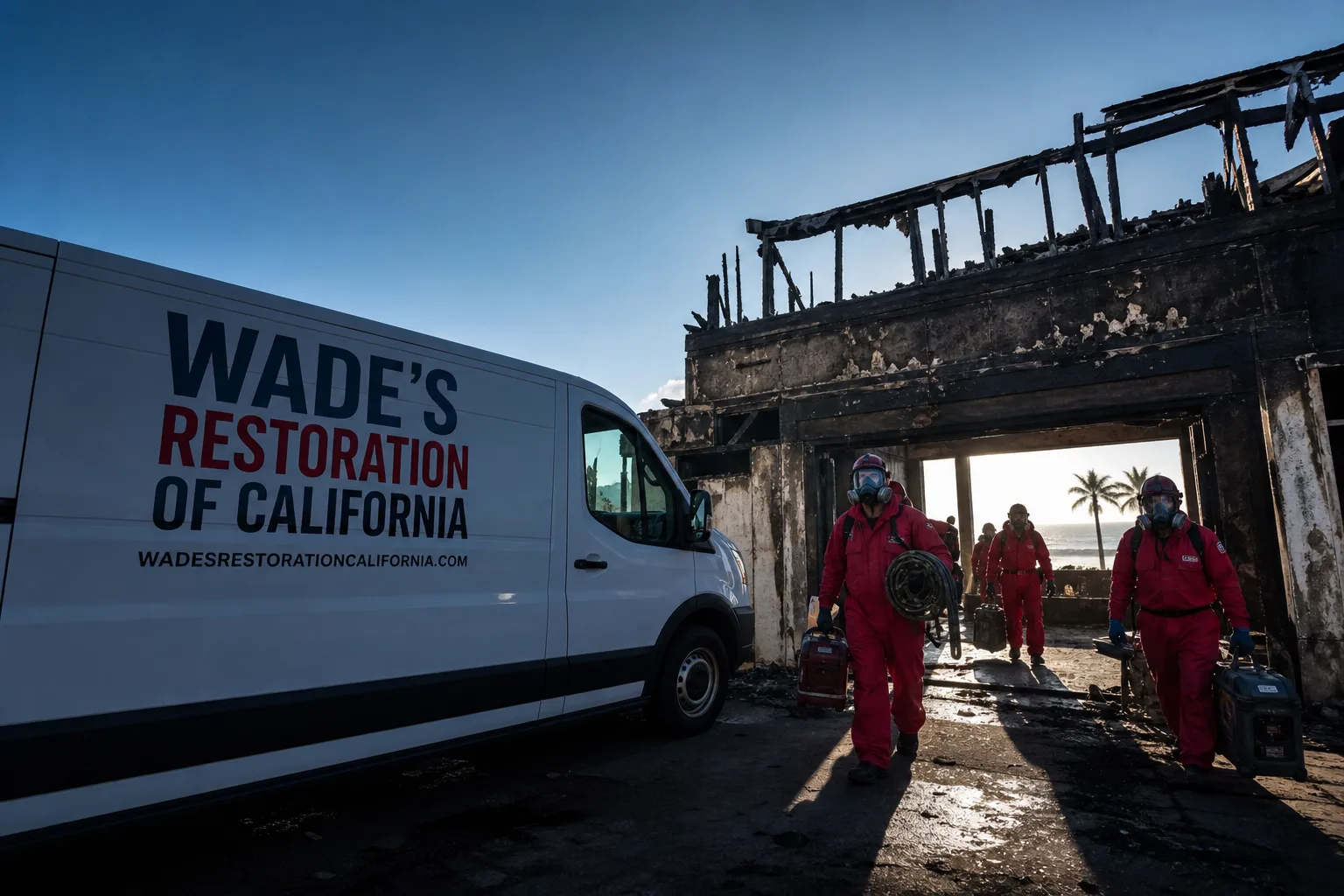
Fast, Reliable Mold Remediation Across West Hills
Mold remediation in West Hills typically costs $1,800-$6,500 depending on the square footage affected and whether the HVAC system has been infiltrated. Most jobs we handle in the 91307 and 91308 ZIP codes are completed within 3-5 days, with air quality clearance testing done before we call the job finished. Wade Ferris has been running restoration crews in this part of the San Fernando Valley since 2007, and he knows what West Hills attics and crawl spaces look like after two decades of Santa Ana wind events. Call (855) 915-0646 and you will get Wade or someone on his team, not an answering service.
Why Wade’s Restoration of California Is West Hills’s Preferred Mold Remediation Company
Wade publishes his name, his license number, and his address on every estimate. That is not common in this trade, and it matters even more in West Hills, where a lot of homeowners have already been through a fire or a flood claim and learned the hard way that the crew who shows up is not always the company they called. Around here, word travels block by block. Ask anyone on your street about a restoration company that actually answered the phone at 2 a.m. and you will hear Wade’s name come up more than once. He answers his own phone. That is the whole point.
The difference with our team is not a sales pitch about “certified experts.” It is that Wade himself shows up to inspect moisture readings, and he hands you the full daily moisture log when the job is done. Almost nobody in this business does that. In West Hills, where a ranch home from 1972 can hide moisture behind original drywall for months before you smell it, that documentation is the only proof that the problem is actually gone. Our Mold Remediation team runs Dri-Eaz dehumidifiers, HEPA scrubbers, and injectable-dry equipment on every job, and the crew is background-checked and uniformed. No subcontracted strangers in your hallways.
Our Mold Remediation Services in West Hills
Mold Inspection & Testing
A proper mold inspection in West Hills has to go beyond the visible patch on the drywall. The houses here, mostly 1960s-1980s wood-frame ranch homes with slab foundations, have open attic spaces that hold onto moisture from the Santa Susana Pass wind corridor. We run moisture meters across ceilings, walls, and around HVAC returns, take air and surface samples when the situation calls for it, and give you a written scope with numbers you can read before any containment starts. No vague “we will see when we get in there” talk.
Mold Removal
Mold removal in West Hills almost always involves attic insulation, not just the bathroom ceiling. Blown-in fiberglass insulation that sat through the Woolsey Fire and the smoke that followed retains fine ash particulate, which holds moisture and feeds mold growth years after the fire. We remove affected insulation, HEPA-vacuum the framing, treat the wood with antimicrobial encapsulation, and run negative air machines until clearance readings come back clean. This is not a bleach-and-paint job. It takes days, not hours.
Black Mold Remediation
When we find Stachybotrys, the black mold everyone is afraid of, in a West Hills home, it is usually in one of two places: a crawl space under a ranch home with poor cross-ventilation, or an attic corner where a post-Woolsey rebuild has a slightly different pitch than the original framing. Black mold remediation requires full containment, air scrubbers, and often removal of drywall sections rather than surface cleaning. We have done enough of these in 91307 and 91308 to know what the clearance inspector will flag, and we fix it before they get there.
Air Quality Restoration
This is the service that separates West Hills from most other communities in the Valley. Wildfire smoke, not just high humidity, is the primary driver of microbial growth in the attics and HVAC systems here. After we remediate the mold itself, we run HEPA air scrubbing through the ductwork, replace filters with MERV-13 where the system allows, and take post-remediation air samples in the living spaces before we call the job complete. If the air does not pass, we keep working. That is the standard, not an upsell.
What happens when you call
- 1
A real person answersNo phone trees - you reach a local pro.
- 2
You get an upfront price rangeHonest numbers before anyone is dispatched.
- 3
A background-checked tech heads outLicensed & insured, dispatched right away.
- 4
You approve before work beginsNothing starts until you say go.
Trusted Brands We Service in West Hills
Wade’s crew works on every major residential HVAC system you will find in West Hills homes, from original equipment on 1970s ranch houses to newer high-efficiency units on the post-Woolsey rebuilds along the hillsides near Valley Circle Boulevard. We stock common filters, antimicrobial treatments, and duct-supply parts in the trucks that serve the 91307 and 91308 ZIP codes, so a lot of the initial work does not wait on a supply house run. The equipment we run is Dri-Eaz, IICRC-rated, and sized for the square footage we are actually treating, not whatever was in the truck from the last job.
Common Mold Remediation Problems We See in West Hills Homes
- Smoke-impregnated attic insulation re-contaminating after a standard remediation. Too many companies remove the visible mold on drywall and leave the blown-in insulation that has been holding wildfire ash since 2018. The moisture bound to that ash reads as elevated on a meter, and the mold comes back within months.
- Post-Woolsey lightweight-frame rebuilds drying differently than older ranch stock. The newer framing material retains moisture in a different pattern than the 1960s Douglas fir around it, so a crew that treats a rebuild like an older home will close out containment too early. Wade’s team adjusts drying protocols for the specific construction era of the house.
- Santa Susana Pass wind re-depositing ash and damp air onto freshly treated crawl space vents. The wind corridor here is not just a fire hazard. It pushes fine particulate and moisture into exterior vent openings after we have cleaned and encapsulated them, undoing containment work if the vents are not screened properly.
- Attics with no ventilation upgrades since the original build. A 1974 ranch in West Hills with original gable vents and no ridge vent holds moisture at the roof deck all winter. We flag it on every inspection because if you fix the mold without fixing the airflow, you are paying for the same job twice.
Pricing for Mold Remediation in West Hills, CA
We Also Serve Cities Near West Hills
Along with our work across West Hills, Wade’s Restoration runs crews into Canoga Park, Woodland Hills, Calabasas, and Chatsworth. If you are just over the line in one of those neighborhoods, the same crew, the same equipment, and the same moisture log promise applies. Call and tell us which side of Valley Circle Boulevard you are on.
Serving West Hills, CA - Our Local Coverage Area
We’re based in the West Hills area and know this community well. Use the map below to see our service coverage - if you’re nearby, we can almost certainly help.
FAQs - Mold Remediation in West Hills
Why does mold keep returning in my West Hills attic even after a standard remediation?
Because the first crew probably removed the visible mold but left the blown-in attic insulation that has been holding wildfire smoke and ash since the Woolsey Fire, and that organic particulate binds moisture and feeds new growth within months. A West Hills attic needs insulation removal and HEPA air scrubbing, not just surface treatment. Call (855) 915-0646 and ask for a moisture log from the last job; if nobody gave you one, that is your answer.
Do post-Woolsey rebuilds in West Hills require a different mold remediation approach than older homes?
Yes. The lightweight-frame construction used in the 2019-present rebuilds along the hillside sections retains moisture differently than the older Douglas fir framing in 1960s-1980s ranch homes, so drying times and containment protocols have to be adjusted per structure. Our crew treats each house by its construction era, not by a blanket checklist.
Can the Santa Ana winds through the Santa Susana Pass actually cause mold problems?
They can, because the same corridor that drives fire weather also pushes damp air and fine ash into exterior crawl space vents and attic openings, re-depositing organic material on surfaces we have just cleaned and encapsulated. That is why proper vent screening and post-remediation air testing matter more in West Hills than in Canoga Park or Woodland Hills.
How do you confirm that smoke-related mold and odor are fully gone from a West Hills HVAC system?
We run HEPA air scrubbers through the ductwork, replace filters, and take post-remediation air samples in the living spaces, not just in the containment zone. The clearance reading has to fall within normal indoor air quality range before we close out the job, and you get the full documentation showing those numbers.
Is it normal for mold to appear in a West Hills home with no history of water leaks?
In this ZIP code, yes. Wildfire smoke infiltration into attics and HVAC returns creates a moisture-retention condition that does not need a pipe leak to start growing mold. If you are smelling musty air in a home that never flooded, call (855) 915-0646 and we will send someone with a moisture meter, not a guess.
Call Wade’s Restoration for Mold Remediation in West Hills
If you smell something in the attic that no amount of airing out removes, do not wait. The longer mold sits in a West Hills attic, the further it works into the framing and the ductwork. Call (855) 915-0646 and Wade or one of his crew will be on the road to your side of the Valley. Free estimates, a written scope before any work starts, and a moisture log in your hand at the finish.
Written by Wade Ferris, Owner at Wade’s Restoration of California, serving West Hills since 2007.