
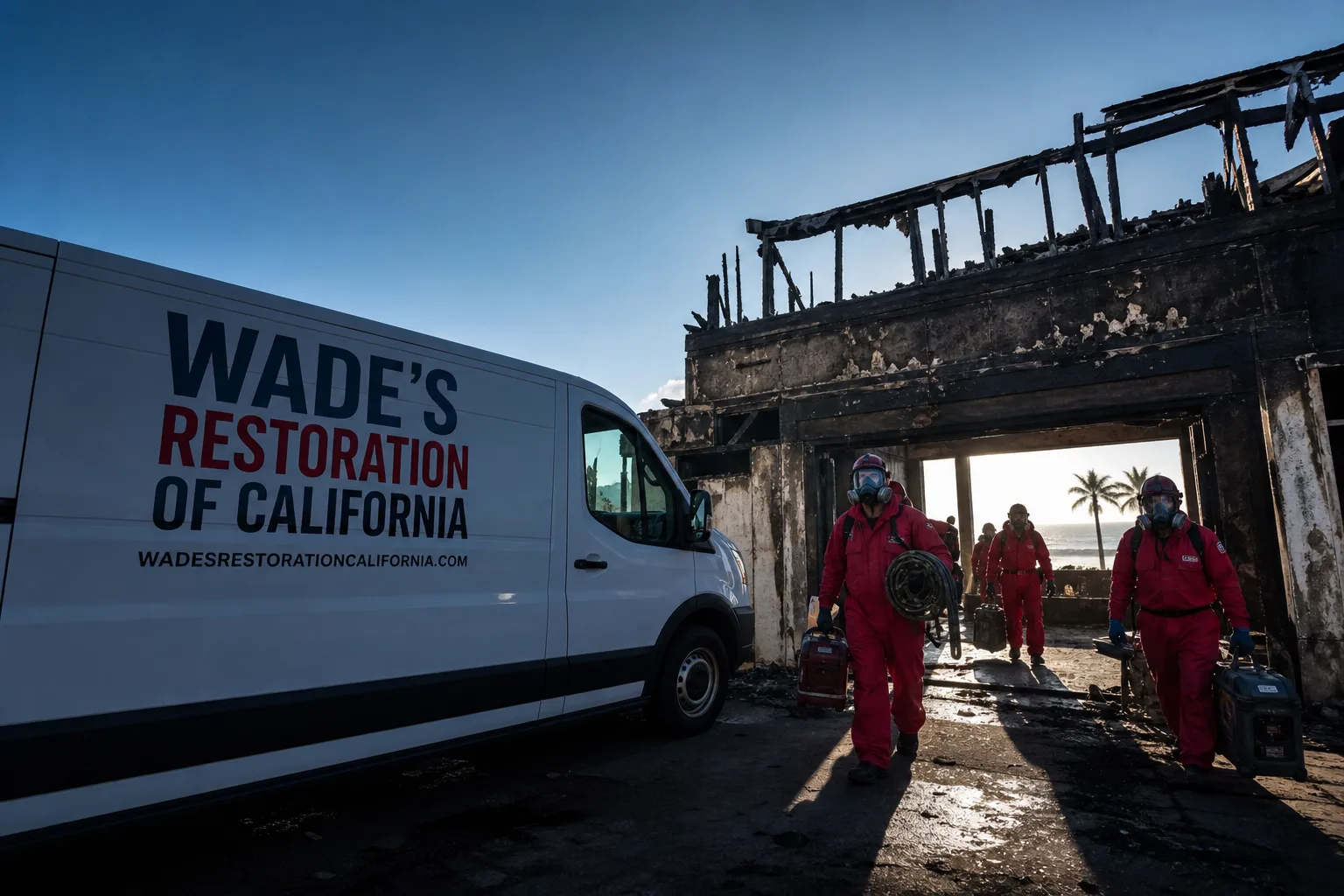
Fast, Reliable Water Damage Restoration Across Los Angeles
Water damage in Los Angeles rarely waits for a convenient hour. A burst galvanized supply line on the third floor of a 1920s Koreatown walk-up can cascade through four units before you even notice the ceiling stain in 90005. That’s why we answer live, 24 hours a day, and why Wade Ferris himself heads out on emergency calls. Call (855) 915-0646 and you’ll talk to a person, not a queue. Our crews know the difference between a Spanish Colonial stucco duplex in 90018 and a flat-roofed 1940s apartment in Westlake, and we bring the right drying plan for each. Extraction should start inside the hour, because in Los Angeles’s plaster-over-wood-lath housing stock, water doesn’t sit. It wicks.
Why Wade’s Restoration of California Is Los Angeles’s Preferred Water Damage Restoration Company
We’ve worked in enough Los Angeles apartment stock to know that a Category 1 water loss in this city can look like a Category 2 by the time anyone opens the wall. That comes from housing age. The 1920s-1940s Craftsman bungalows and Spanish Colonial duplexes that define 90015, 90016, and 90018 were built with original plaster over wood lath, and that material drinks water faster than any modern drywall. When a pipe fails in a South LA bungalow, the moisture climbs the wall cavity before the floor even feels wet. We’ve seen it enough times that our moisture logs account for it from the first reading.
Wade publishes his name, address, and license number. He answers his own phone at midnight. When he says “I will be there myself,” he means it. Los Angeles homeowners who’ve been burned by a national chain calling from a voicemail system appreciate that accountability. Ask anyone on your street. Most of our work in 90016 and 90017 comes from neighbors talking over a fence.
Every water job in Los Angeles carries the 90-Day Done Right Promise in writing. If it’s not done right, Wade makes it right. Not a warranty department. Wade. One call brings him back.
Our Water Damage Restoration Services in Los Angeles
Emergency Water Extraction
When water is actively entering a Los Angeles property, the first hour determines whether you’re drying drywall or replacing it. Our crews run Dri-Eaz extraction units and B-Air air movers sized for the room, the wall material, and the building age. In the high-density apartment corridors of Koreatown and Westlake, a single burst supply line on an upper floor can send water through four to six tenant units before anyone reports it. We map that path. The goal is standing water out fast, then targeted drying. Not a single-room extraction that misses the wicking through plaster-and-lath walls connecting the units below. Call (855) 915-0646 and extraction crews run inside the hour.
Structural Drying & Dehumidification
Los Angeles presents a drying problem most restoration markets never see. Santa Ana wind events, typically September through December, drive rapid surface drying that can fool a standard moisture meter. The plaster and drywall feel dry on top. Behind the stucco, water is still moving through wood framing. A restorer who relies on standard drying timelines in Los Angeles will under-treat, close the wall, and hand you a mold callback six weeks later. We run Phoenix and Dri-Eaz dehumidifiers longer than the textbook says, and we take moisture readings every single day. At the end of the job, you get the full moisture log. Almost nobody in the trade hands that over. Wade does.
Flood Cleanup
Southern California’s Mediterranean rainfall pattern dumps roughly 80% of the year’s rain in three or four winter months. When El Niño or atmospheric-river storms arrive, that water hits soil that drought has compacted into a nearly hydrophobic surface. The water doesn’t absorb. It runs. Low-lying streets and subgrade units in 90015 and 90016 that haven’t flooded in years suddenly take on water, and property owners and insurers are caught unprepared. Our flood cleanup teams handle extraction, sewage contamination when present, and full structural drying. Flat rooftops throughout Koreatown, Westlake, and South LA pond aggressively when drains clog with debris, so we also inspect roof drains after storm events. A ponding flat roof can re-enter units weeks after the first restoration was completed.
Burst Pipe Restoration
Aging galvanized supply lines are a fact of life in 1920s-1940s Los Angeles rental stock. When one fails, it generally fails at the worst possible time. We responded to a burst galvanized supply line in a third-floor Westlake apartment on South Alvarado Street, where water had been cascading through four units below for two days before anyone called. Our tech used Dri-Eaz dehumidifiers and Injectidry floor-drying mats to open the plaster-and-lath walls, follow the wicking path, and stop active mold growth before it reached the original wood framing. That’s the difference between a restoration and a rebuild. We handle the extraction, the drying, and the full reconstruction where needed, with a written scope agreed before work starts. No surprises at the door.
What happens when you call
- 1
A real person answersNo phone trees - you reach a local pro.
- 2
You get an upfront price rangeHonest numbers before anyone is dispatched.
- 3
A background-checked tech heads outLicensed & insured, dispatched right away.
- 4
You approve before work beginsNothing starts until you say go.
Trusted Brands We Service in Los Angeles
We use Dri-Eaz dehumidifiers, Phoenix air movers, and Injectidry floor-drying mats, because this work needs equipment that holds up on multi-day commercial and multi-unit residential jobs. The brand names matter less than the results, but in Los Angeles’s older stock the right equipment makes a measurable difference. Our crews are IICRC-certified, RIA-affiliated, and IFA-recognized. We stock parts and materials locally, which means faster turnaround for emergency calls across 90015, 90016, 90017, and 90018. When a property owner calls with water actively entering a unit, we’re not waiting on a truck from another county. We’re already here.
Common Water Damage Restoration Problems We See in Los Angeles Homes
Wade’s crews have been in and out of enough Los Angeles apartments to know the failure patterns by ZIP code.
- Plaster-and-lath wicking in century-old units. Original plaster over wood lath in 1920s-1940s Craftsman and Spanish Colonial stock absorbs water far faster than modern drywall, so a small pipe leak in a 90018 duplex can present mold indicators before the first technician even arrives.
- Santa Ana wind masking residual moisture. The hot, dry wind that blows September through December dries wall surfaces fast while wood framing underneath stays wet. Standard drying timelines under-treat these jobs, and the mold callback arrives weeks later.
- Drought-compacted soil flooding subgrade units. Years of drought turn Los Angeles clay-heavy soils hard and water-repellent. When winter rains do come, water runs off instead of absorbing, flooding subgrade units in 90015 and 90016 that haven’t seen water in years.
- Flat-roof ponding after storms. Flat residential and commercial rooftops throughout Koreatown and Westlake pond aggressively when roof drains clog. That water re-enters units long after the initial restoration is finished, creating a second loss weeks or months later.
Pricing for Water Damage Restoration in Los Angeles, CA
We Also Serve Cities Near Los Angeles
Our crews cover the neighborhoods and cities around Los Angeles every week. If you’re in Koreatown with a third-floor pipe failure, Echo Park with a hillside runoff issue, Silver Lake with a flat-roof pond, or View Park-Windsor Hills with a slab leak, we’re close. We know the housing stock, the soil, and the storm patterns because we work here. For full details on our coverage area, see our Los Angeles service territory or our main Water Damage Restoration page for the complete list of services.
Serving Los Angeles, CA - Our Local Coverage Area
We’re based in the Los Angeles area and know this community well. Use the map below to see our service coverage - if you’re nearby, we can almost certainly help.
FAQs - Water Damage Restoration in Los Angeles
How quickly does water damage in a 1920s Craftsman bungalow in South LA need to be handled to avoid mold in the plaster-and-lath walls?
In a 1920s Craftsman with original plaster-over-wood-lath walls, you have roughly 24 to 48 hours before active mold indicators appear, not the 72-hour window common in modern drywall construction. The plaster and wood lath wick moisture far faster. Call (855) 915-0646 the moment you see water, and Wade can have extraction running inside the hour.
What makes water damage restoration different in a Koreatown apartment building versus a single-family home in the Valley?
In a Koreatown apartment building, a single upper-floor pipe failure can cascade through four to six tenant units below, moving through connected plaster-and-lath wall cavities that act like wicks between floors. Single-family homes in the Valley generally confine damage to one or two rooms with modern wall materials. Koreatown work requires mapping the hidden water path before extraction, and drying every connected unit, not just the one where the water appeared. That’s why our crews open walls and follow the moisture with daily readings.
Why do flat-roofed buildings in Koreatown and Westlake need special attention after a winter storm?
Flat roofs pond when drains clog with leaves and debris, and in Koreatown and Westlake the problem is chronic. A clogged roof drain after a storm sends standing water into the building envelope that re-enters units days or weeks later, often after the initial restoration was already closed out. Anyone restoring storm damage in these neighborhoods should inspect roof drains on every job or expect a second loss. We include that in our post-storm scope.
How does Santa Ana wind affect the structural drying process after a water intrusion in Los Angeles?
Santa Ana wind drives rapid surface drying that hides moisture behind stucco and drywall. The top layer feels dry while wood framing underneath stays wet, so a restorer who pulls equipment on a standard timeline leaves hidden moisture that becomes a mold problem weeks later. In Los Angeles, we run dehumidifiers longer and rely on daily moisture readings, not surface touch. Our process accounts for the wind from the first reading.
Do you handle water damage in subgrade units that flooded for the first time in years due to drought-compacted soil?
Yes. Extended drought compacts Los Angeles’s clay-heavy soils until they become nearly water-repellent, so winter rain runs off into low-lying streets and subgrade units that haven’t flooded in years. Owners and insurers are often unprepared. We handle extraction, sewage contamination if present, structural drying, and full reconstruction where needed, with a written scope before work starts. Call (855) 915-0646 and we’ll walk you through the first steps.
Call Wade’s Restoration of California for Water Damage Restoration in Los Angeles
When water is moving through your walls at two in the morning, you need someone who will answer the phone and show up. Wade does both. We serve all of Los Angeles, from the 90015 loft district to the 90016 bungalows and the 90017 apartment stock. Call (855) 915-0646 now for a free estimate and straight talk from a local owner who’s been doing this work since 2007. No answering service. No runaround. Just Wade and his team, on the road when you need them.
Written by Wade Ferris, Owner at Wade’s Restoration of California, serving Los Angeles since 2007.