
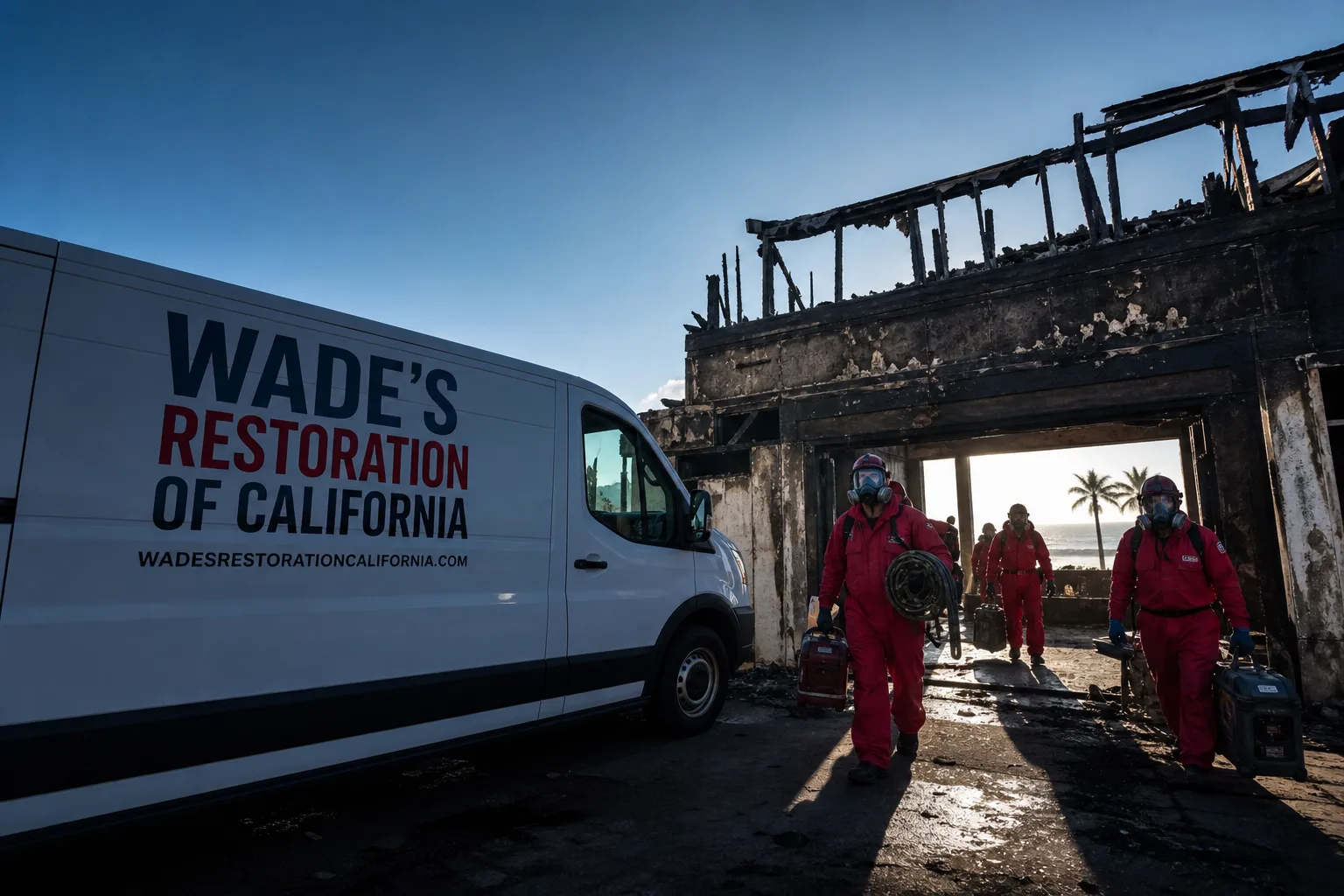
Fast, Reliable Storm & Disaster Restoration Across Torrance
Storm damage in Torrance rarely looks like the textbook version. It’s wind-driven rain working into 1950s stucco, salt air that’s been quietly eating garage-door hardware for a decade, and in the northwest neighborhoods, a refinery on the horizon that changes how you handle soot and odor calls. When a storm hits, you need someone who knows which of those problems you actually have, not a national outfit guessing over the phone. We respond to Torrance calls day or night, and Wade himself answers the phone at (855) 915-0646. No answering service, no call center. Just a real person who knows what Torrance storms do to Torrance homes.
Why Wade’s Restoration of California Is Torrance’s Preferred Storm & Disaster Restoration Company
Wade’s Restoration has been a locally owned, owner-operated company since 2007, and that matters in a city like Torrance. When you call, you’re talking to the person whose name is on the truck. Wade publishes his address and license number, and he answers his own cell at all hours. If you see him at the hardware store on Saturday, he’s going to ask how your cleanup went. That’s the oldest accountability mechanism there is, and it’s one no franchise outfit can replicate.
Our crews serve all of Torrance, from Old Torrance’s Craftsman bungalows near Western Avenue to the 1950s tract homes east of Crenshaw and up into the northwest corridor near Sepulveda and Del Amo. We know the difference between a lath-and-plaster wall behind a 1912 Craftsman exterior and gypsum board over slab-on-grade construction from 1962. That knowledge changes how we dry, how we scope, and how long it takes. Ask anyone on your street about Wade’s Restoration. Somebody’s already called us once. That’s the way it works in a city this size.
Our Storm & Disaster Restoration Services in Torrance
Our Storm & Disaster Restoration team handles the full range of what coastal storms throw at Torrance homes. Here’s what that means in practice.
Storm Damage Cleanup
Storm cleanup in Torrance doesn’t stop at the water you can see. After a wind event, we’re checking for water that wicked through stucco pores, settled into original 1950s galvanized supply lines, and made its way under base plates into slab-on-grade construction. Our crews document everything with moisture readings every day. Daily logs. Handed to you at the end of the job. Almost nobody else in the trade does that.
Flood Damage Restoration
Floodwater in Torrance comes two ways: storm surge pushing heavy rain against slab foundations in the lower-lying sections of 90501, and interior pipe blowouts from corroded galvanized supply lines that finally gave out. Both need structural drying fast, because Torrance’s marine layer keeps ambient humidity high enough that mold colonization starts within 24 to 48 hours. We run Dri-Eaz and Phoenix drying equipment, extract same day, and hold ourselves to the 90-Day Done Right Promise on every water restoration job, in writing.
Emergency Board-Up
When a Torrance tree branch goes through a window during a Santa Ana wind event, the immediate need is simple: get the opening sealed before raccoons, rain, or someone looking for an easy entry notices. We board up same day, and we’re not slapping plywood over the hole and calling it done. Around here, board-up has to account for salt-air corrosion that’s already weakened your fasteners. We use coated hardware that holds.
Roof Tarping
Wind-driven rain peels back roofing in Torrance more often than people expect, especially on 1950s and 1960s homes that still have their original roof decking. We tarp fast, and we don’t treat tarping as a temporary patch to forget about. The marine layer eats exposed sheathing and flashings. That’s why we inspect the whole roof perimeter, not just the visible damage, when we respond to Storm & Disaster Restoration in Torrance calls.
What happens when you call
- 1
A real person answersNo phone trees - you reach a local pro.
- 2
You get an upfront price rangeHonest numbers before anyone is dispatched.
- 3
A background-checked tech heads outLicensed & insured, dispatched right away.
- 4
You approve before work beginsNothing starts until you say go.
Trusted Brands We Service in Torrance
We use professional-grade equipment from Dri-Eaz, and many Torrance homeowners already know the name. We keep common replacement parts on hand for the brands our customers actually have: Phoenix for drying, Injectidry for hardwood floor drying, XPOWER and B-Air for air movement. But the equipment matters less than the training. Wade’s crew holds IICRC certification and the company is affiliated with RIA and recognized by IFA. If a claim goes to insurance, our photo documentation and daily moisture logs speak that language fluently. And we deal with the adjuster directly, so you’re never the one stuck relaying information between two parties.
Common Storm & Disaster Restoration Problems We See in Torrance Homes
- Refinery-related soot and chemical film. In Torrance’s northwest corner, storm-driven smoke and odor events carry hydrocarbon residue from the PBF Energy refinery. What looks like ordinary smoke damage often isn’t, and standard smoke sponges won’t touch it.
- Accelerated garage-door and hardware corrosion. The salt air and persistent marine layer eat through standard steel springs, hinges, rollers, and opener chains years before they’d fail inland. A tension spring that snaps during a windstorm is its own kind of emergency.
- Hidden water intrusion on slab-on-grade homes. Torrance’s 1950s and 1960s tract homes are mostly slab foundations, which means water can travel laterally under walls and flooring without pooling anywhere visible. By the time you see it, it’s already soaked structural framing.
- Old Torrance lath-and-plaster absorption. Craftsman bungalows in 90501 built before 1920 still have original wood subfloors and lath-and-plaster walls that absorb stormwater like a sponge. Those materials dry much slower than modern drywall, and they hold moisture deep enough to feed mold if equipment isn’t placed the same day.
Pricing for Storm & Disaster Restoration in Torrance, CA
Storm Damage Cleanup in Torrance typically runs $1,200 to $4,800 depending on the square footage affected and how far water traveled before we got there. Emergency board-up is usually $450 to $950 for a standard window or door opening, with roof tarping landing between $800 and $2,500 depending on roof pitch and how much area the wind exposed. If floodwater is involved, structural drying and mold prevention expands the job significantly, often into the $3,000 to $9,000 range for a single room or hallway on slab.
Those are honest numbers for this market. A free second opinion on any written estimate is a standing offer from Wade. No trip charge inside our own county, and a permanent Senior & Veteran 10% discount. Call (855) 915-0646 and Wade will give you a straight number.
We Also Serve Cities Near Torrance
We’re based close enough to Torrance that our service coverage extends naturally to Lomita, West Carson, Rolling Hills Estates, and Manhattan Beach. Dispatch and scheduling are coordinated from our Los Angeles office, but the crews who show up are local to the South Bay. If you’re in one of those cities, you get the same response time, the same daily moisture logs, and the same person answering the phone at midnight.
Serving Torrance, CA - Our Local Coverage Area
We’re based in the Torrance area and know this community well. Use the map below to see our service coverage - if you’re nearby, we can almost certainly help.
FAQs - Storm & Disaster Restoration in Torrance
Does living near the Torrance Refinery change how storm damage restoration is handled after a weather-related odor or soot event?
Yes. In Torrance’s northwest ZIP codes (90501 and 90502), any storm-driven smoke, odor, or soot call should include hydrocarbon surface-wipe testing before anyone treats it as routine smoke damage. Refinery flaring and upset events leave a greasy, acrid film that standard smoke sponges won’t remove and standard ozone won’t neutralize. After a winter windstorm peeled back roof sections over a 1950s tract home near Del Amo and Sepulveda, our crew ran hydrocarbon wipes on the garage-door tracks and opener chain. They came back positive, so we followed an industrial-hygiene protocol with HEPA vacuuming and chemical-appropriate cleaners before touching anything else. That’s the difference between clean and “still smells like a gas station.” Call (855) 915-0646 if you’re south of Torrance Boulevard and think you might have refinery residue in the mix.
How fast do garage-door springs and hinges actually corrode in Torrance compared to inland cities?
In our experience, Torrance salt air and the persistent marine layer corrode standard steel garage-door hardware three to five times faster than you’d see in the San Fernando Valley or the Inland Empire. Uncoated springs can rust to the point of failure inside seven to ten years. Galvanized hinges might hold a couple of years longer. The opener chain is usually the first thing to show serious corrosion, since it’s moving constantly against itself. We specify galvanized or coated springs, stainless hinges, and nylon rollers on Torrance jobs for exactly this reason. The first seasonal wind event is not the time to discover your door won’t open because a spring finally gave out.
What should a homeowner in Old Torrance do immediately after a storm blows water under a Craftsman bungalow’s original wood subfloor?
Get air moving and get a professional moisture assessment same day. Old Torrance Craftsman bungalows, especially those in the 90501 ZIP code, still have original wood subfloors and lath-and-plaster walls that absorb water deeper and dry far slower than modern drywall. What looks like surface dampness is often wet framing. Torrance’s marine layer keeps relative humidity high enough that mold can colonize within 24 to 48 hours. The correct move is to call a restoration crew that takes moisture readings daily and hands you the log. If you wait a weekend because it “feels okay,” you might be looking at a full subfloor replacement instead of a drying job. Call (855) 915-0646. We answer day or night.
Why do storm restoration crews in Torrance sometimes need to address roof-penetration flashings even when the visible damage is only to a garage door or window?
Because Torrance’s marine layer and salt air corrode rooftop penetration flashings faster than inland cities. When wind-driven rain pushes into an older 1950s or 1960s stucco home, the water often enters through corroded flashing joints around plumbing vents, chimneys, or attic penetrations, not through the window or garage door that took the obvious hit. We inspect flashings as part of every storm damage call in Torrance, because repairing visible damage without checking the roof penetrations is like treating the symptom and leaving the cause. The water that got in through a flashing joint can travel along attic framing and show up as a ceiling stain weeks later.
Is emergency board-up different for Torrance’s 1950s slab-on-grade tract homes with stucco exteriors?
Yes, in one important respect. Torrance’s older tract homes are mostly slab-on-grade, which means water that enters through a broken window or door has nowhere to drain downward. It spreads laterally across the slab, under base plates and flooring. That makes board-up a water-control measure as much as a security measure. We don’t just cover the opening; we check for water already inside the wall cavity and the slab perimeter. Stucco exteriors from this era also hold moisture longer than modern siding, which extends the drying window and increases what a simple board-up call actually involves.
Written by Wade Ferris, Owner at Wade’s Restoration of California, serving Torrance and the surrounding South Bay communities.