
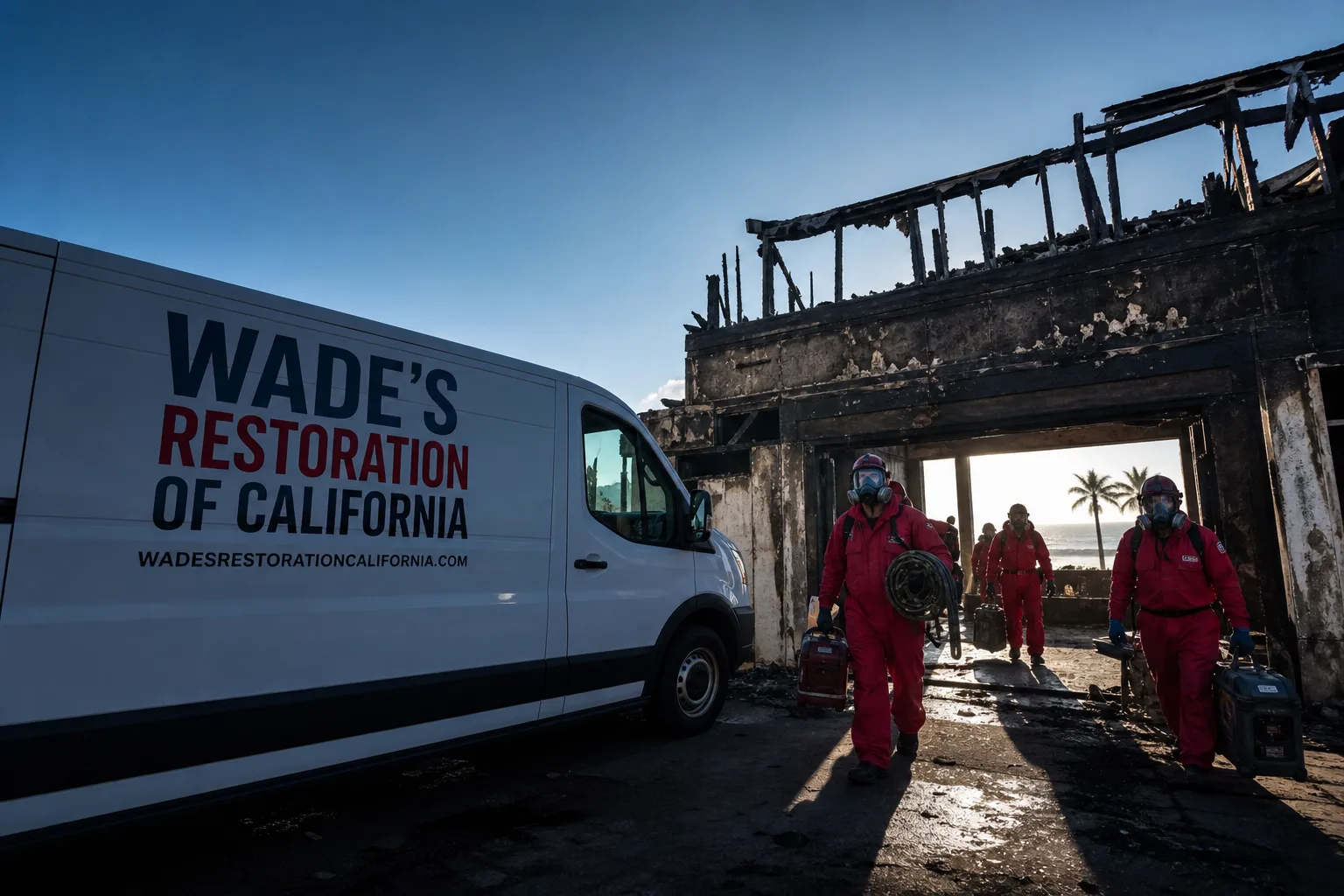
Fast, Reliable Storm & Disaster Restoration Across Lomita
Storm damage in Lomita doesn’t wait for business hours. When an atmospheric river rolls through and sends water from the Palos Verdes hills down into your crawlspace, you need someone who knows 90717’s older bungalows, not a call center three states away. Wade’s Restoration of California gets on the road fast, with equipment sized for post-WWII homes and a crew that’s seen Lomita’s specific failure patterns hundreds of times. Call (855) 915-0646 right now and you’ll hear a live voice, not voicemail.
Most storm jobs in Lomita involve water making a mess of a structure built between the late 1940s and mid-1960s. That changes everything about how we work. The homes are dense, the lots are flat, and the runoff from the south-facing Palos Verdes terrain doesn’t just pool on the surface - it saturates the sub-slab channels and crawlspaces that were never designed for repeated flooding. Wade Ferris, who founded this company in 2007, knows these homes. He’s crawled under enough of them to tell you what’s original, what’s been patched, and what’s about to fail.
Why Wade’s Restoration of California Is Lomita’s Preferred Storm & Disaster Restoration Company
Lomita is small. Two square miles, roughly. That’s an advantage when you need help, because we’re not driving across the county to reach you. We’re already nearby. When a storm hits, we’re not giving you a four-hour window. We’re telling you when the truck leaves and what time it pulls up in front of your house on 250th Street or near Eshelman Avenue.
Wade publishes his name, his address, and his license number. You’ll run into him at the hardware store or walking through your neighborhood. That’s the whole point. He’s not a rotating manager at a national chain who can’t be reached after the invoice is sent. The phone number at the top of this page goes to a live person, 24 hours a day. Often it’s Wade himself. He answers his own phone. He’s been doing it since 2007.
Our crew works with IICRC-certified methods and RIA guidelines, and we use equipment from manufacturers like Dri-Eaz and Phoenix. That matters because Lomita’s older housing stock demands precision, not brute force. You can’t just aim a fan at a 1952 plaster wall and call it dry. The marine layer from the South Bay keeps the air damp overnight, which means drying takes longer here. We know that already before we show up.
Our Storm & Disaster Restoration Services in Lomita
Flood Damage Restoration
Lomita’s flood problems start uphill. The city sits downhill of the Palos Verdes terrain to the south, and when winter atmospheric rivers dump rain, the runoff doesn’t stop at the boundary. It pushes into Lomita’s comparatively flat lots and finds every low point, every crawlspace vent, every crack in a foundation slab from 1955. We’ve seen the same homes flood twice in one season because the drainage was never corrected. Our flood restoration work in Lomita always starts with finding where the water actually went, not where it’s visible. Sub-slab channels hold water you can’t see from above. We check. Most restoration crews don’t.
Roof Tarping
Wind damage in Lomita usually means shingles torn off a roof that was already vulnerable. Many of these homes have original roof decking that predates modern plywood standards. When the decking gets exposed, moisture moves in fast. Marine-layer fog adds another variable. Inland, a tarp can wait a day. Here, overnight humidity from the South Bay means we recommend getting a tarp on the same day the damage happens. We carry roofing tarps, fasteners, and the right anchoring hardware for Lomita’s common roof pitches.
Debris Removal
Storms knock eucalyptus branches onto roofs, send palm fronds through carports, and push mud and gravel into carports and driveways along Lomita’s older streets. Debris removal sounds simple until it’s blocking a doorway or sitting on top of a gas meter. We clear what’s dangerous first, then haul the rest. If the debris includes construction materials from a damaged structure built before 1970, we look for asbestos before we move it. In Lomita, that’s not optional.
Emergency Board-Up
A broken window on a 1950s bungalow isn’t just an eyesore. The marine air rolls in and the interior humidity climbs. Within days, mold starts on drywall and insulation that may contain asbestos. Boarding up in Lomita means securing the opening fast, but it also means documenting exactly what was covered and why. Insurance adjusters want that. We photograph everything before, during, and after. That documentation goes directly to your adjuster so you’re not stuck relaying messages.
We also handle Storm & Disaster Restoration work beyond these core services, including wind damage repair and full reconstruction when the damage is structural. But for Lomita specifically, flood restoration, roof tarping, and debris removal are the three calls we get most after every major storm.
What happens when you call
- 1
A real person answersNo phone trees - you reach a local pro.
- 2
You get an upfront price rangeHonest numbers before anyone is dispatched.
- 3
A background-checked tech heads outLicensed & insured, dispatched right away.
- 4
You approve before work beginsNothing starts until you say go.
Trusted Brands We Service in Lomita
We stock parts and equipment sized for Lomita’s housing stock. That means restoration-grade dehumidifiers from Dri-Eaz, air movers from Phoenix, and the moisture meters we use daily. Wade takes moisture readings every single day on every water and flood job, and at the end of the job, you get the full moisture log. Almost nobody else hands over that log. It’s your proof the drying actually finished. We use RIA and IICRC standards on every job, and our techs train on the same equipment week after week. No rented machines we barely know how to run.
Common Storm & Disaster Restoration Problems We See in Lomita Homes
- Asbestos in the walls, ceilings, and ducts. Lomita’s homes were built in one concentrated postwar burst. Textured ceiling compound, floor tile, and duct insulation from that era frequently contains asbestos. Any water intrusion that touches those materials means testing and abatement coordination before restoration even begins. We’ve learned to schedule that in from day one, not treat it as a surprise.
- Repeated crawlspace saturation from Palos Verdes runoff. The same homes flood the same way every atmospheric-river event because stormwater from higher terrain keeps finding the same low channels. Conventional extraction misses the water trapped in sub-slab voids. We check the crawlspace even when the living area looks dry.
- Hidden galvanized pipe leaks after ground movement. Storm vibration and shifts in Lomita’s moderately hard water pipes leave hairline cracks inside walls. You see nothing for weeks, then a mold bloom appears. We inspect supply lines on every flood job, whether or not the flooding was from outside.
- Marine-layer moisture turning minor wind damage into mold. A broken window or missing shingle left open for a few days in Lomita is different than in Torrance or inland cities. The humidity from the South Bay accelerates mold colonization. We recommend emergency board-up and tarping the day damage happens, not after the weekend.
Pricing for Storm & Disaster Restoration in Lomita, CA
Call (855) 915-0646 for an exact quote. Estimates are free. Wade offers no-charge call-out within our own county and a free second opinion on any written estimate you’ve received from another company. Senior and Veteran discount is 10%, always. On any repair over $200, take $40 off.
We Also Serve Cities Near Lomita
Our crew regularly works in Torrance, Rolling Hills Estates, San Pedro, and West Carson - but Lomita is our focus for this page because its housing stock is uniquely old and uniquely dense. If you’re in one of the neighboring cities, the same Lomita coverage logic applies: local crews, local parts, and a live person on the phone at (855) 915-0646. But the hazmat patterns and runoff behavior we described here are most concentrated in the 90717 ZIP.
Serving Lomita, CA - Our Local Coverage Area
We’re based in the Lomita area and know this community well. Use the map below to see our service coverage - if you’re nearby, we can almost certainly help.
FAQs - Storm & Disaster Restoration in Lomita
Does every storm damage job in Lomita require an asbestos survey before you start drying or demo?
Every storm damage job in a Lomita home built before the 1980s that involves damaged building materials likely requires at least a pointed asbestos survey before drywall demo or structural removal. Most of Lomita’s housing stock was built between the late 1940s and mid-1960s, and textured ceilings, floor tile, and duct insulation from that era routinely contain asbestos. We’ve never once skipped the survey, and we coordinate the abatement with a certified subcontractor before our drying and mold work begins. Call (855) 915-0646 and we’ll tell you whether your specific job needs one.
How does the marine layer from the South Bay affect the timeline after a flood in a Lomita crawlspace?
The marine layer extends drying time in a Lomita crawlspace by a day or two on average compared to an inland city. Persistent overnight humidity slows evaporation because the surrounding air is already saturated. We compensate by running our Phoenix dehumidifiers longer and monitoring daily with Dri-Eaz moisture meters. Wade records every reading and hands you the full log at the end of the job, so you know the crawlspace actually met the dry standard before we left.
When wind damage tears off a section of roof in Lomita, how quickly does the tarp need to go on before mold starts?
Mold can begin colonizing exposed decking and attic insulation in a Lomita home within 48 to 72 hours, even without rain. The marine-layer humidity accelerates fungal growth compared to inland cities. If you’ve lost shingles or a section of roof, call (855) 915-0646 the same day. We’ll get a tarp over the damage before the overnight humidity takes hold.
Do I need a separate permit for flood restoration work in a 1950s Lomita home if only the drywall is replaced?
If only the drywall is replaced and no structural framing, electrical, or plumbing changes are made, the work is usually classified as a repair and may not require a separate building permit. However, because Lomita’s 1950s drywall joints and texture often contain asbestos, the mandatory survey is the regulatory trigger you’re more likely to hit before the city asks about a permit. We’ll walk you through both requirements before any demo begins.
What about the galvanized pipes behind the walls after a storm-do you inspect them even if the flood was from outside?
Yes, we inspect galvanized supply lines on every flood restoration job in Lomita, even when the water intrusion came from the storm and not from the pipes themselves. Lomita’s moderately hard water has been corroding these original pipes for 60-plus years, and the vibration or ground movement from a storm can be the final nudge that causes a hairline crack. If we find one, we document it, we show you, and we quote the repair as a separate line item. You’re not obligated to have us fix it, but at least you’ll know it’s there before mold appears weeks later.
Call Wade’s Restoration of California for Storm & Disaster Restoration in Lomita
Lomita’s post-WWII homes require a restoration company that doesn’t treat this city like every other ZIP code. We know the asbestos triggers, the runoff patterns, the galvanized pipes, and the marine-layer moisture that slows drying. That knowledge is built into every quote and every schedule we set. We don’t hand you a generic “we respond fast” brochure. We tell you what’s actually going to happen when we open your walls and what it’s going to cost.
If your crawlspace is wet, your roof is leaking, or wind debris is stacked against your house, call (855) 915-0646. Live person, day or night. Free estimate. Senior and Veteran discount always honored. Wade’s been doing this in Lomita long enough that your neighbor probably knows his name.
Written by Wade Ferris, Owner at Wade’s Restoration of California, serving Lomita and the surrounding South Bay communities.