
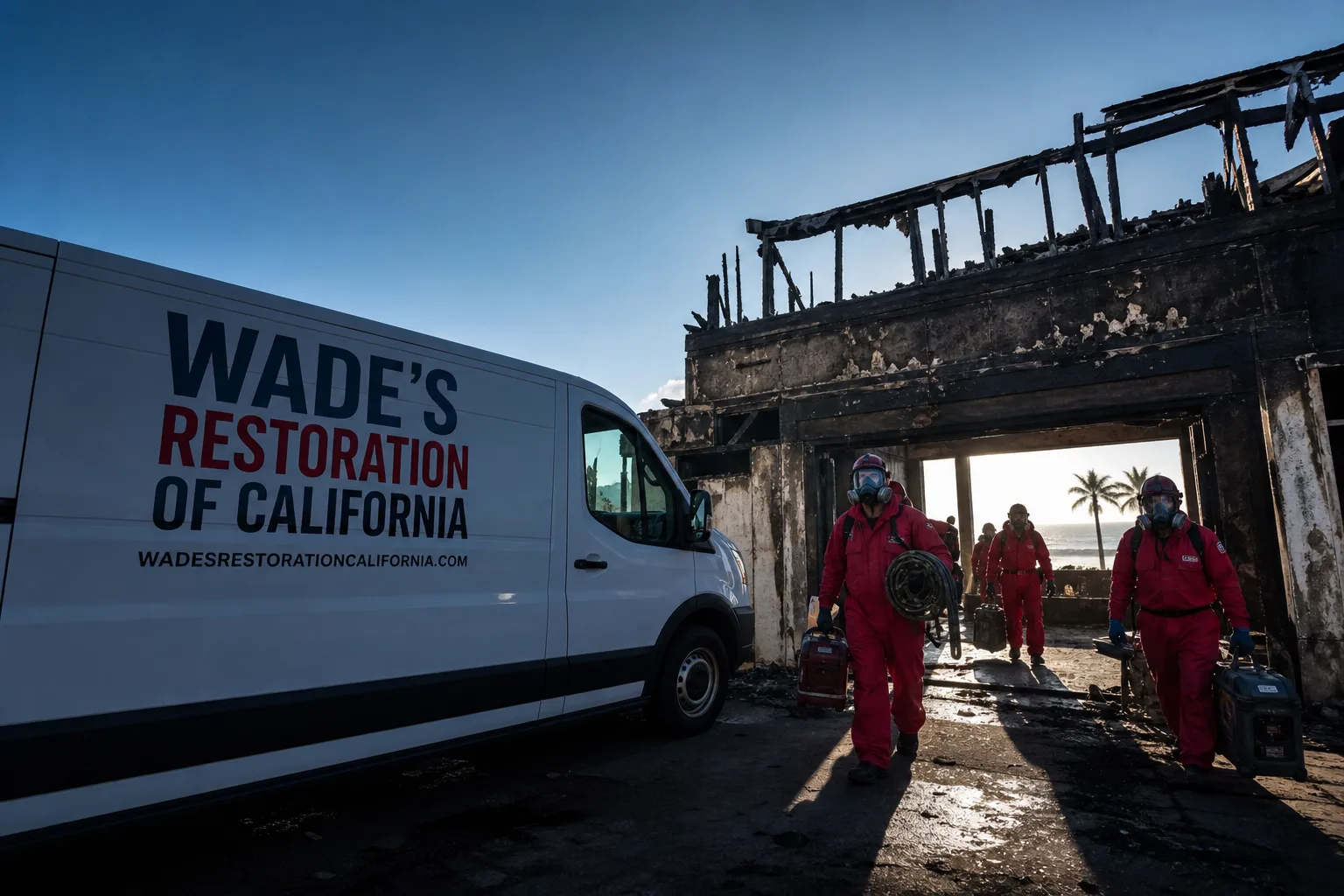
Fast, Reliable Storm & Disaster Restoration Across Signal Hill
Storm damage in Signal Hill moves fast, and so do we. When wind-driven rain gets into a condo off Cherry Avenue or runoff pools against a downslope foundation near the 405, you need someone who knows this hill and how water behaves on it. Wade Ferris has been answering his own phone since 2007, and he can have extraction running inside the hour for most Signal Hill calls. Call (855) 915-0646 any time, day or night. A live person picks up. That part matters when the ceiling is coming down.
Why Wade’s Restoration of California Is Signal Hill’s Preferred Storm & Disaster Restoration Company
Signal Hill isn’t Long Beach. It’s not Lakewood either. It’s two square miles of dense condos, townhomes, and steep slopes sitting on top of one of the most historically productive oil fields in the state. That shape and that history change how storm damage gets scoped, documented, and dried out. We know that because we have worked it. We have pulled water out of common-wall cavities in 1970s condo buildings where the real question wasn’t whether the storm caused the crack in the foundation. It was whether the oil field did, fifty years ago. That distinction matters when an adjuster is looking at your claim.
Wade’s Restoration is locally owned and owner-operated. Wade publishes his address and license number. His crew is background-checked and uniformed, and the equipment is professional grade: Dri-Eaz, Phoenix, XPOWER, B-Air. Every water, fire, and mold restoration job carries the 90-Day Done Right Promise, in writing. If it’s not done right, Wade makes it right. No runaround. No national call center. No stranger who quotes one price on the phone and another at the door.
Response time to Signal Hill is measured in minutes, not hours. Wade lives and works in this metro. He knows the hilltop streets, the alley-load parking under the older complexes, the gates and HOA board quirks. That local knowledge means the tarp goes up right the first time and the extraction plan accounts for where water actually travels in a shared-wall building. Ask anyone on your street. They probably know somebody who has called him.
Our Storm & Disaster Restoration Services in Signal Hill
Storm Damage Cleanup
Storm cleanup in Signal Hill means more than picking up branches. Wind-driven rain gets forced into rooflines, eaves, and stucco joints on the older condo stock, and gravity does the rest. We extract standing water, remove saturated drywall and insulation, set drying equipment, and run daily moisture readings until the structure is dry. Wade hands you the full moisture log at the end of the job. Almost nobody in this trade does that. It’s your proof the drying was done right.
Flood Damage Restoration
Flooding on Signal Hill concentrates at the base of the slopes. The steep perimeter grades channel runoff hard into the downslope properties along the city’s edges, and when drains back up or the ground saturates, water comes in low. We handle the full flood restoration sequence: extraction, drying, sanitizing, and rebuild scoping. In attached townhomes, water migrates across unit lines. We coordinate with adjacent owners and their carriers so nobody’s claim gets tangled up because a neighbor’s wall stayed wet. The IICRC-certified approach means the drying plan is written to the building’s actual construction, not a template.
Roof Tarping
Signal Hill is exposed to Santa Ana wind events more than the flatlands around it. When shingles lift or a tree limb punches through, the damage spreads every minute the roof stays open. We get a tarp up fast, properly secured with furring strips, and documented for your carrier. In the 1980s condo complex off Cherry Avenue, we responded to wind-driven rain intrusion during a Santa Ana event and found uneven floors and hairline foundation cracks that predated the storm, artifacts of long-term soil subsidence from legacy oil extraction. We dried the common-wall cavity with Dri-Eaz extraction and XPOWER air movers, and documented the pre-existing conditions to keep the claim clean. That’s the difference between a restoration crew and one that actually protects your claim.
Trusted Brands We Service in Signal Hill
We maintain and service equipment from the brands restoration professionals actually trust: Injectidry, Dri-Eaz, Phoenix, XPOWER, and B-Air. That matters for two reasons. First, replacement parts and accessories are the same ones our crews run every day, so turnaround is fast. Second, we know how these machines perform in tight Signal Hill interiors, where a 1970s condo hallway is not the place to learn how a drying system behaves. Our IICRC-certified, RIA-affiliated, and IFA-recognized team works with this equipment daily. Your job gets the right tool, not whatever was on the truck.
Common Storm & Disaster Restoration Problems We See in Signal Hill Homes
- Pre-existing foundation cracks mistaken for storm damage. Signal Hill sits on a historically productive oil field. Decades of extraction have left the subsurface prone to settlement and subsidence. Hairline cracks in slabs and uneven floors often predate any storm. We document what was already there before we write the estimate.
- Wind-driven rain at rooflines and eaves. The hilltop exposure means Santa Ana winds push rain sideways into places flatland homes never see water. Eaves, gable ends, and stucco transitions are the usual entry points. Tarping has to be secured for real wind load, not just draped.
- Water migrating across shared walls. Signal Hill has a higher ratio of condos and attached townhomes than most nearby cities. Water doesn’t respect the property line inside a common wall. We coordinate with adjacent unit owners early, because a drywall cavity left wet on the other side will just re-wet your unit.
- Runoff concentration at the base of the hill. The steep perimeter slopes send stormwater hard toward the downslope edges of the city. Properties at the bottom of the grade take on water that started as rain three blocks up. Foundation drains, door thresholds, and window wells need to be checked before the next storm, not after.
Pricing for Storm & Disaster Restoration in Signal Hill, CA
Here are straight numbers for the Signal Hill market. Emergency roof tarping typically runs $400-$900 depending on roof height, pitch, and how much of the roof needs covering. Flood water extraction and drying in a condo or townhome unit usually lands between $1,800 and $4,500. Full storm damage cleanup with drywall replacement and content handling in a shared-wall building commonly falls in the $6,000-$14,000 range. Wind damage repair to siding, eaves, and soffits generally runs $1,200-$3,800. What moves the number: how many stories, whether access is via alley or interior corridor, how much pre-existing subsidence cracking has to be documented, and whether adjacent units are involved. Wade offers a free second opinion on any written estimate, and there is no trip charge inside our own county. Seniors and veterans get 10% off, always. Call (855) 915-0646 and Wade will tell you what he thinks it should cost before anyone starts work.
We Also Serve Cities Near Signal Hill
Most of our Signal Hill customers came to us from a neighbor in Long Beach, Lakewood, Carson, or Hawaiian Gardens. We work all of those cities the same way we work Signal Hill: fast response, written scope before work begins, and a real name behind the job. If you’re on the edge of town or just over the line, call. We’ll be straight with you about when Wade can get there.
Serving Signal Hill, CA - Our Local Coverage Area
We’re based in the Signal Hill area and know this community well. Use the map below to see our service coverage - if you’re nearby, we can almost certainly help.
FAQs - Storm & Disaster Restoration in Signal Hill
They directly affect it. Signal Hill sits on one of the most productive oil fields in California history, and decades of extraction have caused measurable subsidence. Hairline foundation cracks and uneven floors in the older condo stock often predate any storm event by years. Before we write an estimate, we document which conditions existed before the storm. That protects your claim from being denied or reduced because the adjuster assumes the cracking was storm-related. It also means we don’t absorb pre-existing damage into your scope of work without you knowing. Call (855) 915-0646 and ask Wade about this directly. He has seen it enough times to explain it plainly.
Yes, significantly. Water in a shared-wall building travels inside the common wall cavity, under plates, and through floor systems into adjacent units. Extraction has to happen quickly on both sides of the wall to prevent secondary damage. We coordinate with your HOA and the adjacent owner from the first day. Drying equipment placement has to account for corridor access, stairwells, and sometimes parking constraints at the older complexes. The moisture log we hand you at the end documents daily readings so there is no question the cavity dried fully. If your neighbor’s unit is involved, we help keep the two claims from getting tangled.
Because Signal Hill is an exposed hilltop completely surrounded by flatlands. The Santa Ana winds hit this area harder and more directly than they hit Long Beach or Lakewood below. Once a roofline is compromised, wind-driven rain gets forced into the attic and wall cavities at angles that wouldn’t happen in a flatland neighborhood. Every hour the roof stays open, more water moves through the structure. We prioritize roof tarping calls in Signal Hill during wind events and secure the tarp for real wind load, not just for show. Call (855) 915-0646 the moment you see daylight through the roof.
We start with documentation. Wade photographs and measures existing cracks before any demolition begins. Subsidence cracking from oil-field settlement has a characteristic pattern: stair-step cracking in block walls, hairline slab cracks that follow foundation lines, and floor slope that runs in one direction across a room. Storm damage looks different: water stains, fresh displacement, saturated materials. The distinction matters because your carrier is only responsible for storm-related damage. If we don’t document what was already there, the claim gets messy. This is one reason Wade does a free second opinion on any written estimate. You get a straight read on what the storm actually did. Call (855) 915-0646 to schedule it.
Yes. Signal Hill sits within documented methane migration zone requirements tied to its oil-field history. Any project involving sub-slab work, excavation, or trenching falls under these rules, which do not apply the same way in surrounding Long Beach or Lakewood. If your flood restoration requires breaking into a slab, exposing sub-slab plumbing, or digging near the foundation, the scope has to account for methane monitoring and mitigation protocols. We know the requirements and we build them into the plan from the start, so the work doesn’t stall mid-project. If your flood restoration involves slab work, ask Wade directly about the methane zone. Better to know before you dig. Call (855) 915-0646.
Written by Wade Ferris, Owner at Wade’s Restoration of California, serving Signal Hill storm and disaster restoration since 2007.