
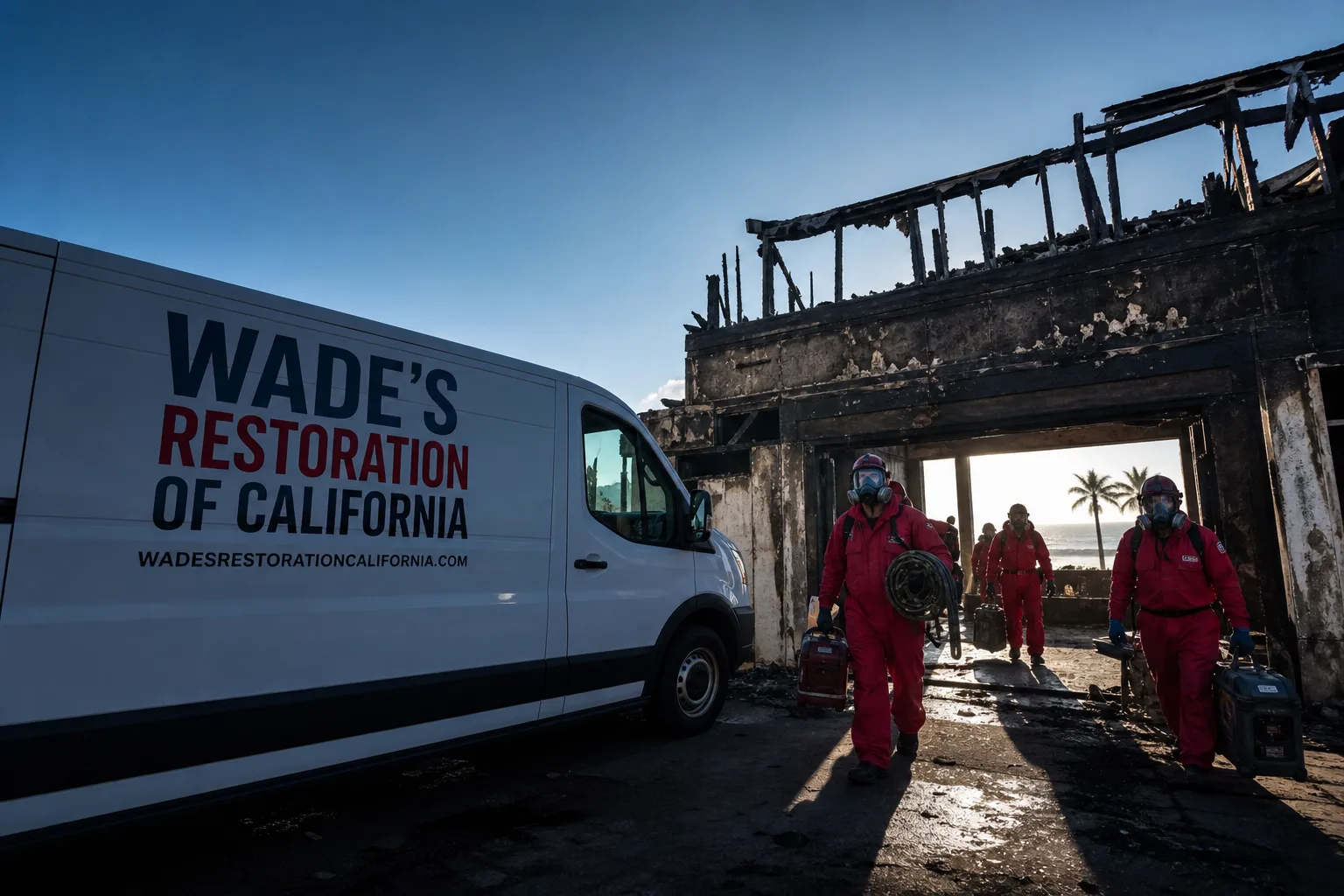
Fast, Reliable Storm & Disaster Restoration Across Long Beach
When a storm tears through Long Beach, the clock starts before the rain stops. Wind-driven water in a 1920s bungalow off 4th Street can saturate plaster, flooring, and framing within hours, and Long Beach’s coastal marine layer means what’s wet at midnight is often still wet at noon the next day. That’s the window where real damage happens. Wade’s Restoration of California knows Long Beach’s wind patterns, its older housing stock, and its building code quirks, and we get to work inside that window. Call (855) 915-0646 and you’ll talk to a live person, not a queue.
Why Wade’s Restoration of California Is Long Beach’s Preferred Storm & Disaster Restoration Company
Wade’s Restoration is the locally owned, owner-operated alternative to the national chains, and that matters in Long Beach for a simple reason. Long Beach’s housing stock runs from 1920s Naples Island canal homes to mid-century tract housing in 90808, and each neighborhood has different failure points when wind and water hit. A crew that understands the difference between a Belmont Shore stucco box and a Spanish Colonial Revival bungalow off 7th Street is a crew that won’t misdiagnose the repair. Wade Ferris founded this company in 2007 and he still answers his own phone. That’s not a slogan. Ask anyone on your street.
Long Beach customers come back to us because we document everything and communicate directly with adjusters. After a winter windstorm on Naples Island, our techs documented pre-existing efflorescence on a 1920s Spanish Revival bungalow’s stem walls before starting flood cleanup. The storm had blown out a patio door, but the canal-front foundation had been wicking moisture for decades. We used Dri-Eaz dehumidifiers and Injectidry mats on the hardwood floors, then re-set the door with impact-rated anchors, saving the homeowner a denied claim by proving the pre-existing condition. That’s the kind of work that builds a reputation in a place where neighbors talk.
Our response time to most Long Beach zip codes, including 90813, 90814, 90815, and 90822, is under an hour for emergency board-up and tarping when roads are passable. We keep equipment staged and ready. When a storm is forecast, we’re already thinking about the call list.
Our Storm & Disaster Restoration Services in Long Beach
Here’s what we actually do when Long Beach gets hit. These are the services people in 90802 through 90822 call about first.
Emergency Board-Up
A blown-out window or a kicked-in door on a storm night in downtown Long Beach isn’t just a security issue, it’s an invitation for the next squall to finish the job. We board up with plywood cut to fit, anchored to code, and we do it fast. In 90802, where port-area wind gusts funnel between older apartment buildings, we use wind-rated fasteners because inland-grade anchors strip out of salt-softened wood. Board-up is temporary; the point is to stop the compounding damage. One call brings Wade’s crew.
Roof Tarping
Long Beach roofs take a beating from wind-driven rain and decades of sun. When shingles lift or a section of roof decking goes, water finds the attic fast. We tarp with heavy-duty material secured to actual anchor points, not just weighted down with sandbags, because Long Beach wind will take a poorly secured tarp and turn it into a sail. In 90810 and 90806, the Port of Long Beach’s salt-laden air also means roof flashing and fasteners corrode faster than homeowners expect, so we inspect while we tarp.
Wind Damage Repair
This is the repair phase after the emergency is contained. Wind damage in Long Beach means resetting doors, re-hanging gutters, replacing sheared fence sections, and repairing siding that’s pulled away from framing. The older bungalows in 90804 and 90805 often have original window and door openings that were never wind-rated, so we re-anchor with impact-rated hardware where code requires it. We’re not replacing anything that doesn’t need replacing. Wade gives a written scope before work starts, not after.
Storm Damage Cleanup
After wind and water, the debris is the next problem. Downed tree limbs, soaked drywall, ruined carpet, and the fine silt and leaf litter that Long Beach storm drains push back up into low-lying yards. We remove it, dry the structure, and document moisture levels daily. In Long Beach’s persistent marine layer, you can’t just open the windows and wait. Wet framing behind plaster in a 1930s house off Pacific Avenue will stay wet for weeks without mechanical drying, and mold follows.
What happens when you call
- 1
A real person answersNo phone trees - you reach a local pro.
- 2
You get an upfront price rangeHonest numbers before anyone is dispatched.
- 3
A background-checked tech heads outLicensed & insured, dispatched right away.
- 4
You approve before work beginsNothing starts until you say go.
Trusted Brands We Service in Long Beach
We stock parts and materials for the storm-related brands and systems Long Beach homeowners actually have: And that includes the professional-grade drying equipment we run on every water-heavy storm job. Our crews use Dri-Eaz dehumidifiers, Phoenix axial air movers, and Injectidry mats, because those are the tools that pull water out of hardwood floors and plaster walls without ripping everything out first. If you’ve got a damage assessment that says “replace,” call us for a free second opinion before signing anything.
Common Storm & Disaster Restoration Problems We See in Long Beach Homes
Here’s what actually goes wrong in Long Beach when storms hit. These are the patterns from thousands of jobs:
– Skipping pre-loss moisture documentation on Naples Island. Canal water sits at or near foundation level year-round in 90803, so post-storm flooding often “reactivates” chronic sub-slab moisture. If we don’t document efflorescence and previous mold staining before starting work, an adjuster can deny the whole claim as a pre-existing condition.
– Using inland-grade door seals in 90802 or 90804. Port of Long Beach salt air corrodes standard weatherstripping within a season or two. After a storm, those degraded seals let wind-driven rain straight into the wall cavity. We use marine-grade seals on exterior doors in the port-influenced zip codes.
– Waiting for the marine layer to dry out framing before mold treatment. Long Beach’s spring and early summer humidity means secondary mold colonization starts within 48 hours on saturated drywall. You can’t wait for “dry weather.” We set dehumidifiers the day we arrive.
– Treating every boarded-up window the same. A board-up on a 1920s bungalow in 90802 has different anchoring requirements than a mid-century tract home in 90808, where the wall sheathing is thinner and the stud spacing is wider. Wind rating is not a suggestion.
Pricing for Storm & Disaster Restoration in Long Beach, CA
We Also Serve Cities Near Long Beach
Our crews cover Long Beach and the surrounding communities daily, including Signal Hill, Lakewood, Carson, and Compton. If you’re in one of those cities and need Storm & Disaster Restoration, the same local team responds. Learn more about our work across the area on our Storm & Disaster Restoration hub page, and see how we serve the wider region on our Long Beach hub.
Serving Long Beach, CA - Our Local Coverage Area
We’re based in the Long Beach area and know this community well. Use the map below to see our service coverage - if you’re nearby, we can almost certainly help.
FAQs - Storm & Disaster Restoration in Long Beach
How does Long Beach’s coastal marine layer change post-storm drying timelines compared to inland cities like Lakewood?
The marine layer keeps relative humidity elevated through spring and early summer, which means water-damaged materials can take twice as long to dry passively as they would in Lakewood or Paramount, 10 miles inland. That compressed drying window is why we set Dri-Eaz dehumidifiers and Phoenix air movers on day one, not day three. In Long Beach, waiting for the air to dry out is how you get mold. Call (855) 915-0646 and we can have drying equipment running the same day a storm passes.
Why do restoration crews on Naples Island need to document pre-existing moisture before starting storm cleanup?
Because canal water sits at or near foundation level year-round on Naples Island (90803), and many homes there already have chronic sub-slab wicking, efflorescence on stem walls, and prior mold staining before any storm arrives. If we don’t photograph and log those conditions before starting work, an insurance adjuster can claim the new storm damage is just the old foundation moisture problem, and deny the claim. We document pre-existing conditions and we deal with your adjuster directly. That’s standard practice on every Naples job we do.
What wind-rating requirements apply to boarded-up doors in 90802 vs. 90808 after a storm passes?
90802 falls in a wind-exposure zone near the Port of Long Beach where board-up anchoring must account for higher sustained gust loads and salt-softened framing, so we use impact-rated fasteners with wider washer spreads. In 90808, the mid-century tract construction has thinner sheathing and wider stud spacing, so the same fasteners would need different backing. Long Beach building code treats these zones differently, and we inspect before we anchor. For board-up in either zip, call (855) 915-0646.
How does port-area salt air in 90810 and 90806 affect roof tarping and post-storm repairs?
Salt-laden marine air from the Port of Long Beach accelerates corrosion on roof flashing, fasteners, and anchor points, which means a tarp secured to rusty hardware won’t hold in the next wind event. We check anchor integrity before we tarp, and we use marine-grade fasteners and corrosion-resistant flashing on post-storm repairs in 90810 and 90806. Skipping that step is how you end up re-tarping the same roof twice.
What’s the biggest mistake homeowners make with debris removal after a windstorm in Long Beach’s 1920s bungalow belt?
The biggest mistake is hauling debris out before documenting what’s actually damaged underneath it. In the 1920s bungalow belt of 90804 and 90805, windstorms often send tree limbs through original single-pane windows and pull plaster ceilings down, and if you clear that debris before photos are taken and moisture readings are logged, you’re handing your adjuster a reason to question the claim. We photograph, log, and then remove. That order matters. For a documented cleanup after a Long Beach windstorm, call (855) 915-0646.
Contact Wade’s Restoration of California in Long Beach
When a storm has already hit Long Beach, the last thing you need is a phone tree. Call (855) 915-0646 and you’ll get a live person, likely Wade himself. He’ll ask what happened, tell you what he thinks over the phone, and head out to look. No trip charge inside the county. No sales pitch before the inspection. The 90-Day Done Right Promise applies to every water, fire, and mold restoration job we do, in writing. Senior and veteran discount always applies. Free second opinion on any written estimate. When the wind stops, the work starts. Call now.
Written by Wade Ferris, Owner at Wade’s Restoration of California, serving Long Beach since 2007.