

Fast, Reliable Mold Remediation Across Hemet
Mold remediation in Hemet runs $1,800 to $6,500 for a typical single-room job, with crawlspace and manufactured-home belly-board work landing between $2,200 and $9,000 depending on how far the moisture has wicked. If you’re seeing dark staining on walls, smelling musty air near the floor, or dealing with a leak that happened weeks before anyone noticed, we can have a crew at your door in Hemet same day, usually inside two hours. Call (855) 915-0646 and you’ll get Wade Ferris or a live person who knows Hemet’s housing stock, not a call center in another state.
Why Wade’s Restoration of California Is Hemet’s Preferred Mold Remediation Company
Wade’s Restoration has been doing Mold Remediation in Hemet since 2007, and Wade Ferris still answers his own phone. Around Hemet’s manufactured home parks on Florida Avenue and the tract neighborhoods east of State Street, word travels on a first-name basis. Neighbors know which crew showed up when the San Jacinto Valley flooded, and which one actually pulled the skirting off a mobile home instead of just fogging the living room and driving away. Ask anyone on your street. They’ll tell you the same thing: Wade’s crew is the one that comes back if it’s not right.
We show up in uniform, background-checked, with a published address and license number. No third-party subcontractors. No mystery franchises. Just Wade and the people he’s trained, running IICRC-certified protocols with equipment from Dri-Eaz and Phoenix. And every mold job in Hemet carries the 90-Day Done Right Promise in writing: if it’s not done right, we make it right. Wade comes back himself. One call brings him to your door.
Hemet homeowners appreciate that we don’t quote one price on the phone and another at the door. Before any work starts, you get a written scope. And if you have a written estimate from another company, we’ll give you a free second opinion on it. No charge for that.
Our Mold Remediation Services in Hemet
Mold Inspection & Testing in Hemet
A proper mold inspection in Hemet has to account for what you can’t see from the living room. In the 92544 and 92543 ZIP codes, where manufactured homes from the 1970s through the 1990s sit low on skirted crawlspaces, we pull the vinyl skirting and thermally image the belly board underneath before we ever open a wall. That’s not standard practice at most remediation companies. It’s the standard here. We also run moisture readings on every affected surface and hand you the full log at the end of the job, which almost nobody else does.
Mold Removal in Hemet
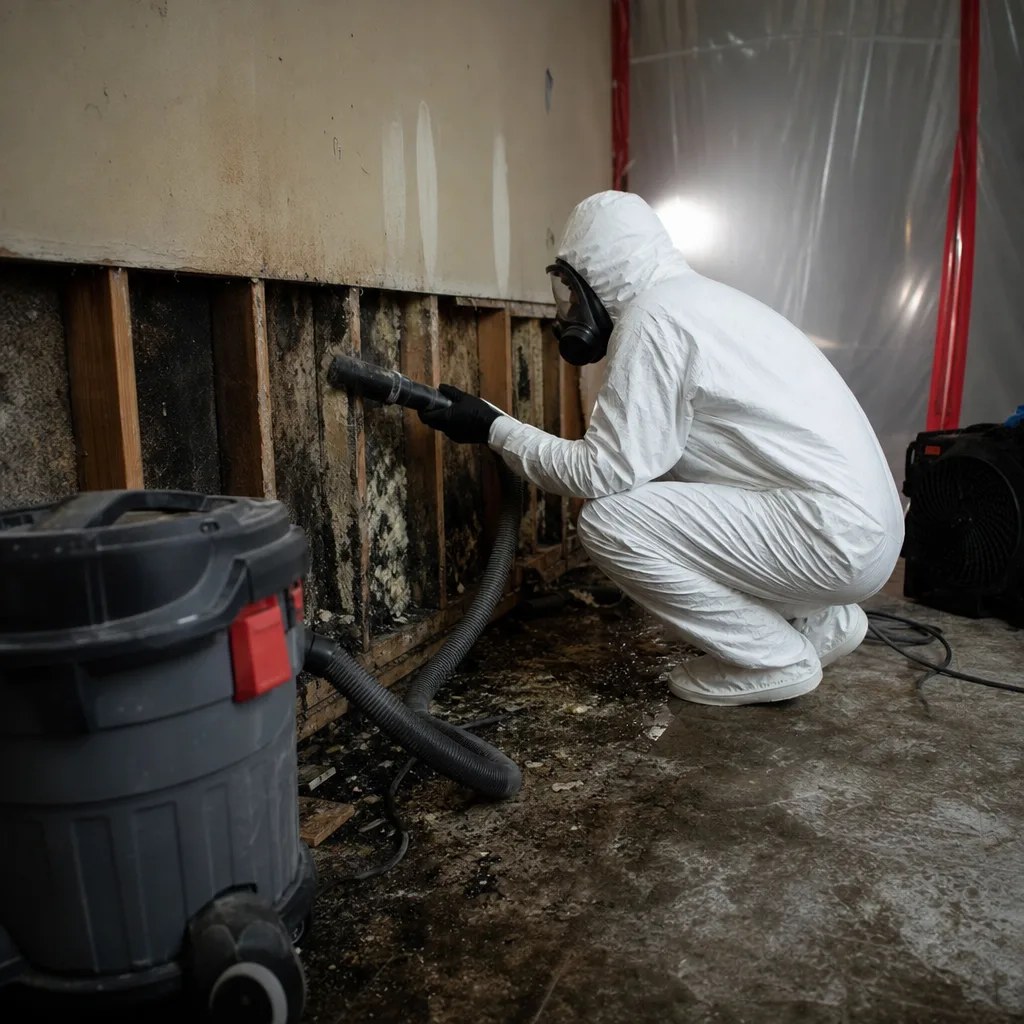
Mold removal in Hemet homes requires more than treating visible staining. In the thin-wall assemblies common to Hemet’s manufactured housing stock, moisture wicks behind vinyl wallboard and along aluminum wiring conduits, creating secondary growth that a wall-only cleanup misses entirely. We contain the affected area with negative air pressure, remove contaminated drywall or wallboard, cut out wet insulation, and dry the cavity with professional axial air movers before rebuilding. The result is a mold-free space that stays mold-free.
Black Mold Remediation in Hemet
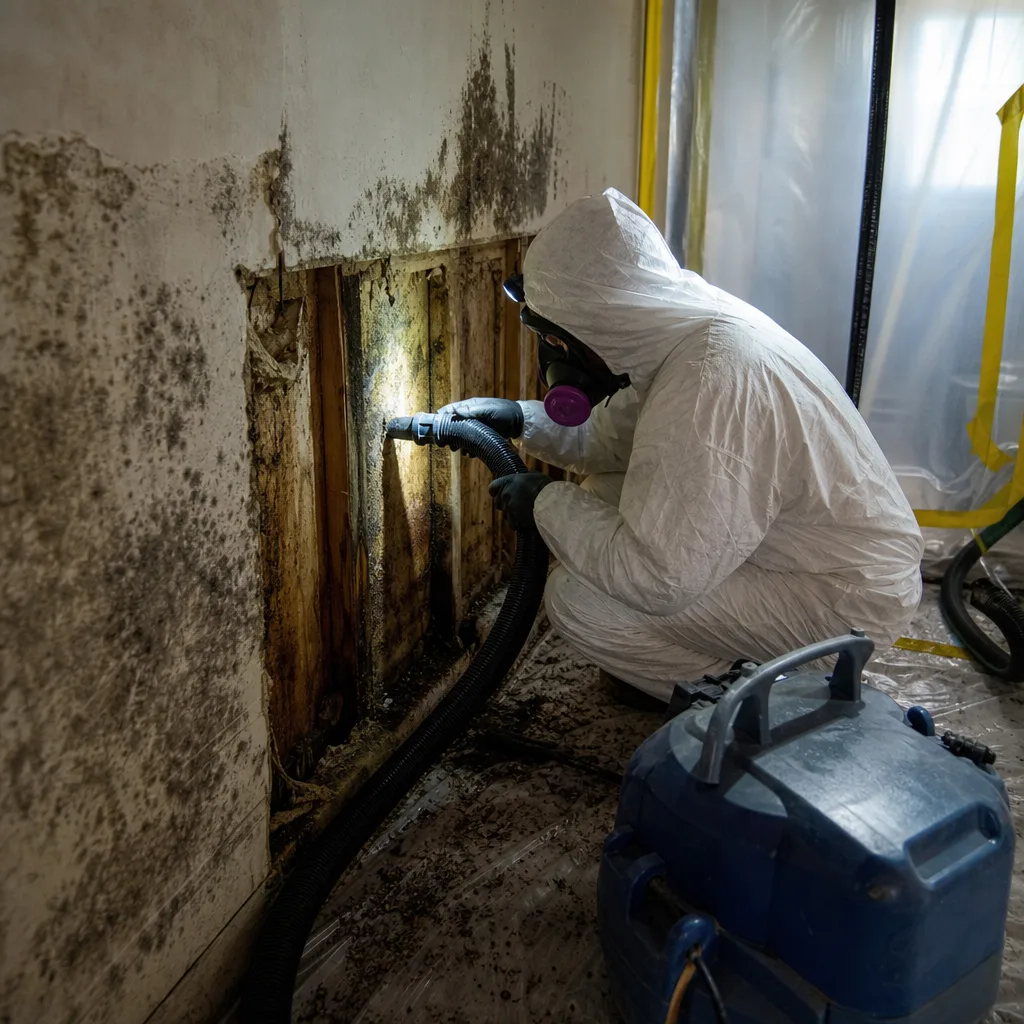
When black mold shows up in a Hemet home, it’s usually feeding on moisture that’s been trapped out of sight for weeks. We see this repeatedly in the mobile home parks along Sanderson Avenue and near the San Jacinto River corridor, where belly-board fiberglass soaks up water from slow appliance leaks and never dries on its own. Our process includes full containment, HEPA air scrubbing, removal of contaminated materials, and post-remediation clearance testing so you know the air inside your home is safe before we pack up.
Air Quality Restoration in Hemet
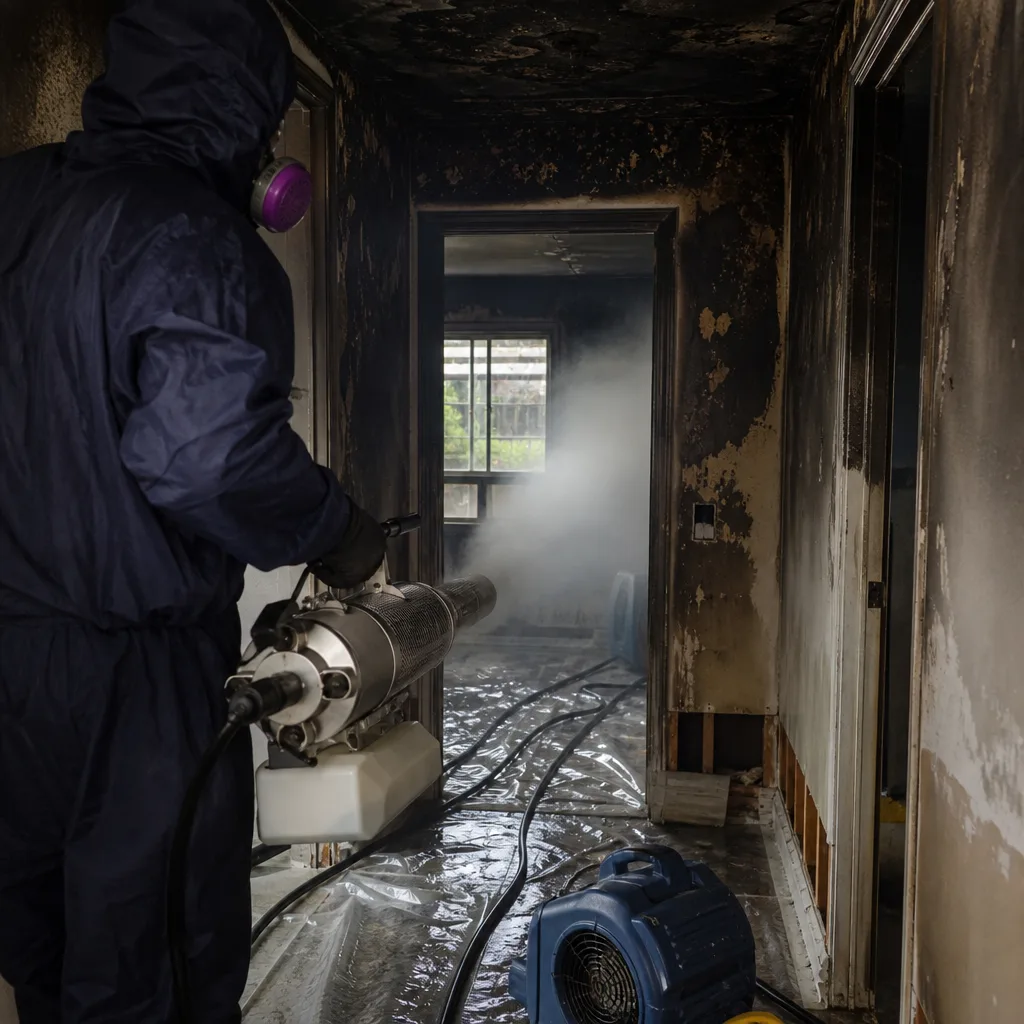
Mold spores don’t respect the wall line. Once disturbed, they move into your HVAC system, your furniture, your lungs. In Hemet, where Santa Ana winds kick up dust and ash from the surrounding hills, indoor air quality takes a double hit in fall. We run HEPA air scrubbers during remediation and offer post-job air quality testing to verify spore counts are back to normal outdoor background levels. If your home smells musty even after a cleanup, the air needs to be addressed, not just the drywall.
What happens when you call
- 1
A real person answersNo phone trees - you reach a local pro.
- 2
You get an upfront price rangeHonest numbers before anyone is dispatched.
- 3
A background-checked tech heads outLicensed & insured, dispatched right away.
- 4
You approve before work beginsNothing starts until you say go.
Trusted Brands We Service in Hemet
Over 29 years of restoring water and mold damage across Southern California, we’ve learned which equipment holds up and which fails on the third day of a hot Hemet summer. Our trucks carry Dri-Eaz dehumidifiers, Phoenix axial air movers, and infrared cameras that see moisture inside a wall or under a mobile home before we ever cut into it. We don’t rent equipment by the day and pass the cost to you. We own our gear, we maintain it, and Wade’s crew knows how to run it in Hemet’s manufactured-home crawlspaces, which is a different skill set than drying a Temecula stick-built tract home.
Common Mold Remediation Problems We See in Hemet Homes
- Hidden belly-board moisture in manufactured homes. A visible wall stain in a Hemet mobile home is frequently the tip of the problem. Moisture wicks through the particle-board floor into the fiberglass insulation packed against the belly board underneath, where it sits for weeks and feeds mold the homeowner never sees until a smell gives it away.
- Flat-lot drainage failures after valley-floor runoff. Hemet sits in a basin ringed by the San Jacinto Mountains. When late-summer monsoon storms or winter rain cells hit, runoff sheets across flat manufactured-home lots and pools against skirting, seeping into crawlspaces that were never designed to handle standing water.
- Thin-wall assemblies that trap moisture behind vinyl. Standard wood-framed drying protocols don’t work on 1970s-era manufactured homes. The vinyl wallboard and aluminum wiring conduits in these homes create vapor-tight layers that hide moisture, so techs who only dry the visible surface leave mold behind to bloom again in six weeks.
- Polybutylene supply line failures in 1980s and 1990s tract homes. In affordable stick-built homes in the 92543 and 92545 ZIP codes, original polybutylene pipes corrode faster in Inland Empire hard water, and when they fail, they leak inside walls and under floors for days before anyone notices. The mold that follows is usually worse than the plumbing repair itself.
Pricing for Mold Remediation in Hemet, CA
Here’s what mold work actually costs in Hemet, based on what we’ve priced on hundreds of local jobs. A contained single-wall remediation in a stick-built home runs $1,800 to $4,000. Full containment with crawlspace access and belly-board removal in a manufactured home typically runs $3,500 to $9,000. Mold inspection and testing with thermal imaging runs $300 to $600. Moisture and humidity control, including under-home vapor barrier replacement, runs $1,200 to $3,800. What moves the number is depth: whether we’re cutting out one wall or pulling skirting and replacing subfloor sections, and whether HVAC ducting needs scrubbing. Estimates are free. Call (855) 915-0646 and Wade will walk through the numbers with you before you commit to anything.
We Also Serve Cities Near Hemet
Beyond our work across Hemet, Wade’s crew regularly handles mold remediation in East Hemet, Valle Vista, San Jacinto, and Homeland. Each of those communities has its own mix of manufactured homes and aging tract housing, but the issue is almost always the same: moisture trapped where you can’t see it. We schedule work across the San Jacinto Valley every week, and calls are answered by a live person around the clock.
Serving Hemet, CA - Our Local Coverage Area
We’re based in the Hemet area and know this community well. Use the map below to see our service coverage - if you’re nearby, we can almost certainly help.
FAQs - Mold Remediation in Hemet
Mold reappears because the moisture source was never fully removed. In Hemet’s manufactured homes, water from a leak wicks into the fiberglass insulation packed against the belly board under the floor, and a wall-only remediation never touches that hidden reservoir. Within weeks, the mold colony re-establishes and creeps back up into the wall cavity. The fix is to pull the skirting, inspect the belly board with thermal imaging, and remove wet insulation and subfloor material wherever the moisture traveled. If a company quotes you a wall patch without looking underneath, the job isn’t done. Call (855) 915-0646 for an inspection that goes below the floor line.
No, not properly. The vinyl or metal skirting on a 1970s mobile home blocks both visual access and airflow, and the space underneath is tight enough that you can’t get a meaningful look from the perimeter. We remove a section of skirting to access the belly board and run a thermal scan with a Dri-Eaz infrared camera. That’s the only way to see moisture that has wicked through the subfloor into the insulation. Anyone who says they inspected it from the outside didn’t inspect it.
First we contain the area with negative air pressure so spores don’t spread through the rest of the home. Then we cut out the affected particle-board subfloor section, remove the wet fiberglass insulation under it, and dry the remaining structure with axial air movers and dehumidifiers. After the moisture readings come back dry, we replace the subfloor and rewrap the belly with new vapor barrier material. Particle board doesn’t dry back to structural soundness once it’s soaked, so it gets replaced, not dried. The whole process usually takes three to five days in a typical Hemet mobile home.
Santa Ana winds themselves don’t cause mold, but they change what happens inside your home. In fall, Hemet homeowners shut windows and doors tight against blowing dust and ash, which traps indoor humidity. If there’s already moisture in a wall cavity from a small leak, that sealed-up environment accelerates mold growth. The wind events also drive wildfire smoke and ash into homes near the wildland interface, which settles into ductwork and carpets. We recommend a humidity check after any extended Santa Ana period, especially in the 92543 and 92545 ZIP codes closest to the hills.
Properties in 92545 sit closest to the foothills, where wildfire ash, smoke residue, and wind-driven dust accumulate faster than in the valley center. An inspection there has to account for both water-driven mold and the organic debris that blows in during fire season and feeds microbial growth in damp corners. We check HVAC intakes and attic spaces more carefully in this ZIP code because that’s where the ash settles. The inspection also covers exterior drainage, since runoff from the slopes can pool against foundations and skirting after rain events. Call (855) 915-0646 to schedule an inspection, and remember we offer a free second opinion on any written estimate you already have.
If you’re dealing with mold in a Hemet home, don’t wait for the smell to spread or the staining to climb the wall. Call (855) 915-0646 now. Wade or one of his crew will answer, ask about what you’re seeing, and give you an honest read on what it’ll take to fix it. Estimates are free, the 90-Day Done Right Promise is in writing, and we’ll pull the skirting and look underneath before we ever tell you it’s handled.
Written by Wade Ferris, Owner at Wade’s Restoration of California, serving Hemet and the San Jacinto Valley since 2007.