
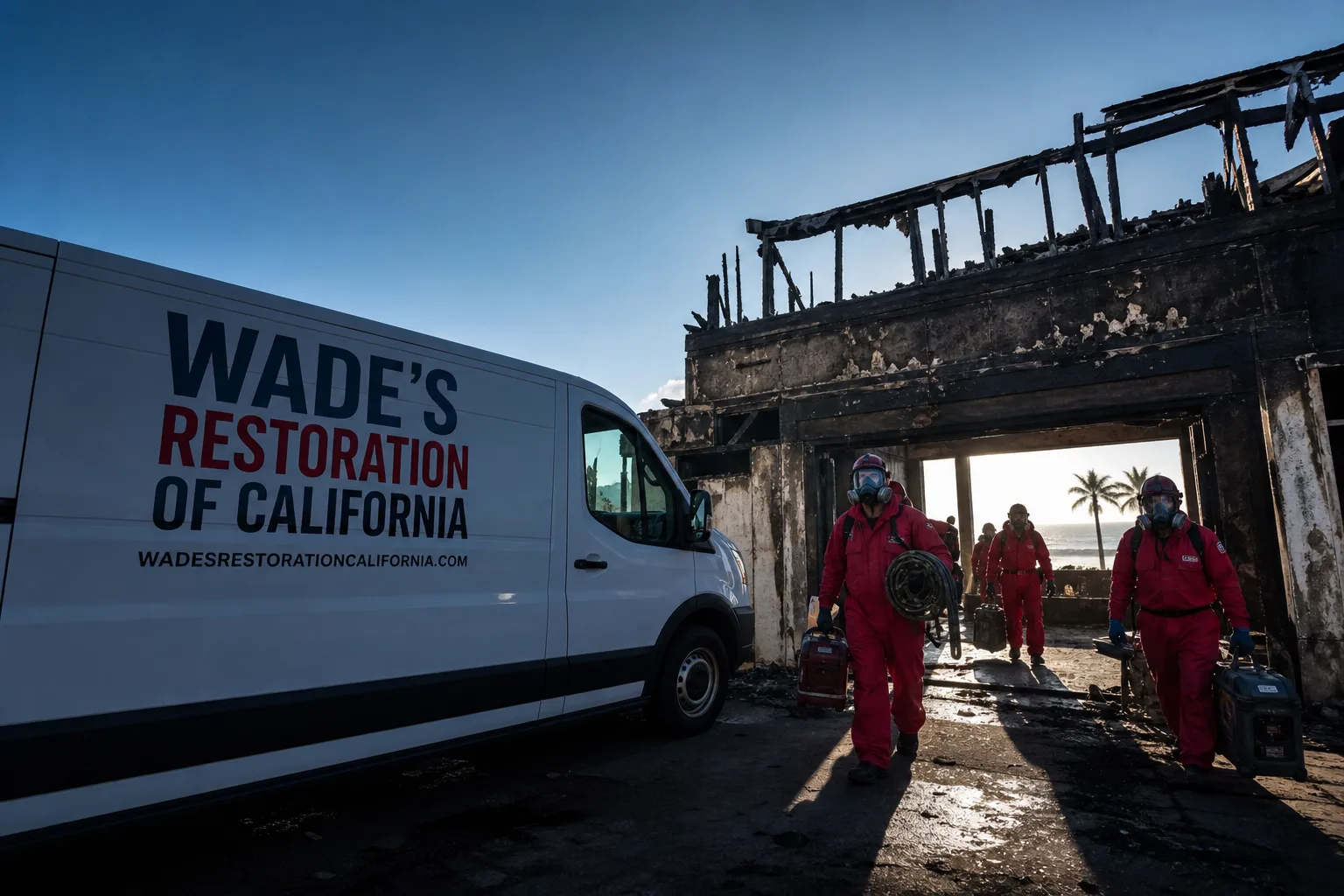
Fast, Reliable Water Damage Restoration Across Stanford
A burst pipe in a 1950s faculty home near Escondido Village. A flooded crawlspace after San Francisquito Creek overbanks. A slow ceiling leak in a graduate housing complex that finally gave way. Water damage in Stanford, CA doesn’t wait for business hours, and neither do we. Wade Ferris founded Wade’s Restoration of California in 2007, and he still answers his own phone at (855) 915-0646, 24 hours a day. We know the campus, we know the housing stock, and we know how to get work approved through Stanford’s systems. Here’s the honest truth about water damage restoration in Stanford: speed matters, but access matters just as much. If you can’t get a crew through the approval process, the best equipment in the world won’t help. We handle both.
Why Wade’s Restoration of California Is Stanford’s Preferred Water Damage Restoration Company
Stanford isn’t like Palo Alto or Atherton. In those cities, a homeowner calls us directly and we show up. In the 94305 zip code, nearly every property falls under Stanford University ownership. That means Facilities Management, approved-vendor requirements, and access protocols that would stall a crew that’s never navigated them. We have. Wade and his team have worked on faculty housing, graduate student complexes like Escondido Village, and academic buildings across campus. We know who to call, what paperwork is needed, and how to keep a restoration moving while staying inside Stanford’s rules.
But institutional knowledge only matters if the work is good. Wade’s Restoration is licensed, insured, and bonded, and Wade puts his name, address, and license number on every contract. He’s not a franchise operator in another state. He lives here, works here, and you’ll run into him at the hardware store on a Saturday. That’s the oldest accountability mechanism there is.
Every water damage restoration job in Stanford is backed by the 90-Day Done Right Promise, written into the contract: if it’s not done right, Wade makes it right. No fine print. No phone tree.
Live Answers, Real Response Times
When you call (855) 915-0646 at 2 a.m. with water coming through a ceiling, you get Wade or a member of his crew. Not an answering service. Not a voicemail. A live person who can have extraction equipment running inside the hour, depending on access. For Stanford properties, the access piece is where we earn our keep. We’ve already been through Facilities Management’s approval process on prior jobs, which shortens the lag between your call and our arrival.
Our Water Damage Restoration Services in Stanford
Water damage has a hierarchy of urgency. Standing water demands extraction. Wet materials demand drying. Contaminated water demands containment. Here’s what we handle across Stanford, from faculty homes near the Main Quad to graduate housing off Escondido Road.
Emergency Water Extraction
Standing water doesn’t just damage what it touches. It migrates. Under baseboards, into wall cavities, down into subflooring and crawlspaces. The sooner it’s pulled out, the less demolition you’re facing later. In Stanford’s older faculty homes, many of which date from the 1940s through the 1960s, that migration happens fast. Hardwood floors are common, and they’ll cup and warp within hours of sustained water exposure. Our extraction crews use truck-mounted and portable units from Dri-Eaz and XPOWER to pull water out at scale, then get air moving immediately. For a typical burst pipe in Stanford faculty housing, extraction and initial drying setup usually runs $1,200 to $2,800 depending on square footage and how far the water traveled.
Structural Drying & Dehumidification
Extraction is step one. Drying is where you actually prevent mold and structural rot. Wade’s crew takes moisture readings every single day and hands the homeowner the full log at the end of the job. Almost nobody in this trade does that. In Stanford specifically, we’re often dealing with crawlspaces under postwar homes that were never designed for modern humidity control. Deferred maintenance in university-owned housing means a slow leak behind a wall can saturate framing for weeks before anyone notices. Our dehumidifiers and air movers run until the moisture meter says the structure is actually dry, not just until the surface feels dry. Structural drying in Stanford typically runs $800 to $2,200 depending on the size of the affected area and drying time.
Flood Cleanup
San Francisquito Creek runs along the edge of the Stanford campus, and it has a documented history of overbank flooding during atmospheric river storms. When creek water enters a structure, it’s Category 3 water: contaminated with silt, organics, and whatever else the storm picked up upstream. That’s not a mop-and-bucket situation. Flood cleanup in Stanford requires extraction, disposal of contaminated porous materials, antimicrobial treatment, and structural drying with verification. We coordinate directly with Facilities Management on university properties so the work gets done to their standards, not just ours. Flood cleanup after creek overflow or storm surge in the 94305 area typically runs $2,500 to $6,000 depending on depth and contamination level.
Burst Pipe Restoration
Aging plumbing in 60- and 70-year-old faculty homes means burst pipes are a regular winter call in Stanford. When a supply line fails, the water is Category 1 (clean), but the damage isn’t any lighter. Water under pressure sprays into wall cavities, saturates insulation, and pools in places you can’t see. Our crew responded to a burst pipe in a 1950s faculty home near Escondido Village. Using Dri-Eaz dehumidifiers and XPOWER air movers, we extracted standing water, dried the crawlspace, and coordinated access through Stanford’s Facilities Management to complete the job without disrupting the tight street parking. Burst pipe restoration in Stanford typically runs $1,500 to $4,000, including extraction, drying, and repair coordination.
What happens when you call
- 1
A real person answersNo phone trees - you reach a local pro.
- 2
You get an upfront price rangeHonest numbers before anyone is dispatched.
- 3
A background-checked tech heads outLicensed & insured, dispatched right away.
- 4
You approve before work beginsNothing starts until you say go.
Trusted Brands We Service in Stanford
When water damage hits, you don’t have time to wonder whether the equipment showing up is up to the job. Wade’s crew runs professional-grade gear from Dri-Eaz and XPOWER, the same brands used by IICRC-certified restoration firms across the country. We carry the standard hoses, fittings, and adapters on the truck, so we’re not waiting on a parts run from San Jose while your subfloor soaks. For Stanford’s older campus buildings and historic masonry structures, we adjust our drying approach to the materials involved. You can’t blast a sandstone wall with the same airflow you’d use on modern drywall. We know the difference, and we stock accordingly.
Common Water Damage Restoration Problems We See in Stanford Homes
- University approval delays. Stanford’s centralized Facilities Management system means a restoration job can’t start until access is granted and the vendor is cleared. Contractors who aren’t pre-vetted simply cannot get the work. We’ve already been through the process, which saves hours or days.
- Concealed water intrusion in aging housing stock. Postwar faculty homes and mid-century graduate complexes were built before modern vapor barriers and drainage standards. Deferred maintenance cycles on university-owned properties can mask slow leaks that turn into major extraction jobs.
- Historic masonry constraints near the Main Quad. The sandstone Romanesque buildings from the 1890s can’t be treated with aggressive drying methods. Standard techniques could damage the stone or violate landmark-preservation rules. Restoration in these structures requires a lighter, slower, more deliberate approach.
- Hidden seismic compromise from the 1989 Loma Prieta earthquake. Ongoing retrofits mean our technicians frequently encounter partially upgraded or unreinforced masonry walls. Concealed cracks and shifted framing from decades-old seismic damage create pathways for water to move invisibly. What looks like a small patch of ceiling stain can be a much larger structural moisture problem.
Pricing for Water Damage Restoration in Stanford, CA
We Also Serve Cities Near Stanford
Wade’s Restoration handles Water Damage Restoration throughout the mid-Peninsula. If you’re in Palo Alto, Atherton, East Palo Alto, or Los Altos Hills, we’re close enough to get there fast and familiar enough with the housing stock to know what we’re walking into. We serve the entire Stanford area and the surrounding communities with the same equipment, the same written-scope pricing, and the same 90-Day Done Right Promise. See our Water Damage Restoration in Stanford page for campus-specific details.
Serving Stanford, CA - Our Local Coverage Area
We’re based in the Stanford area and know this community well. Use the map below to see our service coverage - if you’re nearby, we can almost certainly help.
FAQs - Water Damage Restoration in Stanford
Do I need Stanford University approval before scheduling water damage restoration in faculty housing?
Yes. Stanford’s CDP is almost entirely Stanford University-owned, which means virtually every restoration job in faculty housing, graduate housing, or academic buildings must go through centralized Facilities Management and the approved-vendor system. You can’t treat it like a private home in Palo Alto where you just call a contractor directly. Wade’s Restoration is already familiar with this process, and Wade or his team will coordinate with Facilities Management so the approval doesn’t stall your restoration. Call (855) 915-0646 with your building details and we’ll help you start the process the same day.
Can you handle water damage in the historic Main Quad buildings without violating landmark restrictions?
Yes. The Main Quad’s sandstone Romanesque buildings from the 1890s require a restoration approach that respects the masonry. Standard drying methods that work on drywall and modern framing can damage sandstone or conflict with preservation standards. We adjust air movement, temperature, and drying time to the materials involved. We’ve worked on historic campus structures before and we document our moisture readings the same way we do on every job: daily, with the full log handed to the property manager or owner at the end.
How quickly can you respond to flooding from San Francisquito Creek near campus?
When San Francisquito Creek overbanks during an atmospheric river event, standing water is the immediate emergency. Wade answers his own phone 24/7, and our crew can have extraction equipment running inside the hour if access is already arranged. If the property is university-owned and we need to go through Facilities Management, we’ll start working on that approval immediately while preparing equipment. Creek water is contaminated, so our first action is extraction and containment, then we move to antimicrobial treatment and drying.
Can you identify hidden water damage from the 1989 Loma Prieta earthquake in my campus building?
Yes. The 1989 Loma Prieta earthquake caused well-documented structural damage across Stanford’s historic campus, and decades of retrofit work have left a mix of upgraded and unreinforced masonry. Concealed cracks, compromised mortar, and shifted framing from that event can create water pathways that are invisible until a restoration event exposes them. Our crew has encountered this pattern before and knows to look for moisture migration that doesn’t match the visible water source. We’ll document what we find with moisture readings and photos, and we’ll tell you honestly whether it’s a current leak or old damage.
Are you an approved vendor for Stanford University water damage restoration?
Yes, we’ve worked through Stanford’s approved-vendor system on prior water damage restoration jobs in faculty housing, graduate complexes, and academic buildings. We understand the procurement, access, and compliance requirements that the university’s institutional ownership imposes. If you’re coordinating a restoration through Stanford, call (855) 915-0646 and ask for Wade. He’ll walk you through the process and get your job scheduled.
Call Wade’s Restoration of California Today
If you’re dealing with water damage in Stanford, CA, don’t wait for the damage to spread while you sort out approvals. Call (855) 915-0646 and ask for Wade. He’ll answer, ask the right questions, and tell you exactly what comes next. We serve all of 94305 from faculty homes near the Main Quad to graduate housing in Escondido Village. We’re licensed, insured, and bonded, with IICRC-certified work and a 90-Day Done Right Promise on every job. If you’ve got a written estimate from another company, bring it for a free second opinion. No trip charge in our own county. Senior and Veteran discount always. The number is (855) 915-0646. Wade will be there himself.
Written by Wade Ferris, Owner at Wade’s Restoration of California, serving Stanford and the mid-Peninsula since 2007.