
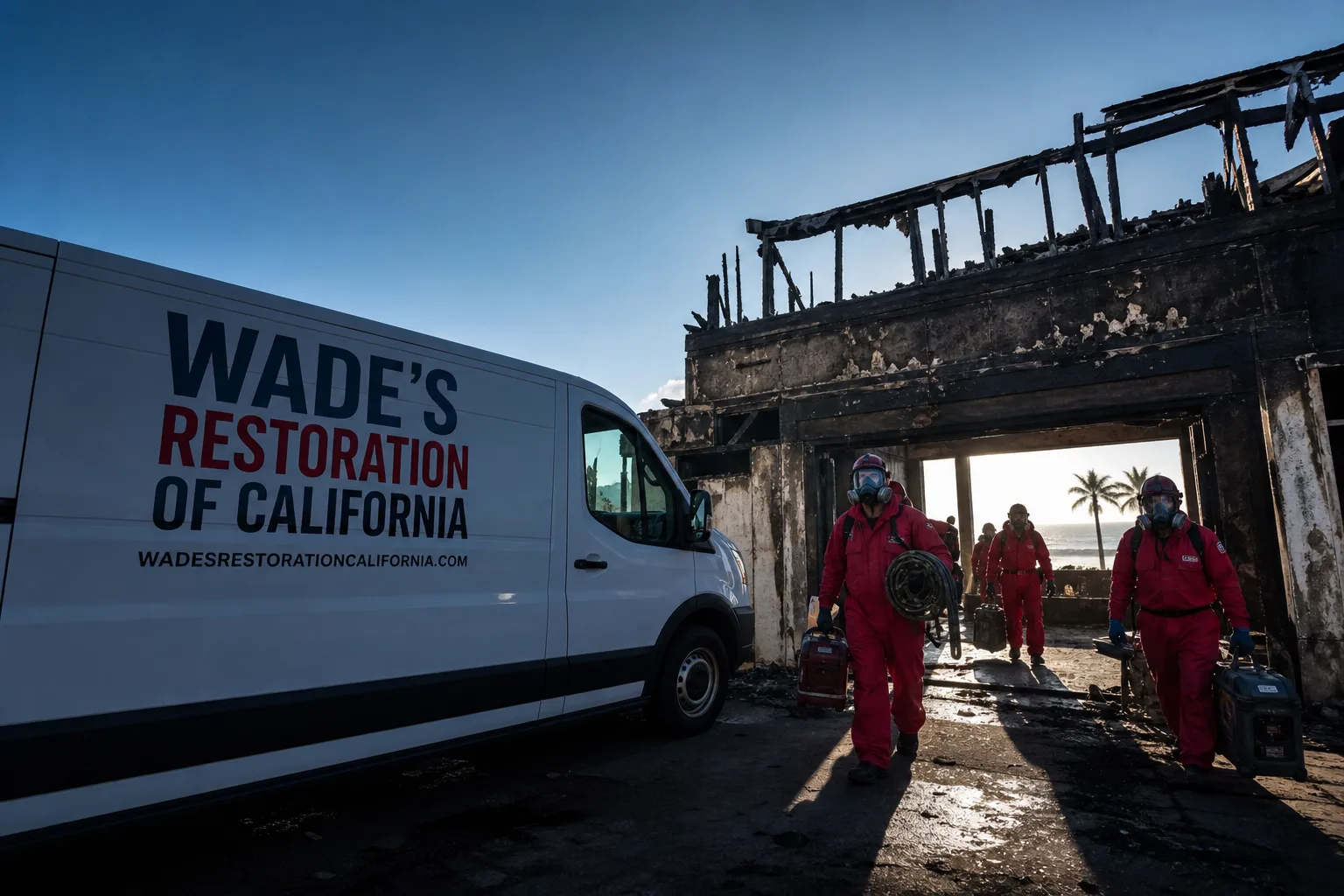
Fast, Reliable Mold Remediation Across San Bernardino
Mold remediation in San Bernardino typically runs $2,800-$6,500 for a standard 1,200-1,800 sq ft home, with crawl space treatment adding $1,400-$3,200. Most jobs are scoped within 24 hours of your call, and because the owner answers his own phone, you’ll get a straight answer about what needs to happen before anyone knocks on your door. If you’ve spotted mold behind baseboards in a 1950s ranch, smelled something musty coming from the crawl space, or watched water seep under the slab during a winter storm off the San Bernardino Mountains, call Wade’s Restoration of California at (855) 915-0646. Wade Ferris has been running this company since 2007, and he’ll tell you honestly whether you need full remediation or just targeted drying.
Here’s the thing most national chains won’t say about Mold Remediation in this city: your house was built to fail in very specific ways. The post-WWII tract homes that fill San Bernardino’s 92404 and 92407 ZIP codes were framed with slab-on-grade foundations and thin vapor barriers that were never designed for the wet-dry beating this basin dishes out. When a Santa Ana wind event slams rain against the north side of your house and then three weeks of 105-degree heat bakes it dry, moisture gets trapped behind stucco, under baseboards, and inside crawl spacies where nobody looks until the smell gives it away. That’s why we approach every San Bernardino mold job by starting underneath the house, not just inside the rooms you can see.
Why Wade’s Restoration of California Is San Bernardino’s Preferred Mold Remediation Company
You’ll hear Wade’s name around San Bernardino. Since 2007, he’s been the guy who shows up himself, reads a Dri-Eaz moisture meter in front of you, and writes down the numbers instead of making vague claims. Ask anyone on your street. The people who’ve hired him once tend to call him directly the next time something goes wrong because they have his cell, not an 800-number queue. He’s locally owned and owner-operated, with his name on the truck and his address published. That kind of accountability matters in a city where homeowners have been burned by national franchises quoting one price on the phone and a different one at the door.
Our Mold Remediation in San Bernardino customers consistently mention three things in their reviews: that Wade answered the phone himself at 7 p.m., that the crew was background-checked and showed up in uniform, and that the moisture log handed over at the end of the job was a revelation. Almost nobody in this trade does that. Wade takes moisture readings every single day and you get the full log when we finish. That’s not a trick. It’s how you know the drying actually happened. And every mold restoration job carries the 90-Day Done Right Promise, written into the contract: if it’s not done right, he makes it right.
Response time to San Bernardino is fast because our Inland Empire office is local, not a call center in another state. Wade heads out himself for initial assessments, and live people answer the phone 24/7. No voicemail. No answering service. You call, he answers, and if there’s water actively moving into your house, he’s on the road.
Our Mold Remediation Services in San Bernardino
Mold Inspection & Testing
Before we remove anything in a San Bernardino home, we document what’s actually there. That means indoor air samples compared against outdoor baselines, surface samples from suspect areas, and a moisture audit of walls, floors, and the crawl space. In older 1940s-1960s tract homes, we routinely find hidden mold behind baseboards that nobody suspected because the dry summer heat masks the moisture signature for months. Testing tells you whether you’re dealing with a cosmetic patch job or a real interior colonization. You get the results explained in plain English, and you keep the lab report.
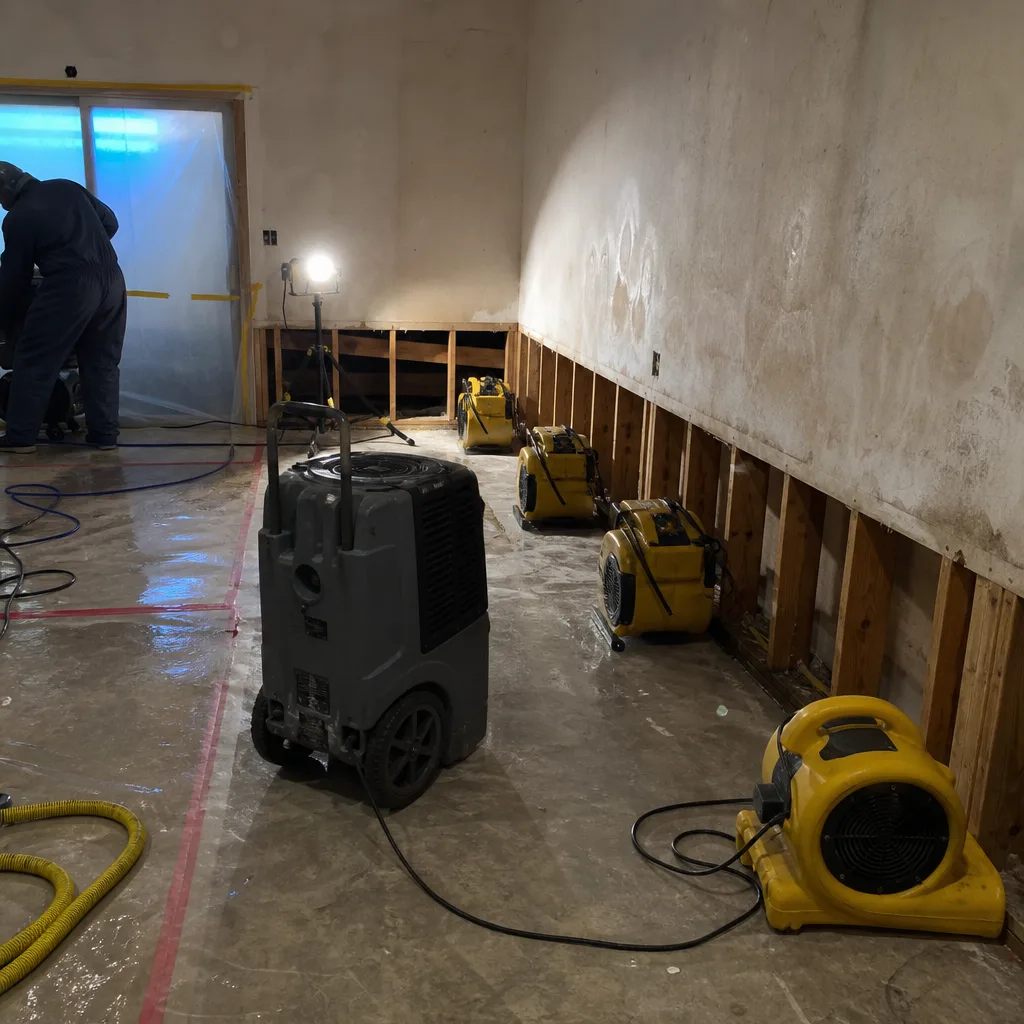
Mold Removal
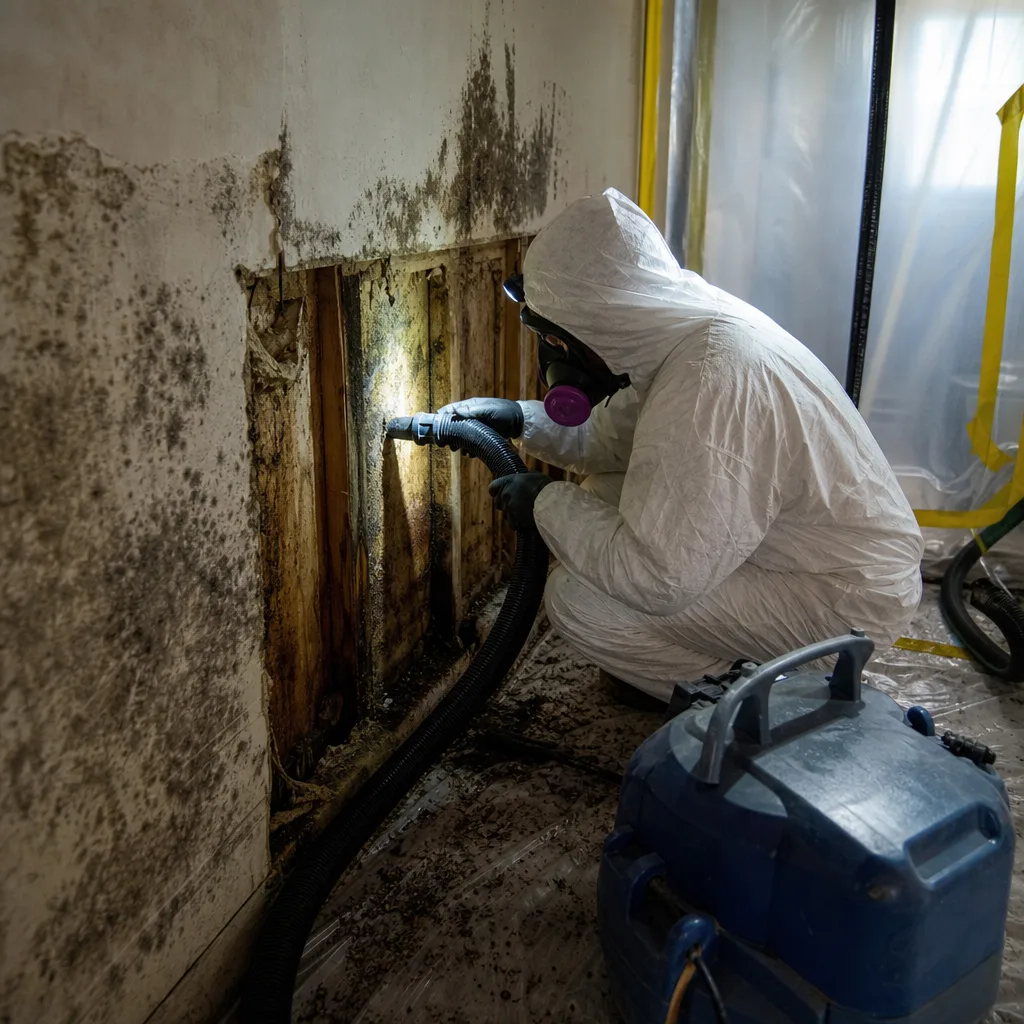
Mold removal in San Bernardino isn’t a bleach-and-paint job. We set up containment, run HEPA air scrubbers, physically remove contaminated materials, and then verify clearance with post-remediation sampling. On a 1950s ranch near Shandin Hills or the neighborhoods west of Perris Hill Park, that often means pulling saturated baseboard, cutting into drywall that looks fine on the surface, and following the moisture trail to wherever it ends. If you’ve got mold behind a wall from cracked stucco, we find the intrusion point and fix it before we close the wall back up. Otherwise you’re just waiting for round two.
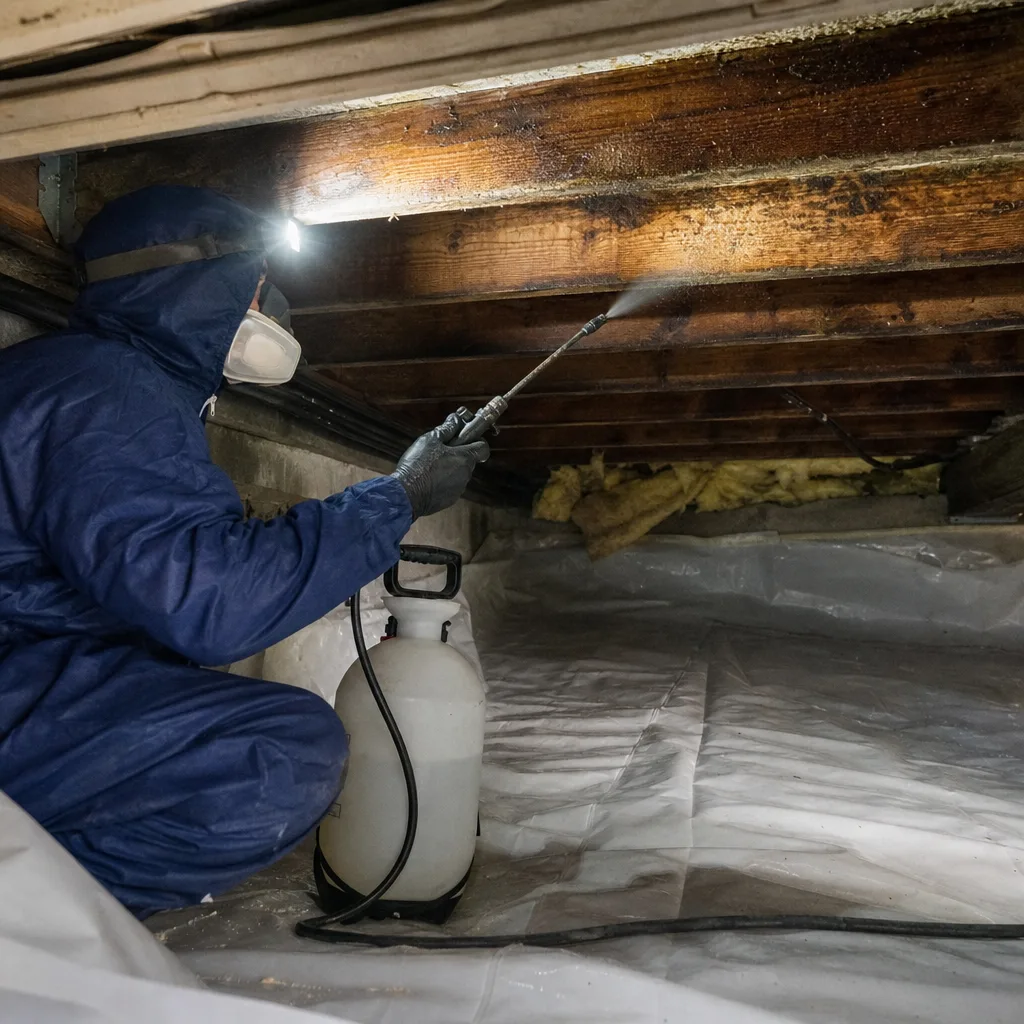
Black Mold Remediation
Black mold (Stachybotrys) gets attention because it’s the one people have heard of, but the reality in San Bernardino is that any mold growing in a chronically damp crawl space or behind a slab leak can cause respiratory irritation. We treat black mold with the same protocol as any other toxigenic species: full containment, proper PPE, removal of porous contaminated materials, and clearance testing. The difference is that in San Bernardino’s older housing stock, black mold usually means the moisture source has been active for months, which means we’re almost certainly going to find structural damage once we open the area up. We tell you that up front, before any work starts, with a written scope.
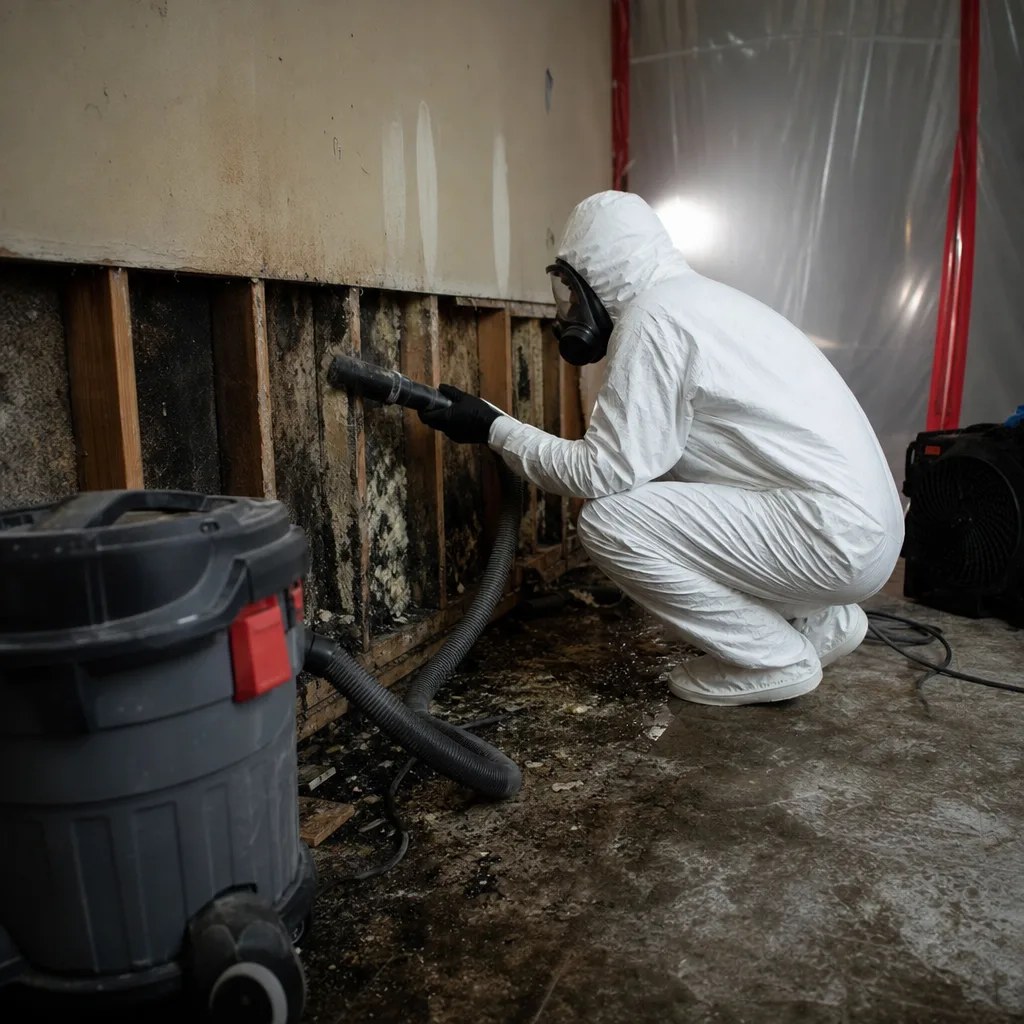
Air Quality Restoration
Mold doesn’t stay where it grows. Spores move through your HVAC system, settle in ductwork, and recirculate through every room. After mold removal, air quality restoration includes HEPA air scrubbing during the job and, often, duct cleaning and HVAC inspection. In San Bernardino specifically, the Cajon Pass wind effect adds another layer: fine ash and particulate get pulled into attic spaces and ductwork even when no fire is nearby. That means a home that had mold remediation but skipped air quality restoration often still smells like the crawl space. We address the air, not just the wall cavities.
What happens when you call
- 1
A real person answersNo phone trees - you reach a local pro.
- 2
You get an upfront price rangeHonest numbers before anyone is dispatched.
- 3
A background-checked tech heads outLicensed & insured, dispatched right away.
- 4
You approve before work beginsNothing starts until you say go.
Trusted Brands We Service in San Bernardino
We don’t cut corners on equipment, because San Bernardino’s mold problems don’t respond to box fans and household dehumidifiers. On mold jobs across the 92408, 92410, 92411, and 92412 ZIP codes, Wade’s crew runs Dri-Eaz dehumidifiers and air movers, Phoenix drying systems, and Injectidry injection drying for tight cavities. Our technicians carry IICRC, RIA, and IFA credentials, and they know how to place equipment correctly in a slab-on-grade 1950s ranch so the drying actually works, not just looks busy. That’s what separates real remediation from a guy with a spray bottle and a Home Depot rental unit.
Common Mold Remediation Problems We See in San Bernardino Homes
If you live in San Bernardino, especially in the flatter neighborhoods south of Highland Avenue or up toward Devore, you should know what we find again and again. Here’s what’s hiding in homes that look fine:
- Slab-on-grade moisture wicking: The original vapor barriers under 1940s-1960s tract homes were often six-mil plastic that degraded decades ago. Moisture moves up through the slab, saturates the sill plate and flooring, and mold grows behind baseboards where you can’t see it until it’s well established.
- Crawlspace alluvial silt intrusion: After heavy winter storms, runoff from Lytle Creek and Devil Creek carries fine sediment that finds its way under slab edges and into crawl spaces. That silt holds water against the structure for months, causing mold callbacks 60-90 days later when it wasn’t caught on the initial assessment. Our crews in the 92407 corridor automatically inspect for this after any mountain rain event.
- Stucco cracking from extreme wet-dry cycles: Summer highs above 105°F followed by sudden cold-weather rain cause the stucco on older San Bernardino homes to crack. Water gets behind the wall, and the heat bakes it into a perfect mold environment. The mold often doesn’t show itself until the next long dry spell, when the smell comes out of the walls.
- Ember-driven attic moisture: Santa Ana winds push fine ash and embers into attics through thin mesh vents and single-pane window gaps. Even without a fire, the wind-driven rain and ash combination creates damp, organic-rich dust in attic insulation that molds quietly. The 2012 bankruptcy and years of deferred maintenance left many San Bernardino homes with original attic venting that can’t handle this.
Pricing for Mold Remediation in San Bernardino, CA
Mold remediation in San Bernardino runs $2,800-$6,500 for most single-family homes, with smaller isolated jobs like a single bathroom coming in around $900-$1,800. Crawl space treatment runs $1,400-$3,200 depending on square footage, and full air quality restoration with duct cleaning typically adds $800-$2,000. The biggest cost driver on older San Bernardino homes is what we find once we open a wall or pull up flooring. Hidden slab moisture that’s been saturating subfloor for years costs more than a surface mold patch. We give you a written scope and a fixed price before anything gets ripped out. Estimates are free. Call (855) 915-0646 and Wade will walk you through what to expect. No trip charge inside Inland Empire county. And if you’re a senior or veteran, ask about the standing 10% discount. It’s not a promotion. It’s always been there.
We Also Serve Cities Near San Bernardino
While this page focuses on mold remediation in San Bernardino, our crews are on the road every week through Muscoy, Highland, Loma Linda, and Rialto. The same post-WWII housing stock and mountain-adjacent moisture patterns affect these communities too, and the same crew that knows your neighborhood’s slab failures knows theirs. If you’re just over the line in any of those cities, the same phone number applies: (855) 915-0646.
Serving San Bernardino, CA - Our Local Coverage Area
We’re based in the San Bernardino area and know this community well. Use the map below to see our service coverage - if you’re nearby, we can almost certainly help.
FAQs - Mold Remediation in San Bernardino
Mold returns in this generation of San Bernardino homes because the moisture source was never actually eliminated. If the original slab vapor barrier is still in place, moisture continues wicking up through the concrete, and mold comes back within months. Same thing if runoff from Lytle Creek or Devil Creek deposited silt under your slab edge that holds water against the structure. Real remediation means fixing the water path, not just killing visible mold. Call (855) 915-0646 and ask Wade to check the slab readings first.
Santa Ana wind events in San Bernardino push fine ash, dust, and wind-driven rain into attics through thin mesh vents and gaps around single-pane windows, creating a damp organic layer in insulation that molds quietly for months. The Cajon Pass accelerates these winds to 60-80 mph, so your attic gets pummeled even when no fire is close. We’ve seen this pattern in homes from 92410 to 92412. The fix is often drying the attic, replacing contaminated insulation, and upgrading the venting, not just spraying something on the sheathing.
In a 1950s San Bernardino home with the original vapor barrier, replace it. After Lytle Creek runoff pushes silt and water under the slab edge, a 60-year-old six-mil barrier won’t stop the moisture from re-wetting your subfloor. We install new 20-mil barrier in crawl spaces routinely, and it typically runs $1,400-$3,200 depending on access and square footage. A crew that tries to just patch the old barrier is doing you a disservice. We’ll test the slab with a Dri-Eaz meter before and after so you can see the numbers.
Slab drying after Devil Creek or Lytle Creek intrusion means getting water out from under the edges where it wicks in, not just drying the visible floor surface. We run Injectidry panels into the sill plate zone, place Dri-Eaz dehumidifiers in the crawl space, and take moisture readings every day until the slab reaches a stable, low reading. On that 1950s ranch near the 92407 corridor, we saw slab relative humidity drop from 98% to 62% inside 72 hours with the right equipment running. A box fan won’t do that.
No, testing isn’t needed for every water loss. If you catch a pipe burst or roof leak fast and we’re drying within 24-48 hours, visible mold never gets a chance to establish. But in older San Bernardino homes where water may have been sitting for weeks inside a wall or under flooring before anyone noticed, testing is worth it. You need to know whether what you’re seeing is surface mold or a deeper colonization. That changes the scope. Call (855) 915-0646 and Wade will give you a straight answer on whether testing makes sense for your situation.
The San Bernardino Mold Problem No One Else Explains This Clearly
Here’s what separates a San Bernardino mold page from a generic one: this city has a specific wind-and-flood cycle that turns hidden post-WWII housing defects into predictable mold hotspots. The Cajon Pass accelerates Santa Ana winds into 60-80 mph blasts that drive wind-driven rain and ash into attics, while the San Bernardino Mountains channel flash-flood runoff down Lytle Creek, Warm Creek, and Devil Creek onto alluvial fans in the 92404 and 92407 ZIP codes. Those two forces alternate. Fire-and-ash season in fall. Mud-and-water season in winter. And the homes built between 1940 and 1965, with their slab-on-grade foundations, six-mil vapor barriers, single-pane windows, and thin attic mesh, fail in predictable ways when those forces hit. That’s why mold after a Santa Ana rain event is almost guaranteed behind baseboards and under flooring in the older neighborhoods. You’re not unlucky. You live in a specific housing stock in a specific climate pattern. Knowing that means you know where to look before you even call us. That’s the point of this page. Now call (855) 915-0646 and let Wade tell you what’s under your slab.
Written by Wade Ferris, Owner at Wade’s Restoration of California, serving San Bernardino since 2007.