
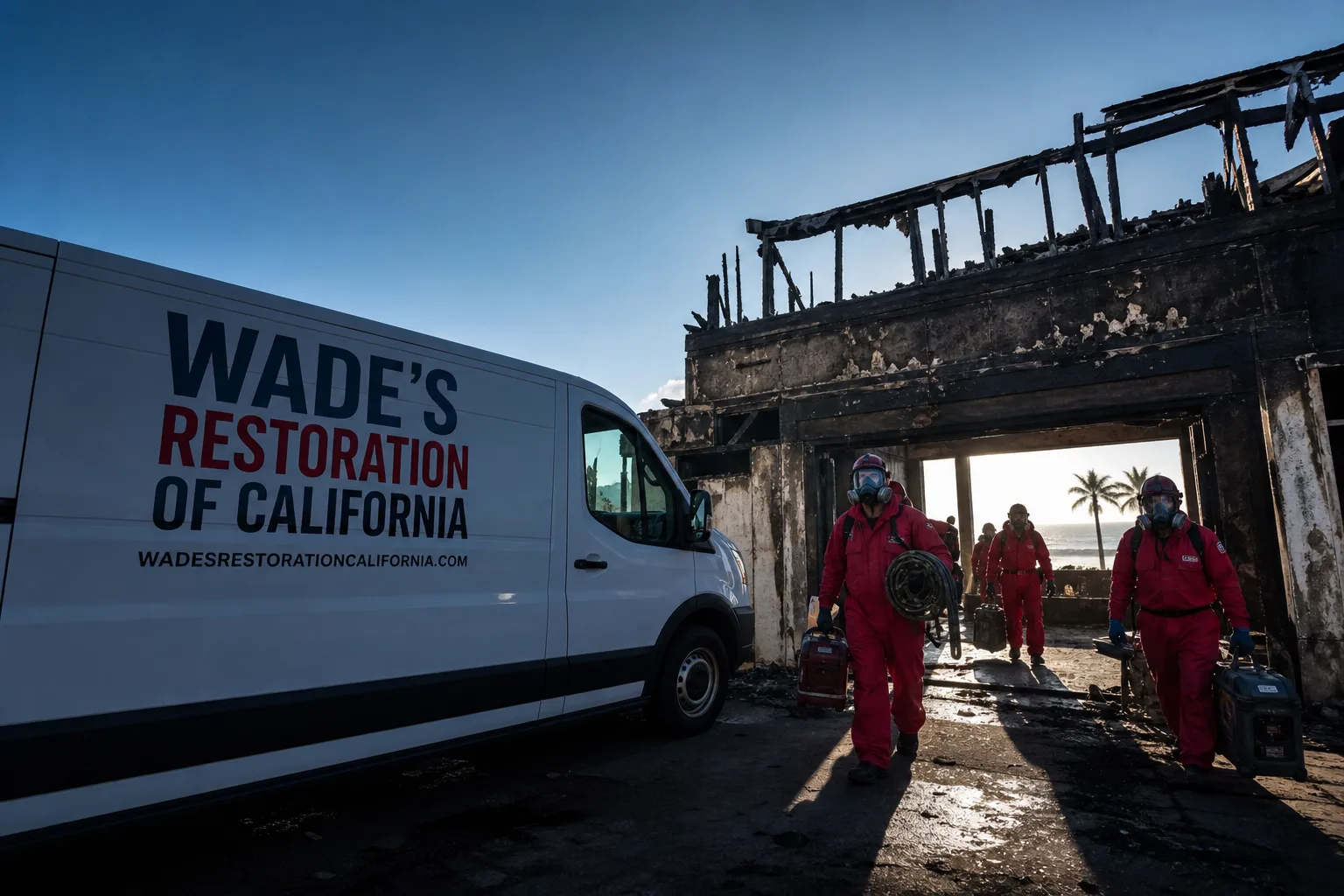
Fast, Reliable Mold Remediation Across Big Bear Lake
Mold remediation in Big Bear Lake typically costs $1,800-$4,500 for a standard room cleanup and runs $3,500-$12,000 when crawl spaces, wall cavities, or multiple rooms are involved. Most jobs can be started within 24-48 hours once we’ve assessed the damage. If you’re dealing with a musty smell in a rental cabin off Big Bear Boulevard or visible growth spreading across a wood-paneled wall near the Village, call Wade’s Restoration of California at (855) 915-0646. Wade Ferris answers his own phone, and he’ll tell you straight what you’re looking at before anyone sets foot in your cabin.
We’re not a national franchise with a call center three time zones away. Wade lives the mountain life, understands what 6,752 feet of elevation does to drying equipment, and knows why a 1960s A-frame near Pine Knot Avenue molds differently than a stucco tract house in Yucaipa. When your second home or rental is sitting wet after a pipe burst, you don’t need a scripted phone tree. You need someone who knows the roads up here, the property managers, and the building quirks of these old cabins.
Why Big Bear Lake Homeowners Call Wade’s Restoration of California
Wade Ferris founded this company in 2007 and built it on a simple idea: put your name on the truck, publish your address, and answer the phone yourself. That’s what he still does. The 90-Day Done Right Promise is stamped in writing on every mold remediation contract in Big Bear Lake. If it’s not done right, Wade comes back and makes it right. No fine print, no adjuster shuffle.
We’ve handled mold problems across 92315, from Sugarloaf-adjacent cabins to properties up near Moonridge and down toward the dam. Property managers who run short-term rentals here don’t gamble on fly-by-night crews. They call the guy they’ll run into at the hardware store next weekend. That’s Wade. He knows the difference between surface mildew from a humid summer and the kind of deep fungal bloom you get after an ice dam forces meltwater into a wall cavity and nobody notices for two weeks.
The response time matters when you’re an absentee owner in Riverside watching your Airbnb calendar fill up. Wade’s crew can get to a Big Bear Lake property fast, document everything with photos for your adjuster, and start the moisture-mapping work that tells you whether this is a contained issue or a gut-the-drywall situation.
Our Mold Remediation Services in Big Bear Lake
Mold Inspection & Testing
We start with moisture readings, not guesswork. In Big Bear Lake, that means checking wall cavities behind wood paneling, probing crawl space joists, and pulling air samples where a musty smell lingers but no growth is visible. A typical inspection runs $250-$450 and includes a written scope of what we actually found. Wade takes moisture readings every single day on active jobs and hands you the full log at the end. Almost nobody in this trade does that.
Mold Removal
This is containment, removal, and disposal done right. In Big Bear Lake, mold removal in a single bathroom or closet usually runs $1,800-$3,500. We contain the affected area with negative air pressure, remove affected drywall or insulation, and treat framing with an EPA-registered antimicrobial. If you’ve got a crawl space involved, the price climbs because those pier foundations up here mean working on your back, in the cold, often with frozen soil beneath you.
Black Mold Remediation
Black mold in Big Bear Lake cabins often traces back to a leak that happened weeks before anyone noticed. A supply line freezes in a wall, cracks, and quietly soaks the insulation for days. By the time a property manager smells it during turnover, you’ve got Stachybotrys growing on the backside of drywall. Full black mold remediation with containment, removal, treatment, and clearance testing typically runs $3,500-$8,000 in Big Bear Lake depending on how many rooms and whether cabinetry or floor coverings need pulling. This is not a bleach-and-paint job. It’s controlled demolition with safety barriers, HEPA air scrubbers, and post-remediation air sampling.
Air Quality Restoration
After we remove the mold, the air needs cleaning too. That means HEPA filtration, running the right air scrubber for the square footage, and post-remediation air samples that confirm spore counts are back to normal for a house at 6,752 feet. Air quality restoration in Big Bear Lake typically adds $600-$1,400 to a mold removal job. Some companies skip clearance testing to keep the bid low. We don’t, because a rental guest with allergies is going to find mold faster than any inspector.
Crawl Space Treatment
Crawl spaces in Big Bear Lake are where mold starts and nobody sees it for months. Pier foundations, exposed supply lines, fiberglass insulation that freezes and thaws and freezes again. A crawl space mold treatment here runs $2,200-$5,000 depending on square footage and whether insulation needs replacing. We remove the contaminated insulation, treat the joists and subfloor, and recommend closed-cell foam so the next January freeze doesn’t do it all over again.
Moisture & Humidity Control
Big Bear Lake summers are dry, but winters create humidity you never see. Snow melts against the foundation, vents get buried under snowmelt, and moisture drives into the framing. We install vapor barriers, improve crawl space ventilation with altitude-appropriate specs, and set up dehumidification that actually works when outdoor temps stay below freezing for weeks. Moisture control retrofits typically run $1,500-$3,200 in the cabins up here.
Trusted Equipment and Standards on Every Big Bear Lake Job
We run Dri-Eaz desiccant dehumidifiers and Phoenix air movers because they’re built for real conditions, not showroom demos. At 6,752 feet, atmospheric pressure changes how water evaporates from building materials. Standard drying charts go out the window. Our crew adjusts settings for altitude and extended timelines, which is why we don’t pull equipment early just because a schedule says we should. Our technicians carry IICRC certifications, and we’re RIA-affiliated and IFA-recognized. That’s not alphabet soup. It means we follow the industry protocols that matter when a cabin’s framing is wet and the owner is four hours away in Orange County.
Common Mold Problems We See in Big Bear Lake Homes
- Ice dam cavity leaks. Big Bear Lake averages 59-100 inches of snow a year. When warm attic air melts snow on the roof and it refreezes at the cold eave line, water backs up under shingles and drains into wall cavities. The mold shows up weeks later behind 1970s wood paneling, and by then the damage is four layers deep.
- Frozen pipe floods in unoccupied cabins. A January cold snap hits 10°F, the heat gets set too low (or fails), and a galvanized supply line cracks. Water runs for days before a property manager checks in. That’s not a damp spot. That’s structural saturation with mold already colonizing the insulation.
- Crawl space frost-line moisture. Pier foundations expose the underfloor to freeze-thaw cycles all winter. Snow melts, water wicks into fiberglass batts, and the joists stay damp for months. This is the most overlooked mold source in Big Bear Lake.
- Rental turnover masking. Short-term rental managers sometimes “freshen up” a room with Kilz and a coat of paint before the next guest arrives. The mold is still there, sealed inside the wall cavity, growing toward the next booking’s negative review.
Pricing for Mold Remediation in Big Bear Lake, CA
How Big Bear Lake’s Elevation Changes the Whole Job
Most mold remediation companies are writing drying plans from sea-level assumptions. Big Bear Lake sits at 6,752 feet, and that changes physics. Lower atmospheric pressure reduces the rate at which water evaporates from wood, drywall, and insulation. A wall cavity that dries to 16% moisture content in 72 hours in San Bernardino might take 5-6 days up here with the same equipment settings. Pull that equipment too early and you’ve left the subfloor wet enough to re-bloom mold before the next winter cycle even hits.
This is the local intelligence that separates a mountain remediation crew from a fly-in outfit. We adjust desiccant dehumidifier settings for altitude, extend drying timelines accordingly, and don’t declare the job done until our moisture meter says it’s done. That’s why our crawl space treatments on pier foundations work the first time. That’s why property managers keep calling back.
We Also Serve Mountain Communities Near Big Bear Lake
Wade’s Restoration of California covers Big Bear Lake and the surrounding mountain towns: Big Bear City, Lucerne Valley, Mentone, and Yucaipa. If you own a rental in any of these communities, the same altitude-adjusted drying approach applies. One call gets the same crew, the same written promise, and the same owner answering the phone.
Serving Big Bear Lake, CA - Our Local Coverage Area
We’re based in the Big Bear Lake area and know this community well. Use the map below to see our service coverage - if you’re nearby, we can almost certainly help.
FAQs - Mold Remediation in Big Bear Lake
How does Big Bear Lake’s 6,752-foot elevation change mold remediation drying times?
Drying at 6,752 feet takes 30-50% longer than the same job at sea level because lower atmospheric pressure slows evaporation. A wall cavity that dries in three days in Riverside can take five to seven in Big Bear Lake, which means we leave desiccant dehumidifiers running longer and take daily moisture readings so we’re not guessing. The mold is gone when the moisture meter says it’s gone, not when a calendar says it’s been long enough. Call (855) 915-0646 for specifics on your cabin.
Why do short-term rentals in Big Bear Lake see repeat mold in the same wall cavity?
Repeat mold in a rental almost always means the original water source was never found, not that the cleanup failed. Up here, that source is often an ice dam forcing meltwater behind the siding, or a pinhole leak in an old copper line that only drips when the cabin is occupied and the water is flowing. A proper remediation starts with finding the leak and verifying the cavity is fully dry before new drywall goes up. Wade’s crew does that on every job. Estimates are free.
Can you treat mold in a crawl space without removing the pier foundation insulation?
No, not if the insulation is contaminated. Mold roots into fiberglass batts and the paper facing, and you can’t spray it clean. The insulation has to come out, the joists get treated with an EPA-registered antimicrobial, and we recommend closed-cell foam so the next freeze cycle doesn’t soak it all over again. A typical crawl space treatment in Big Bear Lake runs $2,200-$5,000. Call (855) 915-0646 to set up an inspection.
How soon after a January pipe burst in an unoccupied cabin should mold remediation start?
Mold can start colonizing wet drywall and insulation within 48-72 hours. If a cabin was sitting wet for a week or more, the remediation should start immediately, which means water extraction, demolition of saturated materials, and drying equipment on site as fast as possible. In Big Bear Lake, access can be the wild card: snow-blocked roads and unplowed driveways sometimes delay arrival by a day or two. Call us the moment you know there’s water. Wade can advise you over the phone on what to do first, at no charge.
Does servicing brands like Dri-Eaz or Phoenix affect how well my Big Bear cabin dries out?
Brand matters because equipment performance at altitude matters. Dri-Eaz desiccant dehumidifiers handle low-temperature, high-humidity conditions better than standard residential units, and Phoenix air movers push the kind of air volume needed to dry wall cavities behind 1970s paneling. But the real factor is the person reading the meters and writing the drying plan. Wade’s crew has the training and the local experience to run this equipment correctly at 6,752 feet. That’s the difference between a one-time fix and a re-bloom next winter. Call (855) 915-0646 for a free estimate on your Big Bear Lake property.
Call Wade’s Restoration of California for Mold Remediation in Big Bear Lake
Mold doesn’t wait, and neither should you. If you’ve got a musty rental cabin, a soggy crawl space under a pier foundation, or a wood-paneled wall that’s been hiding something for months, call (855) 915-0646 right now. Wade Ferris answers his own phone, 24 hours a day, seven days a week. He’ll ask the right questions, tell you what’s probably going on, and get a crew headed up the mountain. The estimate is free, the work is guaranteed in writing, and you won’t get a bait-and-switch number when the crew arrives. That’s how it’s been done since 2007.
Written by Wade Ferris, Owner at Wade’s Restoration of California, serving Big Bear Lake and surrounding mountain communities.