
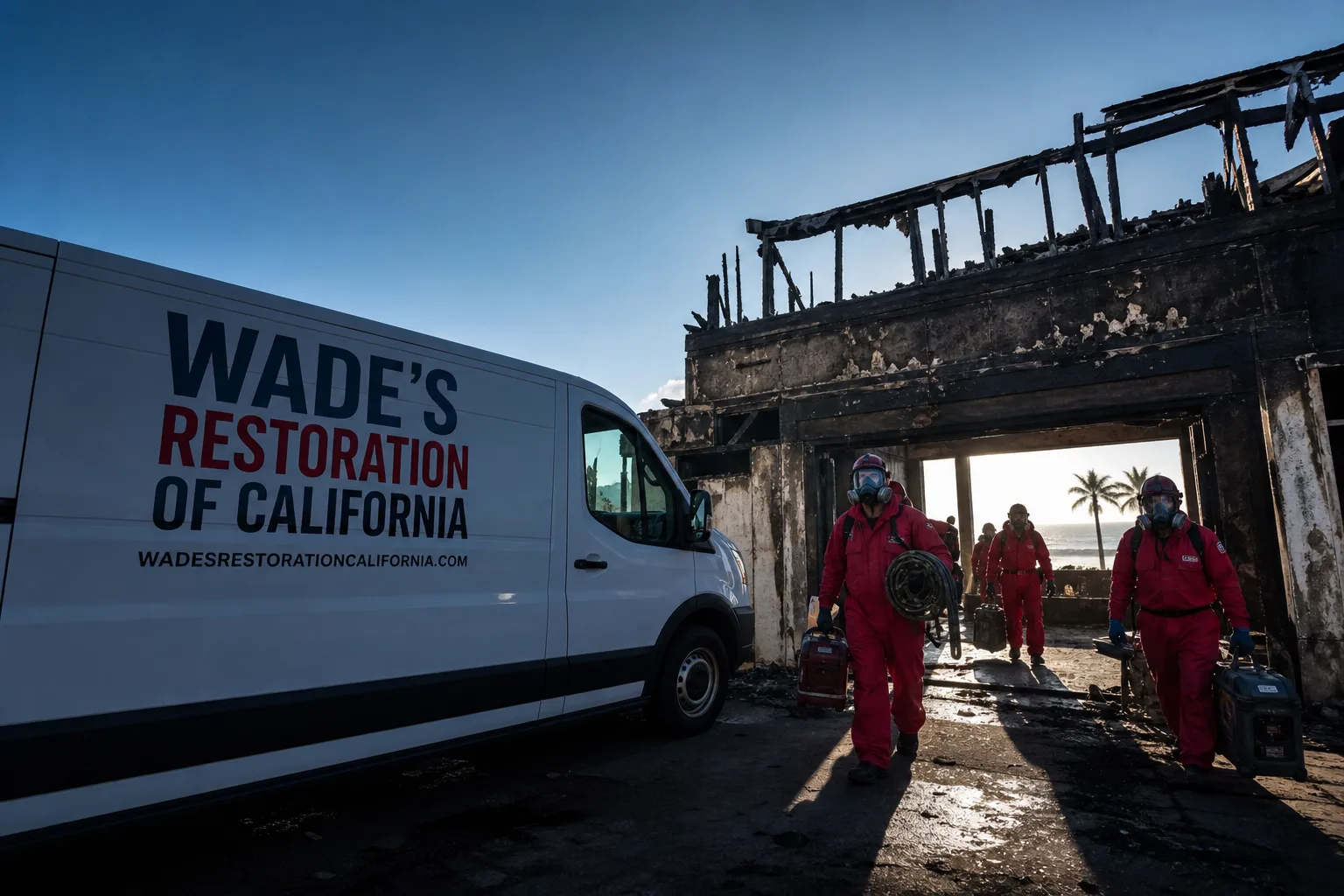
Fast, Reliable Water Damage Restoration Across Monrovia
Water damage in Monrovia rarely waits for business hours. When a pipe lets go in a 1927 Craftsman off Myrtle Avenue, or a post-wildfire storm pushes mud into a crawl space north of Foothill Boulevard, you need someone who knows these homes and these streets. That’s why Wade Ferris answers his own phone and can have extraction running inside the hour anywhere from Mayflower Village to the canyon mouth. Call (855) 915-0646 and you’ll get Wade, not a call center.
Why Wade’s Restoration of California Is Monrovia’s Preferred Water Damage Restoration Company
Wade’s Restoration has been owner-operated since 2007. Wade Ferris publishes his name, address, and license number, then backs every water, fire, and mold job with a 90-Day Done Right Promise in writing. If it’s not done right, he comes back and makes it right. No arguing, no fine print.
Monrovia homeowners tend to ask the same thing before anyone gets near the front door: who am I actually dealing with? The answer here is simple. Wade’s crew works in uniform, background-checked, using professional-grade equipment from Dri-Eaz and Phoenix. He runs moisture readings every single day and hands you the full log when the job’s done. Almost nobody in this trade does that. His IICRC certification and RIA affiliation aren’t wall decorations either. They’re the standard he holds every Monrovia job to, whether it’s a flooded basement on a 1950s ranch or a mud-packed crawl space under a 1920s bungalow near Canyon Crest Drive.
Ask anyone on your street. Ask the hardware store regulars in Old Town. Wade’s the one who shows up.
Our Water Damage Restoration Services in Monrovia
Emergency Water Extraction
When water is standing in a Monrovia living room, every hour matters. Wade heads out immediately, not after a callback window. His team brings truck-mounted extraction units and portable Dri-Eaz extractors sized for tight Craftsman hallways and narrow pier-and-beam crawl access. A typical emergency extraction in Monrovia runs $500-$1,200 depending on square footage and water volume. The goal in the first visit is simple: get the water out, map the moisture, and stop the damage from spreading into framing and flooring.
Structural Drying & Dehumidification
Drying a Monrovia home isn’t just pointing fans at wet drywall. The pre-1950 stock near Old Town has lath-and-plaster walls, and those plaster assemblies hold moisture differently than modern gypsum. Wade’s crew sizes dehumidification by the cubic foot, not by guesswork. Expect $40-$75 per day per dehumidifier with LGR units from Dri-Eaz and Phoenix, and job lengths of three to seven days for most Category 1 clean-water losses. We hand you the moisture log daily, so you can see the numbers dropping.
Flood Cleanup
Flooding in Monrovia is different from flooding in Arcadia or Duarte. When rain hits the burned slopes of the San Gabriel Mountains above Monrovia Canyon, hydrophobic soil turns that water into a slurry of mud, gravel, and debris that moves fast. That material finds its way into stem-wall gaps and crawl space vents in the foothill neighborhoods. Flood cleanup here means mucking out sediment, pressure-rinsing sill plates, drying the subfloor cavity, and treating framing with an EPA-registered antimicrobial. Plan on $1,500-$4,500 for a typical crawl space flood cleanup involving mud and sediment removal, drying, and vapor barrier replacement.
Burst Pipe Restoration
Monrovia’s older homes, especially the Craftsman bungalows and mid-century ranches, still carry galvanized steel supply lines. Those pipes corrode from the inside out and let go without much warning. A burst supply line behind a wall or under a pier-and-beam floor means extraction, structural drying, and often drywall replacement. Burst pipe restoration in Monrovia typically runs $1,800-$5,000 when it includes removing water-damaged wall sections, drying the cavity, and replacing affected drywall and insulation. If the pipe is accessible from the crawl space, costs stay on the lower end.
What happens when you call
- 1
A real person answersNo phone trees - you reach a local pro.
- 2
You get an upfront price rangeHonest numbers before anyone is dispatched.
- 3
A background-checked tech heads outLicensed & insured, dispatched right away.
- 4
You approve before work beginsNothing starts until you say go.
Trusted Brands We Service in Monrovia
Wade’s crew works with equipment from Dri-Eaz, Phoenix, Injectidry, XPOWER, and B-Air, and we stock common parts and drying accessories that fit the tight, low-clearance crawl spaces under Monrovia’s older homes. That means less waiting on supply runs and faster drying start times. Our Water Damage Restoration team knows which units will actually fit through a 24-inch pier-and-beam access opening without knocking out more bricks.
Common Water Damage Restoration Problems We See in Monrovia Homes
- Mud and debris in pre-1950 crawl spaces. Homes within a half-mile of Monrovia Canyon Park sit in mapped LA County debris flow hazard zones, and after heavy post-fire rain, we routinely dig feet of sediment out from under 1920s Craftsman homes. Leaving that mud against 100-year-old fir joists means persistent moisture, rot, and a termite invitation.
- Water wicking into lath-and-plaster walls. Santa Ana wind-driven roof leaks on pre-1950 bungalows push water through the roof deck and down inside walls. Plaster wicks it fast, and by the time you see a stain, the wall cavity is wet well beyond the visible damage. Extraction and drying have to happen fast to keep the plaster from crumbling and the lead paint from becoming a contamination problem.
- Galvanized pipe failures in mid-century ranches. The flatland homes between Foothill and Huntington often still run original galvanized steel plumbing. When those pipes let go, the water goes straight into a slab or crawl space. Slab leaks in particular require specialized drying lines and sometimes floor removal to reach the wet underside of the subfloor.
- Roof leaks during Santa Ana wind events. High wind peels shingles and drives rain sideways under the eaves of hillside-facing roofs. We see this most often on the north-facing rooflines that catch the full force of the wind coming down the canyon. A small leak during a Santa Ana can turn into a full ceiling collapse within days if the water sits.
Pricing for Water Damage Restoration in Monrovia, CA
We Also Serve Cities Near Monrovia
Our Water Damage Restoration in Monrovia service area extends to the communities around it. We regularly work in Mayflower Village, Duarte, Arcadia, and Sierra Madre. Same owner, same crew, same 90-Day Done Right Promise on every job.
Serving Monrovia, CA - Our Local Coverage Area
We’re based in the Monrovia area and know this community well. Use the map below to see our service coverage - if you’re nearby, we can almost certainly help.
FAQs - Water Damage Restoration in Monrovia
How do I know if my Monrovia foothill crawl space needs post-debris-flow remediation rather than standard water extraction?
If your home sits north of Foothill Boulevard within about a half-mile of Monrovia Canyon Park, and you’ve had heavy rain following a fire season in the Angeles National Forest, check your crawl space for mud, gravel, or sediment against the stem wall. Standard water extraction handles standing water. Debris flow remediation means physically removing feet of hydrophobic post-fire sediment, pressure-rinsing framing, drying a dirt-floor cavity that’s holding far more moisture than a standard flooded crawl, and replacing the vapor barrier. If you can see mud lines on the foundation wall, you need remediation, not just extraction. Call (855) 915-0646 and Wade will come look at it himself.
Can your team remove mud and gravel from a 1920s Craftsman crawl space without damaging the original pier-and-beam foundation?
Yes. We responded to a 1920s Craftsman off Canyon Crest Drive after a post-wildfire storm pushed mud through the stem wall and into the crawl space. Our crew ran two Dri-Eaz LGR 7000XLi dehumidifiers and a Phoenix Rover axial air mover inside the contained dirt-floor cavity while cutting a section of perimeter board to access the subfloor, then pressure-rinsed the sill plate and treated the framing with an EPA-registered antimicrobial before restoring the vapor barrier. The original piers and beams stayed untouched. That’s the standard we bring to every Monrovia crawl space.
What makes water damage from Santa Ana wind-driven rain different in Monrovia than in Arcadia or Duarte?
Monrovia sits directly at the mouth of Monrovia Canyon, so when Santa Ana winds blow, they hit the foothill-facing rooflines hard and fast, driving rain sideways under eaves and into wall cavities. Arcadia and Duarte sit mostly on flatland with less direct canyon wind exposure. Monrovia hillside and canyon-adjacent homes also get runoff channeled down the shortest possible path from the mountains, leaving almost no reaction time between the rain starting and water reaching the foundation. That changes how fast we need to respond and where we look for hidden moisture.
After a wildfire season, how quickly should I remove water or mud from under my Monrovia home before it becomes a structural issue?
Within days, not weeks. Post-fire hydrophobic soil means the ground above your home can’t absorb water the way it used to, so what would have been a normal rain event turns into a concentrated mud surge aimed straight at foothill neighborhoods. That mud packs against 100-year-old fir joists and sill plates, holding moisture against the wood continuously. Rot starts fast, and termites follow moisture. If you’ve had any mud or water enter the crawl space after a fire season, call us that same week. It’s cheaper to muck out and dry now than to replace structural framing later.
Do you handle burst pipe restoration in Monrovia’s older homes with galvanized steel plumbing?
We do. Galvanized steel supply lines in Monrovia’s pre-1960 homes corrode from the inside and fail without warning. When one lets go, the water often travels through wall cavities or under floors before you ever see it. We handle the full restoration: extraction, structural drying, drywall removal where needed, and coordination with a plumber if repiping is part of the fix. The restoration side of a burst pipe in Monrovia typically runs $1,800-$5,000, and we’ll put that in writing before we start.
Call Wade’s Restoration for Water Damage in Monrovia
If you’ve got water where it shouldn’t be, call (855) 915-0646 right now. Wade answers his own phone, every hour of the day, every day of the week. He’ll tell you what he thinks is going on, what he’d do first, and whether you even need a crew out tonight or whether it can wait until morning. No charge for that. No trip charge inside the county either. And every water restoration job comes with the 90-Day Done Right Promise in writing. If it’s not done right, Wade makes it right. That’s the deal he’s worked under since 2007, and he isn’t about to change it now.
Written by Wade Ferris, Owner at Wade’s Restoration of California, providing water damage restoration throughout Monrovia since founding the company in 2007.