
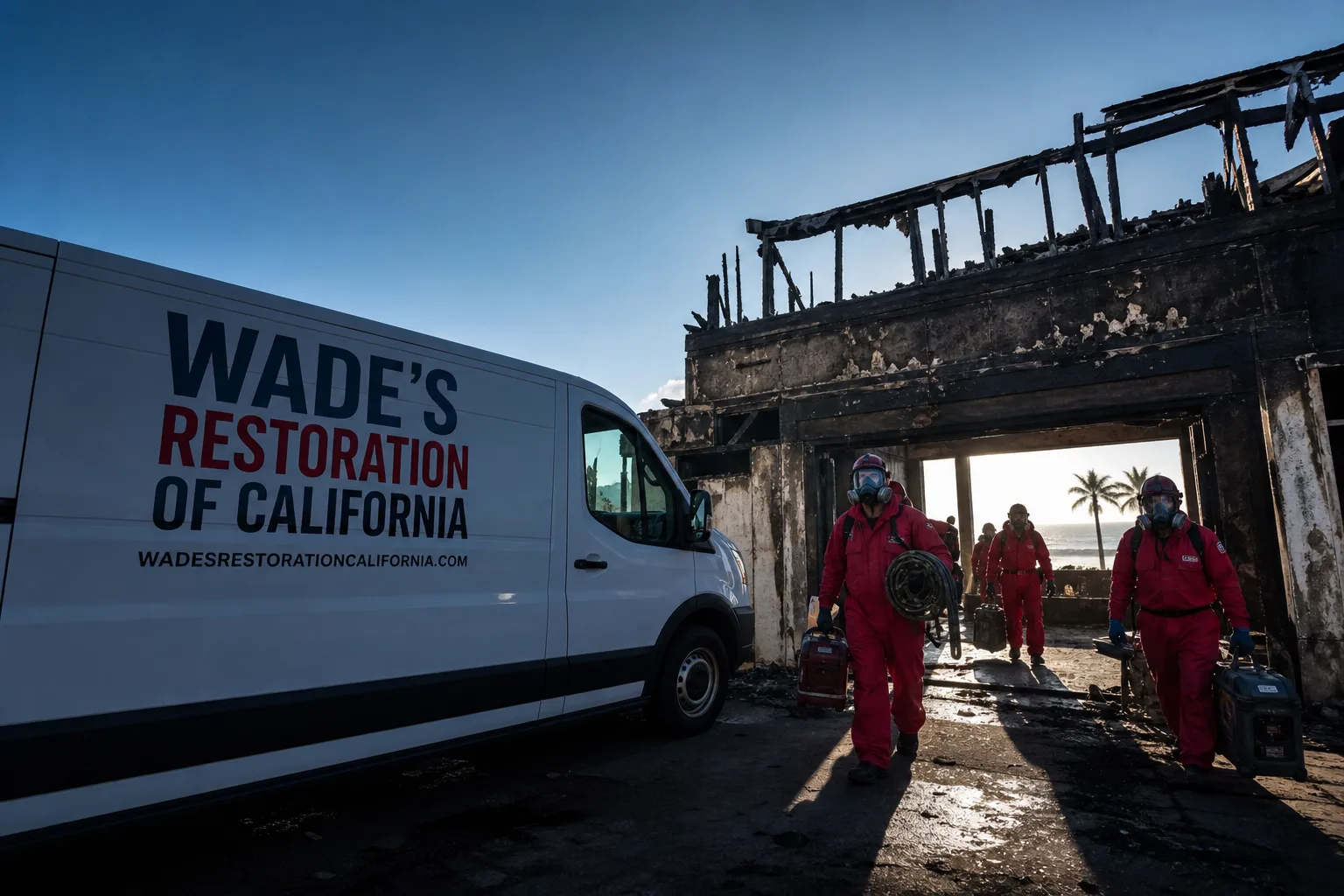
Fast, Reliable Water Damage Restoration Across Lomita
Water damage in Lomita almost never stays simple. The city’s post-WWII bungalows hide original galvanized pipes behind walls that may contain asbestos, and when a line lets go, you do not need a truck that takes three hours to arrive. You need someone who knows exactly what they are walking into the moment they step through your door. Wade’s Restoration of California crews reach Lomita fast, and if you call (855) 915-0646 right now, a live person answers. Not a menu. Not a voicemail. Wade Ferris answers his own phone, and he can have extraction running inside the hour when the job is that urgent.
Why Wade’s Restoration of California Is Lomita’s Preferred Water Damage Restoration Company
Wade has been doing this work since 2007, and Lomita homeowners keep his number saved for the same reason your neighbor keeps a plumber friend on speed dial. He publishes his name, his address, and his license number. He hands you a written scope before work starts, not after. And when he says his crew will be there in under an hour for a burst pipe off 241st Street, he means it. Ask anyone on your street. Someone has already dealt with a flooded garage after a winter storm and Wade showed up while the water was still spreading. That is the reputation this business runs on.
The crews Wade sends are background-checked, uniformed, and IICRC-certified. They do not subcontract to strangers. Wade deals with your insurance adjuster directly so you never have to relay moisture readings or explain why a wall cavity needs another day of drying. He takes moisture readings every single day and hands you the full log when the job closes. Almost nobody in this trade does that. For homeowners in Lomita who have been burned by a national outfit quoting one price on the phone and another at the door, that transparency changes everything.
Our Water Damage Restoration Services in Lomita
Emergency Water Extraction
When a supply line bursts in a Lomita home, every minute matters. Wade’s crews arrive with truck-mounted and portable extraction units, and they start pulling water before the insurance paperwork is even discussed. In Lomita specifically, the marine layer means standing water does not just soak drywall. It raises the indoor humidity enough that mold starts colonizing within 48 to 72 hours in wall cavities you cannot see. Extraction has to be fast and complete, and it has to be followed by aggressive drying, not just mopping.
Structural Drying & Dehumidification
This is where Water Damage Restoration in Lomita separates professionals from amateurs. Wade’s team runs Dri-Eaz LGR 7000XLi dehumidifiers and XPOWER air movers, and because Lomita’s older homes hold moisture in original subfloor and plaster, the drying plan usually includes targeted subfloor systems. The coastal fog that rolls in most nights keeps ambient humidity high, so a half-dried wall will fail a moisture meter check two weeks later. Wade documents readings daily and will not pull equipment until the numbers prove the structure is dry.
Flood Cleanup
Winter atmospheric-river storms send runoff down from the Palos Verdes terrain into Lomita’s flat lots. When that water pushes under slab foundations and into crawl spaces, standard drying misses it because the moisture is trapped beneath concrete or behind vapor barriers. Wade’s crew uses Dri-Eaz subfloor drying systems and injectidry panels to force air through the spaces that other companies skip. Then they treat the cavity to prevent mold. That extra step is not optional here. It is the difference between a dry house and a repeat problem next storm season.
Burst Pipe Restoration
The galvanized supply lines in Lomita’s 1940s through 1960s builds corrode from the inside. When winter pressure spikes, those pipes fail. Wade does not just dry the mess. His team coordinates the repipe with the extraction, so you are not stripping drywall twice. And because disturbing the wall cavity on an older home almost always triggers an asbestos survey, Wade handles that coordination too. You do not file permits and hope. He walks the whole job through from first pump-out to final inspection.
What happens when you call
- 1
A real person answersNo phone trees - you reach a local pro.
- 2
You get an upfront price rangeHonest numbers before anyone is dispatched.
- 3
A background-checked tech heads outLicensed & insured, dispatched right away.
- 4
You approve before work beginsNothing starts until you say go.
Trusted Brands We Service in Lomita
Wade’s Restoration of California runs professional-grade equipment from Dri-Eaz, Phoenix, and B-Air because this work demands it. Those machines are built for continuous operation in the damp, salt-touched air near the South Bay. When a dehumidifier on a Lomita job needs a filter or a sensor swap, the crew has parts on the truck, not on order. The goal is simple. Keep the equipment running so the structure dries on schedule and you are back in your home days sooner, not weeks. The IICRC certification behind the work means the drying plan is written to the industry standard, not to whatever the newest hire learned last month.
Common Water Damage Restoration Problems We See in Lomita Homes
- Asbestos surprises on nearly every job. Lomita’s homes were built in a concentrated postwar wave, and original floor tile, ceiling texture, and duct insulation frequently contain asbestos. Before drywall comes out, testing happens. That adds days and coordination, but skipping it is not an option.
- Palos Verdes runoff pooling under slab foundations. When the hills shed water during heavy winter storms, Lomita’s flat lots collect it. Crawl spaces and sub-slab areas stay wet long after the surface dries, which is why Wade’s drying plan includes subfloor systems most restoration companies never deploy.
- Mold colonizing behind walls before you ever see a stain. The marine layer keeps indoor humidity elevated in Lomita’s older, poorly ventilated homes. A small leak that would dry out inland becomes a wall-cavity mold problem here within days. That is why Wade treats cavities after drying, not just the visible surface.
- Corroded galvanized pipes failing during winter pressure spikes. Original supply lines from the 1950s and 60s are living on borrowed time in Lomita. When they burst, the water damage is only half the job. The repipe has to be coordinated with extraction and drying, or you end up tearing out the same wall twice.
Pricing for Water Damage Restoration in Lomita, CA
We Also Serve Cities Near Lomita
Wade’s Water Damage Restoration in Lomita service area stretches across the South Bay, including Torrance, Rolling Hills Estates, San Pedro, and West Carson. The same crews, the same equipment, and the same overnight response cover all of these communities. If you are a few blocks outside the Lomita line, call anyway. No charge for the trip inside the county.
Serving Lomita, CA - Our Local Coverage Area
We’re based in the Lomita area and know this community well. Use the map below to see our service coverage - if you’re nearby, we can almost certainly help.
FAQs - Water Damage Restoration in Lomita
How does Lomita’s proximity to the South Bay marine layer change mold remediation after a water leak?
The marine layer raises indoor humidity enough that mold starts colonizing hidden wall cavities within two to three days of even a small leak. That means Lomita mold remediation almost always includes cavity treatment with ozone or chlorine dioxide after structural drying, not just surface cleaning. If you skip that step, the problem comes back.
Why is asbestos testing required on almost every water damage job in Lomita?
Because Lomita’s housing stock was almost entirely built between the late 1940s and mid-1960s, and the original floor tile, ceiling texture, and duct insulation frequently contain asbestos. Disturbing those materials requires testing and sometimes abatement before restoration work can legally continue. Wade coordinates the survey and permit so the job stays moving.
What happens when winter atmospheric-river storms flood my Lomita crawl space?
Runoff from the Palos Verdes terrain pushes into Lomita’s flat lots and saturates crawl spaces and sub-slab areas. Standard drying equipment misses moisture trapped under concrete, so Wade’s crew deploys Dri-Eaz subfloor drying systems to force air through those spaces and then treats the cavity to prevent mold. Call (855) 915-0646 the day you notice standing water.
Which water extraction equipment do you use on burst pipes in Lomita’s older bungalows?
Wade’s crews rely on Dri-Eaz LGR 7000XLi dehumidifiers and XPOWER air movers for extraction and drying in Lomita’s post-WWII homes. Those machines move enough air to dry lath-and-plaster walls and original subfloor without destructive tear-out, which matters when the wall cavity still needs asbestos clearance.
How soon after discovering a ceiling leak from a roof storm should I call in Lomita?
Call immediately. In Lomita’s marine-layer climate, a ceiling leak that drips overnight is already raising humidity inside the ceiling cavity, and mold gets a foothold within 48 hours. The sooner extraction and drying start, the less drywall gets cut out. Call (855) 915-0646 and Wade can have a crew on the way within the hour.
Call Wade’s Restoration of California in Lomita
If water is spreading through your Lomita home right now, stop reading and call (855) 915-0646. Wade or someone on his team answers live, 24 hours a day, seven days a week. You get a real person, a straight answer, and a crew that shows up ready to work. Estimates are free. The 90-Day Done Right Promise is in writing. And when the job is done, you will have the full moisture log, a documented scope, and a straight line to the owner if anything ever needs another look.
Written by Wade Ferris, Owner at Wade’s Restoration of California.