
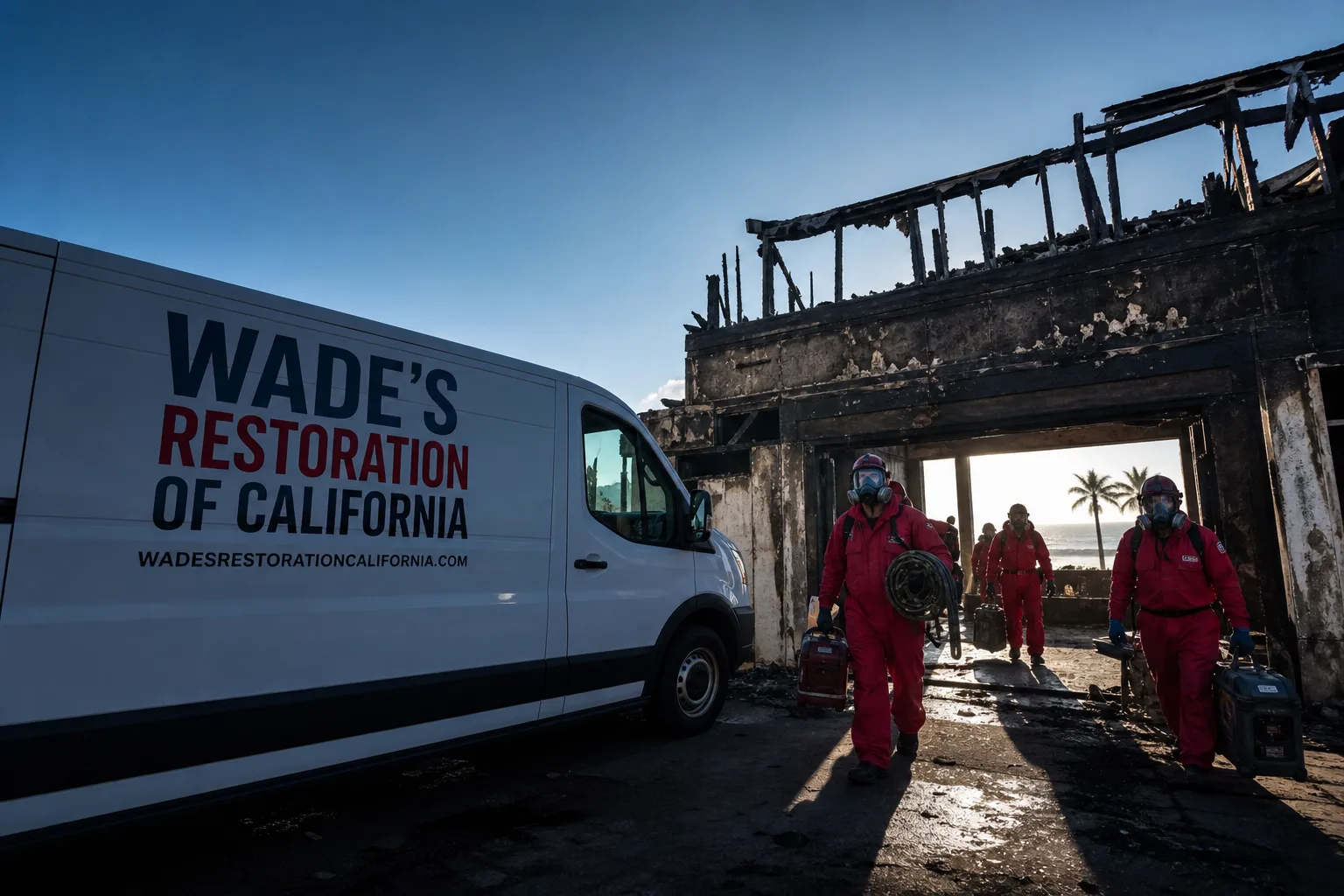
Storm & Disaster Restoration in Saratoga, CA: Hillside Flooding, Wildfire Ash, and Custom-Home Damage
Storm damage in Saratoga hits differently than it does ten minutes east in San Jose or Sunnyvale. The Santa Cruz Mountains wring extra rain out of every storm system that stalls against them, and when that water lands on steep wooded lots, it doesn’t just pool on the surface. It moves. Under foundations, through crawl spaces, behind custom millwork, into post-and-beam connections that have stood since the 1950s. We’re Wade’s Restoration of California, and our Storm & Disaster Restoration team knows exactly where to look when a Saratoga home starts showing water, ash, or storm damage. Call (855) 915-0646 and you’ll get Wade Ferris himself on the line, not a call center. He heads out to Saratoga himself and can have extraction running inside the hour, because in the Wildland-Urban Interface where Saratoga sits, waiting turns a $3,000 cleanup into a $40,000 reconstruction.
What Storm & Disaster Restoration Costs in Saratoga, CA
A typical storm damage cleanup in Saratoga runs $2,800 to $12,000 depending on what got hit and how long the water’s been moving. Emergency board-up on a custom home usually lands between $450 and $1,200 for the first window or door, with each additional opening adding $150 to $400. Roof tarping on steeply pitched Saratoga roofs runs $500 to $1,800, because those 6:12 and 8:12 pitches demand fall-protection rigging and crews who won’t punch through cedar shake. Flood damage restoration in a Saratoga hillside crawl space typically runs $4,500 to $18,000 when you factor in groundwater extraction, subfloor drying, and rim-joist repair. These are Saratoga’s honest numbers: higher than flatland cities because the lots are steeper, the finishes are custom, and the materials aren’t off-the-shelf. Every estimate at Wade’s is free, it’s written down before any work starts, and the 90-Day Done Right Promise is stamped on every contract. If it’s not done right, Wade makes it right. In writing.
| Saratoga Storm Restoration Service | Typical Range | What Affects the Price |
|---|---|---|
| Storm Damage Cleanup | $2,800 - $12,000 | Debris volume, water category, affected rooms, finish level |
| Flood Damage Restoration | $4,500 - $18,000 | Hillside crawl-space access, subfloor condition, drying duration |
| Emergency Board-Up | $450 - $1,200 per first opening | Custom door sizes, security needs, glass type |
| Roof Tarping | $500 - $1,800 | Pitch, roof material, number of penetrations, access |
| Wind Damage Repair | $1,500 - $9,500 | Siding material, custom millwork replacement, structural involvement |
Why Saratoga Homes Need a Different Kind of Storm Restoration
Here’s what we know that most restoration companies don’t, because most of them don’t actually work Saratoga’s hill neighborhoods week after week. Saratoga sits at the base of the Santa Cruz Mountains, squarely inside the Wildland-Urban Interface. That means your home faces two overlapping damage drivers that flat Silicon Valley neighbors simply don’t share. The first is wildfire smoke and ash intrusion from the mountain corridor. The 2020 SCU Lightning Complex triggered evacuations in Saratoga’s hill neighborhoods, and even when flames never touched a house, fine ash worked its way into attic insulation, HVAC ducts, and every gap in the building envelope. That ash is acidic. It corrodes electrical contacts, it embeds in carpet fibers, and it keeps releasing odor every time the furnace kicks on. The second driver is orographic lift rainfall. Storm systems hitting the Santa Cruz Mountain front stall and dump measurably more rain on Saratoga than on San Jose or Sunnyvale, which sit in the rain shadow. Prolonged water intrusion and saturated hillside soils are a recurring seasonal restoration trigger here, and they are not the same job as a burst pipe in a Campbell slab home.
The Hidden Flood Source on Saratoga Hillsides
On sloped lots in the Congress Springs and Pierce Road hill neighborhoods, crawl-space foundations are commonly cut into the uphill grade. During multi-day rain events, groundwater channels laterally under the house, soaking subfloor assemblies and rim joists from below. Here’s the problem: the interior looks bone-dry. The hardwood floors feel fine. The walls show nothing. And then three weeks later, mold blooms behind the original wood-panel interior because moisture has been trapped in the subfloor cavity the whole time. Standard storm restoration checklists miss this failure mode entirely because they’re written for flatland homes with perimeter slab foundations. We pull insulation and check for saturated mudsills every single time, because in Saratoga, the flood isn’t where the puddle is.
How We Handle Storm Damage Cleanup in Saratoga
Our process starts the same way whether it’s a downed branch through a skylight in the Glen Brae area or wind-driven rain pushing through cedar siding off Highway 9.
Flood Damage Restoration
Saratoga flood damage usually means either surface water backing up against a hillside foundation or groundwater finding its way under one. We run Dri-Eaz extraction equipment, map moisture with daily readings, and set up drying systems sized to the actual cubic footage of the affected crawl space or interior room. Wade takes moisture readings every single day and hands you the full log when the job’s done. Almost nobody in the trade does that, and it’s the only way to prove the subfloor is actually dry before the wood-panel walls go back on.
Storm Damage Cleanup
When a Santa Cruz Mountain storm drops a eucalyptus limb through your deck or fills your yard with debris, you need it cleared and assessed fast. We remove the debris, document the damage for your insurance, and write a scope of work that separates storm-caused damage from pre-existing wear. If a tree came through a wall, we board it up first, then start the cleanup. No charge for the second opinion if you’ve already got a written estimate from another outfit. Wade will give you his honest read and tell you if their scope is right, too small, or padded.
Emergency Board-Up
Saratoga’s custom homes have custom openings. Carriage doors, picture windows, French doors, skylights with custom glazing. When wind blows one out at 11 p.m., you can’t just grab a sheet of plywood from the garage and call it done. Our emergency board-up protects your home from weather and intrusion while we measure, document, and plan for replacement that actually matches. For the steep-roofed homes on Pierce Road and Congress Springs, roof tarping has to be done right the first time. A tarp that lifts in the first windstorm lets water straight into post-and-beam connections and custom finishes. We tie, seal, and anchor the tarp so it stays put until structural repairs can be scheduled, and we coordinate directly with your insurance adjuster so nobody has to relay information back and forth.
Field Experience: A Pierce Road Hillside Job
On a Pierce Road hillside property, we responded to water intrusion after a week of orographic storms. The owner thought it was a minor leak at a foundation vent. What we found was a crawl space cut into the uphill grade, directing groundwater under a 1960s post-and-beam foundation. The rim joists were saturated bed of water. The tongue-and-groove subfloor was wicking moisture up into the living space. Our crew used Injectidry panels and XPOWER air movers to dry the saturated rim joists and subfloor from below. Then we matched the custom cedar siding and original millwork during reconstruction, which required specialty craftsmen who could reproduce the one-of-a-kind 1960s custom ranch detailing. That’s the kind of job where a national chain would have torn out the original wood and installed stock replacement trim, destroying the architectural consistency of a home that’s worth more than most people’s retirement accounts. We don’t do that.
Wildfire Smoke and Ash Contamination in Saratoga Homes
Saratoga sits at the base of the Santa Cruz Mountains, and when backcountry fires burn, the mountain terrain funnels wind-driven smoke and fine ash directly into the foothill neighborhoods. Even when a home is never directly threatened by flame, that ash gets into attic insulation, HVAC ducting, and wall cavities. It settles on every horizontal surface, works into carpet fibers, and leaves persistent odor that returns every time the furnace cycles. Worse, ash is corrosive. It etches metal electrical contacts, pit metal roofing, and degrade air-conditioning coils. Standard storm restoration doesn’t address it. A proper smoke and ash cleanup means HEPA-vacuuming attic insulation or replacing it, pulling and cleaning HVAC ducts, sealing odor inside wall cavities, and washing every surface with the right chemistry. If a home in 95070 or 95071 has been through multiple smoke events without a proper ash cleanup, the attic and ducts are the first places we inspect.
Common Storm & Disaster Restoration Problems in Saratoga Homes
- Hidden crawl-space flooding on hillside lots. Groundwater channels laterally under cut-in foundations during multi-day rain, soaking subfloors and rim joists while interiors look dry. We find this by pulling insulation and checking mudsills, not by looking for surface water.
- Custom millwork replaced with paint-grade trim. Saratoga’s 1950s-1970s custom ranches and splits have one-of-a-kind millwork, imported stone, and tongue-and-groove interiors that cannot be matched from a big-box store. Using stock replacement trim destroys the architectural consistency of a high-end home.
- Wildfire-ash contamination ignored after smoke events. Ash in HVAC ducts and attic insulation leaves persistent odor and corrodes metal components. Standard storm cleanup doesn’t address it, and six months later the homeowner is still smelling smoke.
- Delayed roof tarping on steep custom roofs. Steeply pitched cedar-shake roofs with multiple dormers and valleys are vulnerable at every penetration. A loose or improperly anchored tarp lets water into post-and-beam connections and custom finishes, turning a $1,500 tarping job into a $30,000 structural and finish repair.
Trusted Equipment and Credentials for Saratoga Storm Restoration
We run professional-grade equipment from Dri-Eaz, Phoenix, Injectidry, XPOWER, and B-Air, and our work is backed by IICRC and RIA standards. Those aren’t marketing words. They mean our drying plans follow the industry’s most current science, our technicians are trained and background-checked, and our documentation holds up when an adjuster audits a claim. For Saratoga’s older custom homes, the credentials matter more, not less: a wrong drying decision can warp 60-year-old tongue-and-groove paneling beyond repair, and the replacement cost isn’t something any homeowner wants to face head-on. Wade carries the 90-Day Done Right Promise on every storm, water, and fire restoration job. If it’s not done right, he makes it right. One call brings Wade back, not a phone tree.
We Also Serve Cities Near Saratoga
We work throughout the West Valley and surrounding communities, including Saratoga‘s neighbors: Cupertino, Campbell, Los Gatos, and Santa Clara. If you live in Saratoga but own a rental or a family property in one of those cities, we handle storm and disaster restoration there too, with the same owner response and the same written promise.
Serving Saratoga, CA - Our Local Coverage Area
We’re based in the Saratoga area and know this community well. Use the map below to see our service coverage - if you’re nearby, we can almost certainly help.
FAQs - Storm & Disaster Restoration in Saratoga
How does Saratoga’s hillside terrain affect storm water damage in crawl spaces compared to flat areas?
Saratoga hillsides channel groundwater laterally under cut-in crawl-space foundations during multi-day rain events, soaking subfloors and rim joists from below while the interior stays dry. Flatland homes on slab foundations simply don’t have this failure mode, so standard restoration checklists miss it. Wade’s crew pulls insulation and checks mudsills on every Saratoga storm-water job, because that’s where the flooding actually is. Call (855) 915-0646 for a free assessment before mold blooms behind wood-panel walls.
Can wildfire smoke and ash from Santa Cruz Mountain fires damage a Saratoga home even if flames never reach the property?
Yes. Saratoga sits in the Wildland-Urban Interface, and mountain winds funnel smoke and fine ash directly into foothill neighborhoods. Ash settles in attic insulation, HVAC ducts, and wall cavities, leaving odor and corrosion even when a structure was never threatened by flame. Our smoke and ash cleanup includes HEPA-vacuuming or replacing attic insulation, cleaning ductwork, and sealing odor in cavities. Call (855) 915-0646 for a quote.
Why do Saratoga storm events cause more water intrusion than nearby cities like San Jose or Sunnyvale?
Orographic lift off the Santa Cruz Mountains makes storm systems stall and intensify over Saratoga, dropping measurably more rain than flatland cities just a few miles east. On steep wooded lots, that water moves downhill across saturated soils and finds its way under foundations. Water intrusion is recurring here in a way it isn’t in Sunnyvale or Campbell, and hillside drainage has to be part of every restoration scope.
How do you match custom millwork and finishes when restoring storm-damaged Saratoga homes?
We match custom millwork by sourcing the same species, cut, and profile from specialty mills, and by engaging finish carpenters who work in Saratoga’s high-end custom homes regularly. For one-of-a-kind 1960s tongue-and-groove interiors, imported stone, and original cedar siding, stock replacement trim is not acceptable, and using it would destroy the architectural continuity of the home. Wade will write every finish detail into your scope before work starts.
What emergency board-up and tarping approaches work best for Saratoga’s custom homes with steep roofs and premium doors?
For steep pitched roofs, we use reinforced tarp anchoring with sealed edges that won’t lift in wind, and we protect every penetration point until structural repair is scheduled. For custom doors and windows with premium glass, we measure and document first, then board with protection that doesn’t damage the opening’s framing or finish. Both approaches keep water out and keep your insurance documentation solid. Call (855) 915-0646 anytime, 24/7, and Wade will head out to Saratoga himself.
Call Wade’s Restoration of California for Storm Damage in Saratoga
If a storm has hit your Saratoga home, or if you suspect hidden water from recent rain, call (855) 915-0646. You’ll talk to a real person, and likely Wade himself. He’ll head to Saratoga, assess the damage, write a scope, and start the work that can’t wait. Estimates are free, and if you’ve already got a written estimate from another restoration company, bring it to Wade for a second opinion. No charge for that. He will tell you honestly if the scope is right or wrong, and you’ll know you’re dealing with a neighbor, not a national chain.
Written by Wade Ferris, Owner at Wade’s Restoration of California, serving Saratoga and the West Valley since 2007.