
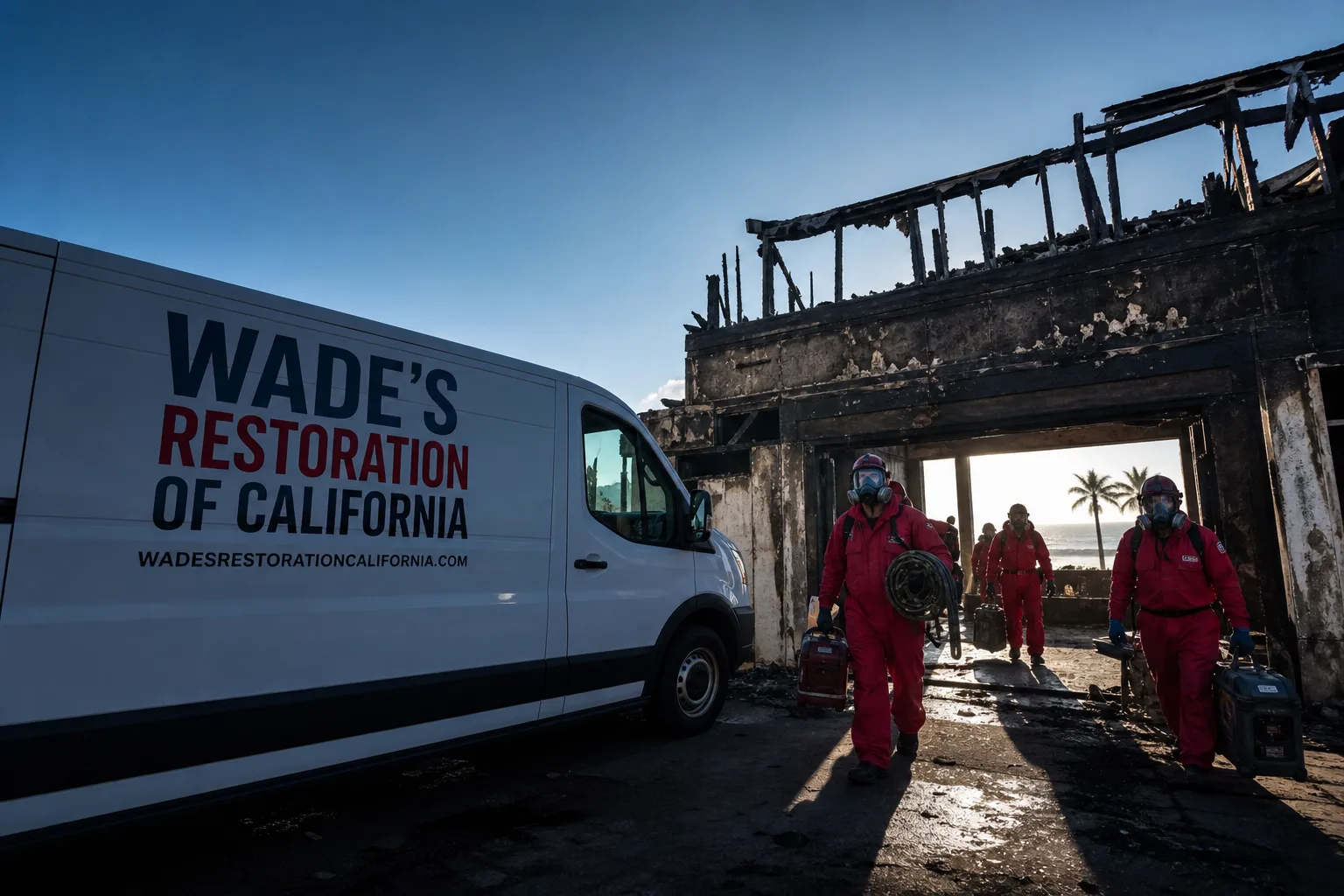
Storm & Disaster Restoration in Norwalk: What It Costs and What Actually Happens on a 1950s Slab Home
Storm and disaster restoration in Norwalk typically runs $2,800-$11,500 depending on how much water entered the home and whether the house was built before 1980. The older the home, the more the job costs and the longer it takes, because Norwalk’s 1950s-1970s slab-on-grade tract housing brings asbestos-era materials into nearly every flood or storm cleanup. That’s not true in Cerritos or most of Bellflower. It’s true on almost every street in Norwalk’s 90650 and 90651 zip codes. If water is inside your house right now, call (855) 915-0646 and Wade will answer.
How Fast Can a Crew Reach My Norwalk Home?
Wade heads out as soon as you hang up. For homes off Pioneer Boulevard, Firestone, or Rosecrans, we’re usually on scene within 45-60 minutes. Norwalk is a compact city. You’re never more than a few miles from the 605 or the 5, and we stage equipment locally when a storm front is moving through LA County.
Speed matters on storm damage in Norwalk for one reason most people don’t think about until it’s too late: water sits on a slab foundation differently than it does on a raised floor. In a raised-floor home, water drains downward into the crawl space. In a Norwalk slab home, the water has nowhere to go. It pools. It wicks into drywall. It works its way under baseboards and into the original 1950s flooring. Every hour it sits, the restoration scope expands.
That’s why Wade answers his own phone at 2 a.m. and can have extraction running before sunrise. Not an answering service. Not a call center. Wade. If you’ve already called a national outfit in Norwalk and got a call center in another state, you already know the difference.
Why Norwalk Homes Turn Routine Storm Cleanup Into a Regulated Restoration Job
Here’s the thing about Norwalk that a generic Storm & Disaster Restoration page won’t tell you. Most of the city’s homes went up between 1950 and 1975. That means slab-on-grade foundations, original galvanized supply lines under the concrete, and building materials that were perfectly legal at the time and are now a legal headache the moment water touches them.
The big one: 9″×9″ vinyl asbestos floor tiles. In Norwalk, these tiles hide under carpet, under linoleum, under the peel-and-stick someone put down in 1992. When storm water soaks through the flooring, the carpet comes up. Then we find the tiles. Legally, all demolition work stops right there. We can’t pull water-damaged flooring, can’t start structural drying of that area, can’t move forward until a licensed abatement contractor assesses and clears the material. This is not a delay Wade invented. It’s a regulatory reality written into California asbestos law, and it hits Norwalk harder than almost anywhere else in LA County simply because of when the houses were built.
We responded to a 1958 slab-on-grade home off Pioneer Boulevard after a storm overwhelmed the flat drainage and sent water through the front door. As our crew pulled saturated carpet, we uncovered the original 9″×9″ vinyl asbestos tiles beneath. Work stopped immediately. We coordinated a licensed abatement contractor before completing structural drying with Dri-Eaz and Injectidry equipment. The homeowner had no idea the tiles were there. That’s common in Norwalk. It’s also why Wade carries moisture readings every single day and hands you the full log when the job is done. You should know exactly what was found, what was tested, and what was done about it.
What Storm & Disaster Restoration in Norwalk Actually Involves
Every storm job in Norwalk starts the same way: a walkthrough, a written scope, and a plan. That written scope is part of Wade’s 90-Day Done Right Promise. If it’s not done right, he makes it right. In writing. No fine print that evaporates when you call back.
For Norwalk specifically, here’s what the work looks like.
Storm Damage Cleanup
Wind and rain push water through doors, windows, and roof penetrations. Debris from the 605 corridor and residential streets ends up in yards and against exterior walls. We remove it, document the damage for your insurance carrier, and start drying the structure. In Norwalk’s stucco-clad tract homes, we pay special attention to window sills and door thresholds. Stucco wicks water upward and outward. What looks like a small stain on the interior drywall often means water has traveled several feet inside the wall cavity.
Flood Damage Restoration
This is the big one in Norwalk. Atmospheric river events overwhelm the flat terrain drainage. Coyote Creek and the San Gabriel River back up in heavy rain, and portions of the city sit in FEMA-designated Special Flood Hazard Areas. Streets flood. Water comes through the front door and garage. Because most Norwalk homes are slab-on-grade, the water pools instead of draining. Extraction has to happen fast, and the drying plan has to account for the fact that there is no crawl space below the floor. We use Phoenix and Dri-Eaz equipment configured for slab drying, and Wade takes moisture readings daily.
Emergency Board-Up
When wind takes out a window or a door, we board it up the same night. Norwalk’s older homes often have original single-pane windows in aluminum frames. Those frames bend. The glass shatters. Boarding isn’t just about keeping rain out. It’s about keeping animals out, keeping the house secure, and keeping your insurance claim clean. We document the damage with photos before we touch anything. Your adjuster gets direct communication from Wade. You don’t have to relay messages back and forth.
Roof Tarping
Flat and low-slope roofs are common on Norwalk’s post-war tract homes. Santa Ana winds in the fall tear up shingles and peel back rolled roofing along Firestone and Rosecrans. We tarp the damaged area same-day, before the next rain turns a roof problem into a ceiling problem. The tarp is a temporary fix. It buys time for a proper roof repair or replacement. Wade will tell you that himself.
Trusted Brands We Use on Norwalk Jobs
Wade’s crew runs professional-grade equipment from Dri-Eaz and Phoenix on every Norwalk storm job. Those aren’t rental-counter machines. They’re commercial restoration units built for the exact conditions we see in LA County: stucco walls, slab floors, and drywall that’s been sitting wet for hours before anyone noticed. We stock common replacement parts for Norwalk’s older housing stock and coordinate directly with suppliers when something specific has to be ordered. Wade is IICRC-certified and affiliated with the RIA and IFA. If you want to check credentials, ask. He’ll show you.
Common Storm & Disaster Restoration Problems in Norwalk Homes
- Slab-leak flooding during heavy rain. Original galvanized supply lines under Norwalk’s concrete slabs have been corroding for decades thanks to LA County’s hard water. When heavy rain saturates the ground, shifting pressure finishes off weakened pipes. Water floods the slab from below before anyone detects a leak. This is one of the most common causes of storm-season flooding in 90650 and 90651.
- Asbestos discovery mid-job. Pulling water-damaged carpet or linoleum in a 1950s-60s Norwalk home often reveals original 9″×9″ vinyl asbestos tiles. Legally, demolition stops. Drying is delayed until an abatement contractor clears the material. Homeowners are almost always surprised by this because the tiles have been hidden for decades.
- Asbestos-laden drywall wicking. Storm water wicks up into original drywall compound in Norwalk’s older walls. Even a minor flood cut-just the bottom 12 to 24 inches of wall-can require asbestos testing before tearout. In newer neighboring cities like Cerritos, this is rarely an issue. In Norwalk, it’s routine.
- Flat terrain drainage failures. Norwalk sits on flat ground adjacent to Coyote Creek and the San Gabriel River. When atmospheric river storms hit, the aging drainage infrastructure can’t move water fast enough. Streets flood, and that water finds the low point: your front door or garage slab.
Pricing for Storm & Disaster Restoration in Norwalk, CA
Here are honest numbers for the Norwalk market. These are the ranges Wade quotes before he sets foot in your house, and he’ll put them in writing.
- Storm damage cleanup (no structural drying needed): $900-$2,800
- Flood damage restoration with extraction and structural drying: $3,500-$9,500
- Emergency board-up per opening: $250-$600
- Roof tarping (typical single-family home): $450-$1,200
- Asbestos assessment and abatement coordination: Wait for the abatement contractor’s quote-it’s a separate licensed trade, and Wade will be straight with you about that.
What changes the price in Norwalk? Whether asbestos tiles appear. Whether the flood was from a burst slab line or surface water. How long the water sat before it was discovered. A 1958 home off Imperial Highway with water from a slab leak and hidden VAT will cost more than a 1990s home off Alondra with clean stormwater entry. That’s just the truth. Call (855) 915-0646 for a free estimate. There’s no trip charge inside our county.
Insurance: Who Deals With the Adjuster?
Wade does. Directly. You hired a restoration contractor, not a part-time negotiator. Wade has been coordinating with insurance adjusters on Norwalk storm and flood claims for years. He provides photo documentation, written scopes, and moisture logs. He talks to the adjuster on your behalf. You get copied on everything. The goal is simple: your claim is settled based on what actually happened, not what someone guesses happened.
Norwalk homeowners often ask us whether insurance covers storm damage. Most homeowner policies cover sudden storm damage, including wind-driven rain and flood damage from a burst pipe. Surface flooding from rising creeks or rivers is a different story-that depends on flood insurance. We can’t promise what your policy says. We can promise that Wade will document everything properly and fight for the scope that’s actually needed.
We Also Serve Cities Near Norwalk
Wade’s crews work throughout southeast LA County. If you’re in Cerritos, Artesia, Bellflower, or Santa Fe Springs, we handle storm and disaster restoration there too, with the same written scope and the same 90-Day Done Right Promise. The asbestos-era housing issues we see in Norwalk also show up in parts of Artesia and Santa Fe Springs, though less consistently than in Norwalk’s core tract neighborhoods.
Serving Norwalk, CA - Our Local Coverage Area
We’re based in the Norwalk area and know this community well. Use the map below to see our service coverage - if you’re nearby, we can almost certainly help.
FAQs - Storm & Disaster Restoration in Norwalk
Because Norwalk’s 1950s-1970s homes frequently have original 9″×9″ vinyl asbestos floor tiles hidden under carpet or linoleum. Legally, California asbestos regulations require a licensed abatement contractor to assess and clear the material before any demolition continues. This stops structural drying and tearout until the abatement is complete. It’s not a choice Wade makes. It’s the law. Call (855) 915-0646 and we’ll walk through exactly what to expect if this comes up on your job.
We coordinate it, but we don’t do the abatement ourselves. Asbestos abatement is a separate licensed trade. When we find suspect material on a Norwalk storm job, we stop demolition, photograph everything, and bring in a licensed abatement contractor to test and clear the area. Wade stays on top of the timeline and keeps your insurance adjuster informed. You’re never left guessing about who’s doing what.
The original galvanized supply lines under Norwalk’s concrete slabs have been corroding for decades from LA County’s hard water. During heavy rain, saturated ground shifts and puts pressure on weakened pipes. They fail. Water floods the slab from below, with no visible roof leak or exterior water entry. This is a Norwalk-specific failure pattern tied to the city’s post-war construction era. Extraction and slab drying have to begin fast.
We run Dri-Eaz and Phoenix drying equipment configured for slab structures, and we take daily moisture readings that go into a log you receive at the end of the job. Before we pull any flooring or cut any drywall that might contain asbestos, we stop and test. Drying continues in areas that are cleared. Areas waiting on abatement are sealed off. The log shows exactly what was dry, what was wet, and when it changed.
It affects how fast water accumulates, not how fast we respond. Norwalk’s flat terrain and aging drainage mean street flooding can go from puddle to front-door intrusion in under an hour during an atmospheric river event. Wade stages equipment locally when a big storm is forecast. We’re typically on scene in 45-60 minutes for Norwalk addresses. Call (855) 915-0646 when the water’s rising.
Call Wade’s Restoration of California in Norwalk
If water’s in your house, call now. Wade answers. If you’re getting quotes and want a straight read on whether the first one was fair, call for a free second opinion on any written estimate. Senior and veteran? There’s a permanent 10% discount. No trip charge inside the county. No call center. Just Wade and his crew, with a written scope and a 90-day promise on the work. Call (855) 915-0646.
Written by Wade Ferris, Owner at Wade’s Restoration of California, serving Norwalk and southeast LA County since 2007.