
Storm & Disaster Restoration in Hollywood: What It Costs and How Fast We Can Get There
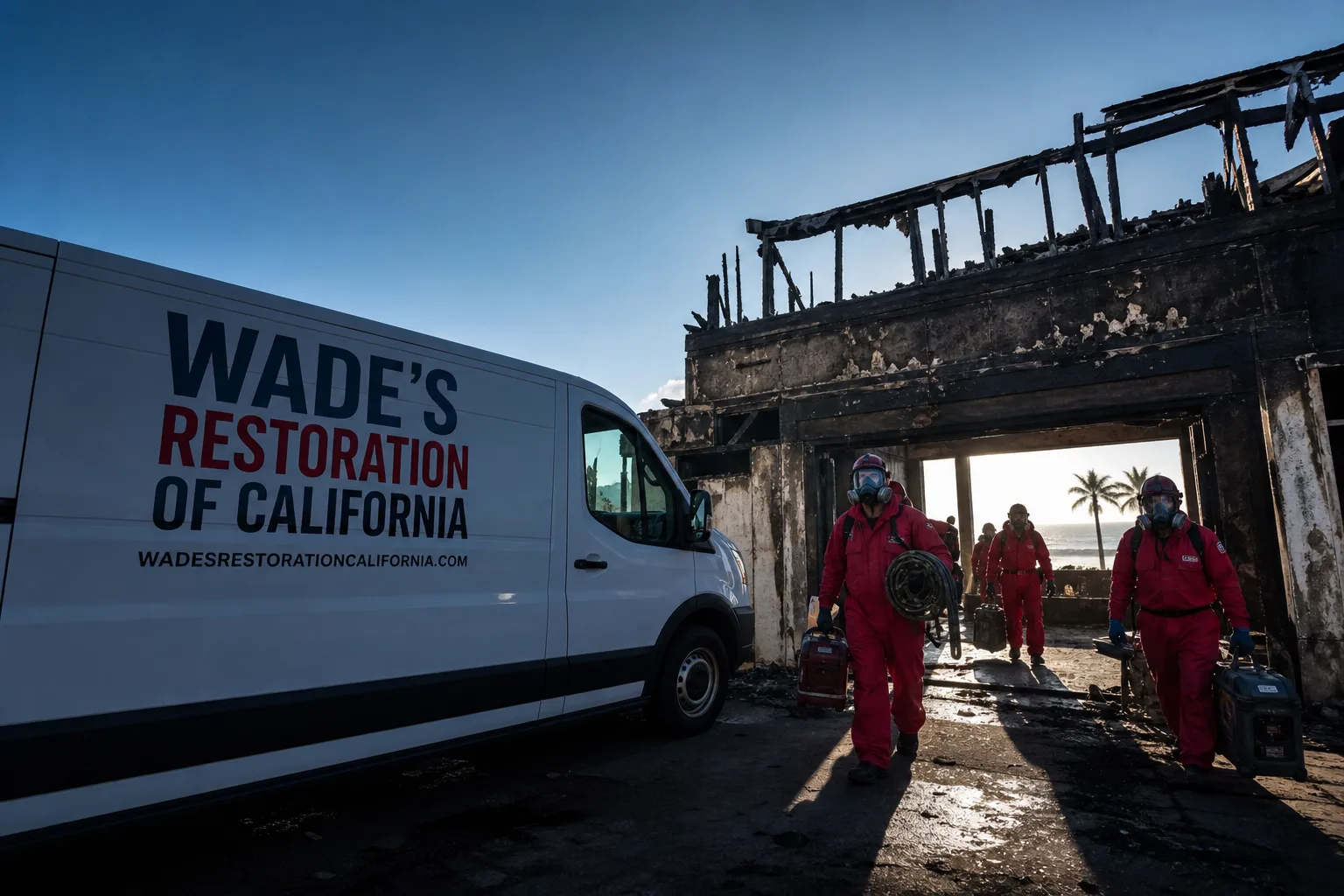
Storm damage in Hollywood usually means water where it shouldn’t be, wind tearing at roofs, or smoke pushing down from the hills. Most jobs in the 90028 ZIP run between $2,800 and $9,500 depending on whether we’re drying plaster walls, tarping a roof, or doing full debris removal. Our Storm & Disaster Restoration team can be on site in Hollywood within the hour, and Wade answers his own phone at (855) 915-0646 when you call.
What makes Hollywood different from every other LA neighborhood we work in is the collision of two things. The Hollywood Hills rise directly above the flatlands, so Santa Ana winds drive embers and smoke down into dense pre-war courtyard apartments. And those apartments are almost all 1920s to 1940s plaster-and-lath construction, which means California-mandated asbestos and lead testing has to happen before we touch a single wall. You don’t get that combination in West LA or the Valley. You get it here, every single storm season.
Storm & Disaster Restoration Across Hollywood’s Older Housing Stock
Hollywood’s 90028 corridor is packed with the courtyard apartment buildings that defined the neighborhood in the 1920s through 1940s. Six to twenty units, shared plumbing stacks, original galvanized or cast-iron supply lines, and wall assemblies made of plaster over wood lath. Interspersed among them are Spanish Colonial Revival bungalows, many subdivided over the decades. Both building types present the same challenge after a storm: water and smoke move through them differently than in modern drywall construction.
Plaster traps moisture invisibly. A wall can feel dry to the touch while holding 40% moisture content inside. Drywall gives you obvious signs: sagging, staining, softness. Plaster doesn’t. It just sits there, wet, feeding mold growth for weeks until someone notices the smell. That’s why we take moisture readings every single day on these jobs and hand you the full log when we finish. Almost nobody in this trade does that, and it matters more in Hollywood than anywhere else because the housing stock is so uniformly old.
The other piece is regulatory. Any structure built before 1978 in California requires asbestos and lead testing before demolition or tear-out work begins. That’s not optional. It’s state law. On a modern drywall job in a newer building, we can start cutting the same day. On a Hollywood courtyard apartment, we schedule the testing, wait for the lab results, document everything, and then start work. It adds two to three days to the front end of the job. Good restorers plan for it. Bad ones skip it and put everyone at risk.
Why Hollywood Homeowners Call Wade’s Restoration First
Wade Ferris started this company in 2007, and his name is on the truck. His address is published. His license number is published. When you call at two in the morning because a storm just put a tree limb through your roof, the person who answers is Wade. Not a call center. Not a national chain’s dispatch queue. Wade. He’ll be the one who shows up, not a crew you’ve never met and will never see again.
Hollywood homeowners have been burned by national outfits before. The pattern is familiar: a quote on the phone that sounds reasonable, then a crew shows up and suddenly the price doubles. Wade competes on transparency instead. You get a written scope of work before anything starts. You get documented moisture logs. You get direct adjuster communication, which means Wade deals with the insurance company so you don’t have to relay information back and forth between two sides that don’t talk to each other.
Every water, fire, and mold restoration job carries the 90-Day Done Right Promise. If it’s not done right, Wade makes it right, in writing. That’s stamped on the contract. And if you’ve got a written estimate from another company, bring it in. We’ll give you a free second opinion on it. No charge for that.
Our Storm & Disaster Restoration Services in Hollywood
Storm Damage Cleanup
Storm cleanup in Hollywood usually means dealing with what the Santa Anas blew in or what the first hard rain pushed down from Beachwood Canyon and Whitley Heights. We handle fallen debris, water extraction, saturated materials removal, and the full drying protocol. On hillside properties especially, we look at drainage first, because hydrophobic soil from prior fire seasons means water moves faster and pools harder than it would on flat ground. Typical storm cleanup in Hollywood runs $1,800 to $4,500 depending on square footage and how much debris is involved.
Flood Damage Restoration
When Hollywood’s winter rains arrive, they arrive hard. Drainage systems in hillside neighborhoods get overwhelmed fast, and foundation intrusion follows. We extract standing water, set up professional-grade drying equipment from Dri-Eaz and Phoenix, and monitor moisture daily until the structure is truly dry. For Hollywood’s plaster walls, that means extended drying timelines with Injectidry panels and penetrating airflow, because standard drywall protocols simply don’t work here. Flood damage restoration in Hollywood typically runs $3,200 to $8,000 for a single-unit job.
Emergency Board-Up
After a storm blows out a window or a tree limb opens up a roof, the first priority is securing the building against further damage and intrusion. We board up broken openings with plywood and framing that meets code, and we get there fast. The second priority in Hollywood’s pre-war buildings is understanding what we’re boarding up against: if smoke and soot got pulled into the walls during a fire-adjacent storm, we document it before sealing anything up, because that documentation matters for your insurance claim later. Emergency board-up in Hollywood runs $450 to $1,200 depending on the number and size of openings.
Roof Tarping
A torn roof on a 1930s Spanish Colonial Revival bungalow needs immediate tarping before the next rain hits. We use heavy-duty tarps secured with proper anchoring, not just nails that pull out in the next wind event. On hillside properties in Beachwood Canyon or Whitley Heights, we account for runoff patterns and soil conditions when we set the tarp, because a tarp that directs water toward the foundation creates a bigger problem than the one it solved. Roof tarping in Hollywood runs $600 to $1,800 depending on roof pitch, accessibility, and damage extent.
What happens when you call
- 1
A real person answersNo phone trees - you reach a local pro.
- 2
You get an upfront price rangeHonest numbers before anyone is dispatched.
- 3
A background-checked tech heads outLicensed & insured, dispatched right away.
- 4
You approve before work beginsNothing starts until you say go.
Common Storm & Disaster Restoration Problems We See in Hollywood Homes
- Plaster walls that look dry but aren’t. Original Hollywood plaster holds moisture invisibly for weeks. We see homeowners and even some restorers pull drying equipment too early, only to discover mold growing six weeks later. Our daily moisture readings and extended drying protocols prevent this.
- Drainage overwhelmed on hillside properties. Beachwood Canyon and Whitley Heights homes sit on slopes where hydrophobic soil from past fire seasons accelerates runoff. Water bypasses drainage channels and enters foundations in places flat-grid neighborhoods never see. Proper tarping and grading assessment matters here.
- Multi-unit water migration through shared plumbing stacks. In a 1920s courtyard apartment, a supply-line failure in one unit can silently travel through common plumbing chases and into adjacent units before anyone notices. We isolate the source and document the full extent before drying begins.
- Smoke damage from hillside fires pulled into pre-war wall cavities. Santa Ana winds drive embers and smoke down from the Hollywood Hills into the flats. That smoke gets sucked into plaster-and-lath walls through gaps and cracks. Cleaning it properly requires understanding how smoke behaves in dense, older wall assemblies, not just wiping down surfaces.
Pricing for Storm & Disaster Restoration in Hollywood, CA
What moves the cost: square footage, whether asbestos and lead testing delays tear-out, how long the plaster takes to dry, and whether we’re working in a multi-unit building with shared systems. We’ll give you a written scope before anything starts, and estimates are free. Call (855) 915-0646 and Wade will walk you through it.
We Also Serve Cities Near Hollywood
If you’re in Universal City, West Hollywood, Koreatown, or Echo Park, we cover those areas too. The same team, the same equipment, the same 90-Day Done Right Promise. And we’re already familiar with the building stock and drainage patterns across the whole corridor. If you’re outside Hollywood proper, call (855) 915-0646 and Wade will tell you straight whether we can get there fast enough to matter. We regularly work across the Hollywood area and the neighborhoods that surround it.
Serving Hollywood, CA - Our Local Coverage Area
We’re based in the Hollywood area and know this community well. Use the map below to see our service coverage - if you’re nearby, we can almost certainly help.
FAQs - Storm & Disaster Restoration in Hollywood
Why does every storm-damage job in a pre-war Hollywood courtyard apartment need asbestos and lead testing before you can even start drying?
California law requires asbestos and lead testing on any pre-1978 building before demolition or tear-out begins. Almost every courtyard apartment in Hollywood’s 90028 ZIP falls into that category. We schedule the testing before we cut into walls, wait for lab results, and document everything. It adds two to three days to the front end, but skipping it risks regulatory fines and health exposure. Call (855) 915-0646 if you’re not sure whether your building is affected.
After a sudden winter rain, water poured down the hill and entered my Beachwood Canyon bungalow through the foundation. What makes this different from a typical flat-ground flood?
Hillside soil in Hollywood is often hydrophobic from prior fire seasons, which means it repels water rather than absorbing it. Runoff moves faster and concentrates in drainage channels that were never designed for that volume. The water enters foundations at pressure points that flat-grid homes don’t experience. We account for that when we set up drying and tarping, and we document the soil conditions for your insurer. It’s a different job than a flooded slab on Wilshire.
How do you prove to an insurer that Hollywood plaster walls need longer drying than drywall?
Insurers are accustomed to drywall drying timelines, and they frequently dispute scope on plaster jobs. We document plaster density, the absence of a vapor barrier, and daily moisture readings using penetrating meters. We hand you the full log at the end of the job. When the insurer sees the data showing moisture trapped deep in the plaster weeks after a drywall job would have been done, they approve the extended drying scope. That almost never comes up in post-1980 construction neighborhoods. In Hollywood, it’s every job.
I live in a 1920s subdivided Spanish Colonial Revival bungalow. After a storm, smoke and soot got pulled into the walls. Can you clean it without tearing out all the original plaster?
In many cases, yes. Smoke that gets pulled into plaster-and-lath walls can be addressed with aggressive HEPA air scrubbing, surface cleaning, and sealing, provided the plaster itself is intact. We assess the wall condition first, document the smoke infiltration, and only recommend tear-out where the plaster is compromised. Preserving original materials matters in Hollywood, and we’d rather save them than replace them. Call (855) 915-0646 for a free assessment.
After a storm, multiple units in our Hollywood courtyard apartment share plumbing stacks. How do you keep a water-damage job in one unit from becoming a building-wide disaster?
Shared plumbing stacks mean water from a single supply-line failure can travel through common chases and into adjacent units before anyone notices. We isolate the source first, then inspect adjacent units for hidden moisture migration. We document the full extent, notify the building owner, and set up drying in every affected space, not just the unit where the leak started. That early documentation is what keeps the claim from turning into a building-wide fight later.
Contact Wade’s Restoration for Storm & Disaster Restoration in Hollywood
If you’ve got storm damage in Hollywood and you’re not sure what to do next, call us. Wade answers his own phone at (855) 915-0646, and he’ll tell you straight whether you need emergency board-up, roof tarping, or full water extraction. He’ll be there himself. He’ll document everything. And he’ll deal with your adjuster so you don’t have to. Free estimates, no trip charge inside the county, and a written scope before any work starts.
Written by Wade Ferris, Owner at Wade’s Restoration of California, serving Hollywood and the surrounding areas since 2007.