
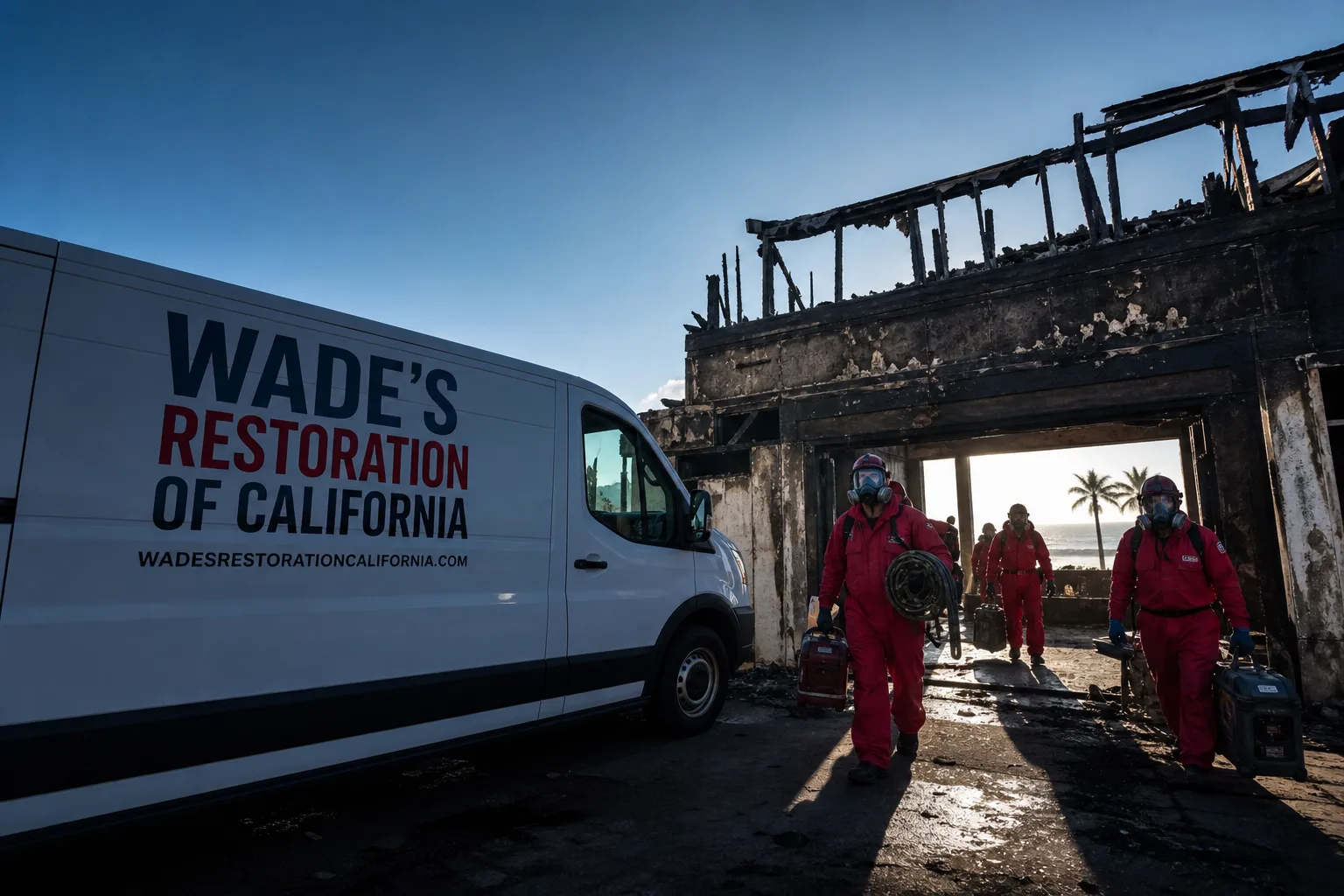
Fast, Reliable Reconstruction & Cleanup Across Montebello
When a pipe bursts inside a 1950s Montebello bungalow or a slab leak soaks the subfloor under your vinyl, you need a crew that knows exactly what they’re walking into before they cut the first hole. That’s us. Wade’s Restoration handles full Reconstruction & Cleanup work in Montebello with an eye for the specific problems this city’s homes throw at you: skimmed-over earthquake cracks, corroded galvanized lines, and mold colonies hiding under floors that were “fixed” decades ago. Call (855) 915-0646 and you’ll talk to Wade himself, not a call center. He answers his own phone, day or night.
Why Montebello Homeowners Call Wade First
Montebello is a different animal from the newer flatland tracts in Commerce or Bell Gardens. Most of the houses here went up between 1945 and 1970, and they’ve been through things newer homes haven’t. Wade Ferris has been working this area since 2007, long enough that his crews can spot the signs of a 1987 Whittier Narrows crack that got skimmed over with a coat of paint instead of actually sealed. That’s not a detail you learn from a franchise training video. That’s what happens when the owner is the one walking your property and writing your scope.
Montebello homeowners call us because they’d rather deal with a person than a rotating cast of subcontractors. Wade’s cell number is on the truck. He’s local. When he says he’ll be there, he means he’ll be there himself, not “someone from our team.” Our crews know the blocks off Whittier Boulevard, the hillside streets near the Montebello Hills, and the flatland neighborhoods near the Rio Hondo. We don’t need GPS to know that a downslope foundation on a hillside home drains differently than a flatland slab on a corner lot.
Our Reconstruction & Cleanup Services in Montebello
Here’s what we actually do, the way we do it in Montebello.
Full-Service Reconstruction
When water, fire, or a failed structural repair has compromised your Montebello home, we rebuild it the way it should have been built the first time. That means opening walls to expose what’s underneath, replacing rotted sill plates and corroded plumbing, then putting it back together to current seismic and moisture standards. In a 1950s stucco home, that’s a completely different job than a patch-and-paint on a 1990s production tract. We handle everything from framing and insulation to drywall, texture matching, paint, trim, and flooring.
Drywall & Flooring Repair
This is the bread-and-butter work that follows most Montebello water losses. A cast-iron drain cracks under a slab, water wicks up through the concrete, and before you know it the vinyl floor is warped and the drywall at the base of the wall is crumbling. We don’t just replace what got wet. We check what got wet underneath it, because Montebello’s older homes hide damage in layers. If a 1987 seismic crack was skimmed over and moisture has been traveling behind the stucco for years, we open that crack, seal it from the exterior, and then rebuild the interior wall so it doesn’t fail again in eighteen months.
Contents Restoration & Pack-Out
When we need to remove damaged drywall and subfloor, your belongings need somewhere safe to go. We do pack-outs for Montebello homeowners the right way: inventory, photograph, pad, wrap, and transport to a clean dry facility. Then we restore what’s restorable, clean what’s cleanable, and document every item for your insurance adjuster. You’ll get a full item-by-item log at the end. That matters when the insurance company asks questions, and it matters when you’re trying to remember whether the china cabinet went to storage or got set aside for restoration.
Carpet & Upholstery Cleaning
Not every water event means full reconstruction. A minor overflow that was stopped fast often leaves carpet and upholstery that need professional extraction, drying, and sanitizing. We run Dri-Eaz and Phoenix equipment to get moisture out and keep mold from getting a foothold. In Montebello’s older homes, where carpet is often laid on concrete slab, under-pad drying is the part that matters most. Most crews skip that step. We don’t, because skip it once and you’ll smell it every winter for the next five years.
What happens when you call
- 1
A real person answersNo phone trees - you reach a local pro.
- 2
You get an upfront price rangeHonest numbers before anyone is dispatched.
- 3
A background-checked tech heads outLicensed & insured, dispatched right away.
- 4
You approve before work beginsNothing starts until you say go.
Common Reconstruction & Cleanup Problems We See in Montebello Homes
- Skimmed-over Whittier Narrows cracks. After the 1987 earthquake, a lot of Montebello homeowners patched hairline stucco cracks with caulk and paint instead of opening and properly sealing them from the exterior. Those cracks have been channeling moisture behind the stucco for thirty-plus years. By the time we open the wall, the sill plate is often rotted and the insulation is saturated.
- Corroded galvanized supply lines. Montebello’s moderately hard water eats at the inside of original galvanized steel pipes. The outside looks fine. The inside is a rusted, pin-holed mess waiting to fail. We see slow leaks inside wall cavities that only show up as bubbling paint or a musty smell after the wood framing has already started to rot.
- Subfloors that were never truly dried. If your Montebello home flooded in the 1990s and the owner at the time just laid new vinyl or laminate over the old subfloor without proper drying, there’s a good chance mold is still there. We find this constantly in the flatland blocks near the Rio Hondo corridor. New flooring laid on top just traps the problem and makes it worse with every winter rain.
- Slab cracks from expansive clay soil. Montebello’s soil shrinks hard in the long dry season and swells when the winter rains come. That cycle cracks slabs over time. Those cracks admit water aggressively during storms, especially on downslope lots where runoff from the Montebello Hills pushes against foundations.
Pricing for Reconstruction & Cleanup in Montebello, CA
We Also Serve Cities Near Montebello
We work throughout the San Gabriel Valley and neighboring communities, including Pico Rivera, South San Gabriel, East Los Angeles, and Monterey Park. If you’re near Montebello, we’re close. Call (855) 915-0646 and Wade will tell you straight when he can be there.
Serving Montebello, CA - Our Local Coverage Area
We’re based in the Montebello area and know this community well. Use the map below to see our service coverage - if you’re nearby, we can almost certainly help.
FAQs - Reconstruction & Cleanup in Montebello
How do I know if the hairline cracks in my Montebello stucco are from the 1987 earthquake and need more than a caulk fix before I repaint?
If the crack runs diagonally from a window corner, follows a stair-step pattern along mortar lines, or has widened since you first noticed it, it’s likely from the 1987 Whittier Narrows event and has probably been channeling moisture behind your stucco for decades. A caulk-and-paint fix only hides the problem. The crack needs to be opened, cleaned, and sealed from the exterior, and you need a moisture reading behind the wall to know what’s already wet. Call (855) 915-0646 and we’ll check it with a moisture meter before you spend a dime on paint.
Why does my 1950s Montebello ranch home get a musty smell under the vinyl flooring every winter even though I had the floors replaced?
Because the subfloor underneath was probably never dried after an earlier flood or plumbing event. In Montebello’s older flatland homes, especially near the Rio Hondo corridor, we find this all the time. New flooring laid over damp, moldy subfloor traps the moisture and the smell comes back with every seasonal rise in humidity. The fix is pulling the flooring, remediating the subfloor, and verifying it’s dry with daily moisture readings before anything new goes down. Call Wade at (855) 915-0646 for a free assessment.
Can you match the original 1940s drywall texture and baseboard profile when you open up my Montebello bungalow wall for a pipe repair?
Yes. That’s a standard part of our drywall repair process. Montebello bungalows from the 1940s and 1950s often have skip-trowel, knock-down, or hand-troweled textures that are tricky to blend if you’ve never done it. We match the texture, the sheen, and the baseboard profile so the repair disappears into the rest of the wall. If the baseboard is original redwood or fir, we’ll salvage what we can and match what we can’t.
Is it better to retrofit my old Montebello home’s original cast-iron drains now or wait until they crack under the slab again?
It depends on condition, but here’s the honest truth: Montebello homes from the post-war era are at the age where cast-iron drains are failing on a steady schedule. If you’ve already had one crack under the slab, you’re likely to have another. A sewer camera inspection costs a few hundred dollars and shows you exactly what you’re dealing with. If the line is heavily scaled and pitted, a retrofit now saves you a slab break-out, floor replacement, and mold remediation later. We’ll show you the camera footage and let you decide.
What should I do with my belongings while you tear out the damaged drywall and subfloor in my Montebello home after a pipe burst?
We handle it. Before we start demolition, we’ll pack out the affected rooms: inventory every item, photograph it, wrap it, and move it to a clean dry storage area. Furniture and larger pieces get padded and protected in place or moved depending on the scope. Everything is documented on a log you can hand straight to your adjuster. You don’t move a thing unless you want to.
Written by Wade Ferris, Owner at Wade’s Restoration of California, serving Montebello since 2007.