
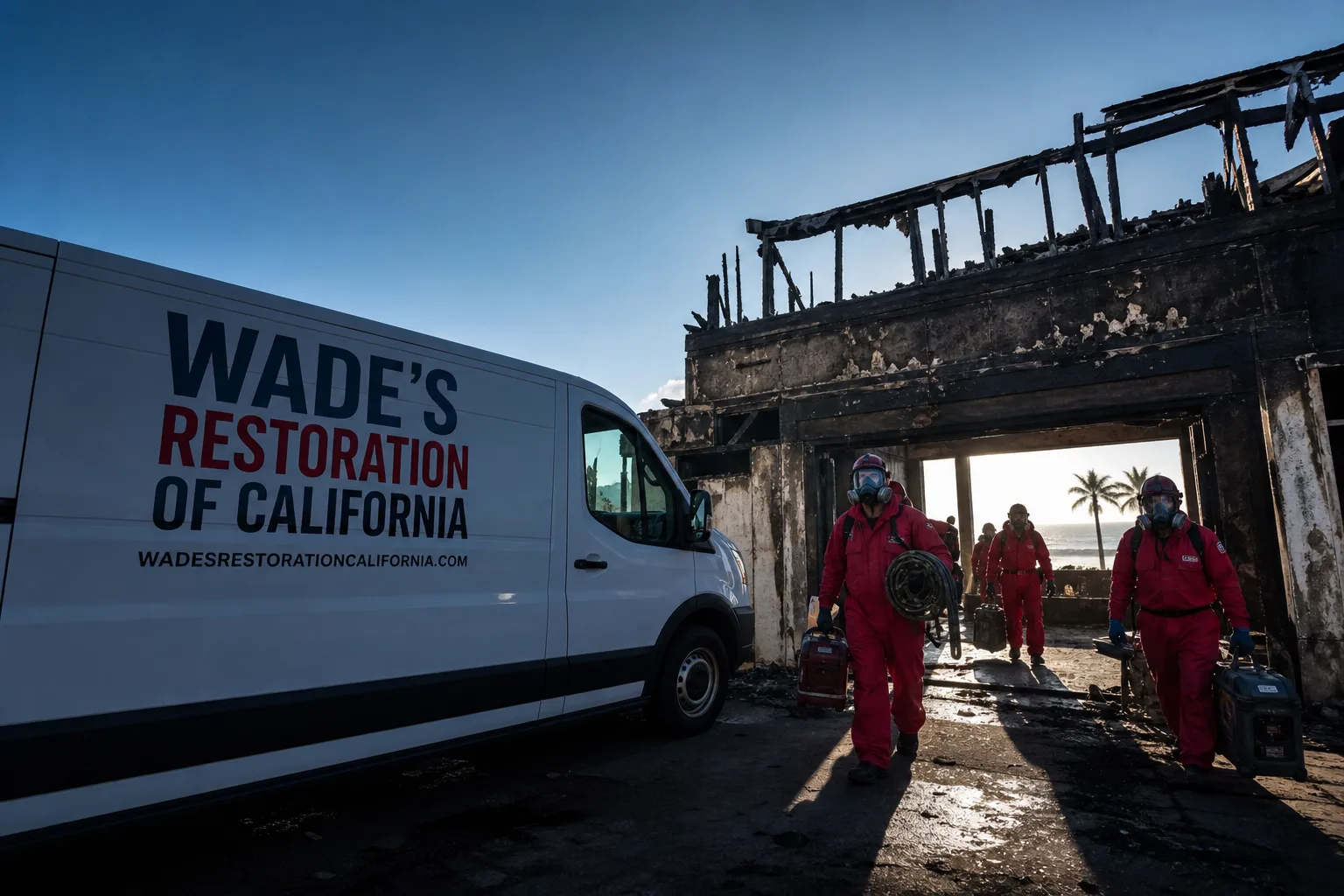
Fast, Reliable Reconstruction & Cleanup Across Alhambra
Reconstruction and cleanup in Alhambra after a storm, a flood, or a long-hidden leak usually means one of two things: the damage is already spreading behind original lath-and-plaster walls, or a wind event just tore something open and water got in while you were still deciding who to call. Most jobs we see in Alhambra run $2,800 to $9,500 depending on what’s behind the wall, and the timeline is almost always driven by how fast the wet materials come out. Call (855) 915-0646 and Wade Ferris himself will answer. He’s the owner, not a call center, and he’ll tell you straight what needs to happen next.
Every hour a wet floor cavity sits sealed behind plaster in a 1920s bungalow, the framing keeps pulling moisture inward. We’ve torn open walls on Main Street and found subfloor rot from a pinhole leak that started six months earlier. Alhambra housing was built to outlive us, but not always to dry itself out.
Why Wade’s Restoration of California Is Alhambra’s Preferred Reconstruction & Cleanup Company
Wade founded this company in 2007 and never turned it into a franchise or an answering service. The name on the truck is the person with his own phone to his ear, 24 hours a day. Homeowners in Alhambra routinely call after a bad experience with a national outfit that quoted one price over the phone and a different one at the door. Wade won’t do that. He writes the scope down before work starts, and if it isn’t done right, the 90-Day Done Right Promise says he makes it right, in writing, on every water, fire, and mold restoration job we touch.
When Alhambra customers call at 2 a.m. with water coming through a front door jamb or a floor drain backing up, the goal is simple: Wade heads out, extraction running inside the hour, and a moisture reading logged before sunrise. Background-checked, uniformed technicians run the equipment, and Wade hands the homeowner a full daily moisture log at the end of every job. Almost nobody in this trade does that. It costs us time and costs you nothing. Ask anyone on your street who’s dealt with a flood in Alhambra: the company that shows up with the written log is the one you call back.
Reconstruction & Cleanup Services in Alhambra
The work we do under Reconstruction & Cleanup in Alhambra is not one-size-fits-all. A 1950s stucco bungalow near the library needs a different approach than a 1930s Spanish Colonial Revival two blocks off Valley Boulevard. We match the repair to the house, not to a playbook.
Full-Service Reconstruction
When water, fire, or a failed structural component has taken a wall, a floor, or a section of framing, we rebuild it to Alhambra’s current code and wind-load expectations. On older homes with original lath and plaster, that often means opening more square footage than the surface damage suggests to check the framing behind it. We cut out what’s compromised, dry the cavity, and rebuild with drywall, insulation, and trim that match the room. If asbestos is suspected in floor tile or popcorn texture, we coordinate abatement before demolition starts, because Alhambra’s 1920-to-1960 housing stock carries that risk more often than most cities in the San Gabriel Valley.
Drywall & Flooring Repair
Wet drywall wicks moisture upward, and by the time a stain shows on the baseboard, the water has usually traveled a foot or more behind the paper face. In Alhambra, where original lath-and-plaster walls act as a water reservoir rather than a moisture barrier, we take readings at multiple heights before deciding what gets cut. We match floor patches to the surrounding oak or fir, and on postwar tract homes with original tongue-and-groove subfloors, we replace only the rotted boards and sister new framing where needed. You don’t pay for a full floor replacement just to satisfy an algorithm or an adjuster’s checklist.
Contents Restoration & Pack-Out
When a bedroom wall or kitchen cabinet gets wet, we inventory, photograph, and pack out the affected contents before demolition begins. Alhambra homes from the 1940s and 1950s often hold furniture and papers that have been in the family for two generations. We document those items individually, restore what can be restored, and give you a written list of what left the house and what came back. That documentation goes straight to your adjuster, which keeps the claim moving without you relaying messages between two sides.
Carpet & Upholstery Cleaning
Post-flood or post-fire, carpet and upholstery hold contaminants that a standard cleaning leaves behind. We run professional-grade extraction and cleaning equipment, with drying logged using Dri-Eaz and B-Air equipment, and we tell you honestly when something is worth cleaning versus replacing. In older Alhambra homes, a 60-year-old wool rug sometimes cleans better than new polypropylene, but we won’t pretend a flooded pad is recoverable just to save you money today. It’ll cost more later if it molds.
What happens when you call
- 1
A real person answersNo phone trees - you reach a local pro.
- 2
You get an upfront price rangeHonest numbers before anyone is dispatched.
- 3
A background-checked tech heads outLicensed & insured, dispatched right away.
- 4
You approve before work beginsNothing starts until you say go.
Common Reconstruction & Cleanup Problems We See in Alhambra Homes
Here’s what keeps showing up at doorways in Alhambra, and what we do about it:
– Galvanized supply lines pinhole behind plaster walls. The San Gabriel Valley’s hard groundwater corrodes original 1920s-to-1950s galvanized steel from the inside. The first sign is often a soft floor or a musty smell, not a puddle. We trace the leak, cut out the corrosion, and dry the cavity before rebuilding.
– Wind-driven water at original front door jambs. Alhambra’s older stucco homes have unreinforced jambs around entry doors. A Santa Ana event drives rain sideways, water ponds at the header, and the interior wall soaks from the top down. We reinforce and seal as part of the rebuild.
– Subfloor rot under 1940s bathrooms. Cast iron drain lines from that era have a 50-to-70-year lifespan, and every year past that is borrowed time. Surface tile often still looks fine while the subfloor is gone underneath. We open it up from below or above, wholesale the damaged framing, and dry the joists with our Dri-Eaz LGR 7000XLi dehumidifiers before we lay down new underlayment.
– Popcorn texture and floor tile that tests hot for asbestos. Alhambra’s housing stock is exactly the age when asbestos was standard. We don’t touch questionable material until it’s tested, and if it comes back positive, we bring in a licensed abatement contractor before our crew opens the wall or floor. Trying to save money by skipping that step crosses both legal and health lines we won’t cross.
Pricing for Reconstruction & Cleanup in Alhambra, CA
– Drywall and flooring repair after a pipe leak: $2,800 to $6,500 depending on square footage, framing condition, and whether asbestos testing or abatement is involved.
– Full-service reconstruction after a flood or fire strip-out: $7,000 to $32,000 when framing, insulation, electrical, and finish work are included.
– Contents pack-out, cleaning, and storage coordination: $1,500 to $5,000 for a typical two-bedroom Alhambra bungalow.
– Post-construction cleanup and final detailing: $900 to $2,800 per phase.
What moves the number is what’s behind the wall, not what the surface looks like. We give you a free estimate before work starts, and on any insurance-covered job, we document the loss in detail, bill the adjuster directly, and stand behind the work with the 90-Day Done Right Promise. Call (855) 915-0646 and Wade will talk you through the actual cost for your street, your house, and your damage.
Local Knowledge You’ll Want on Your Side
Alhambra’s residential core is dominated by 1920s-1950s California bungalows and Spanish Colonial Revival homes that largely retain original lath-and-plaster walls and galvanized steel supply lines. Those pipes corrode from the inside out in the San Gabriel Valley’s notoriously hard groundwater. Because thick plaster masks moisture intrusion far longer than modern drywall would, slow leaks routinely go undetected for months or years. That means restoration crews in Alhambra consistently uncover subfloor rot, compromised framing, and advanced mold colonization that appears far more extensive than the surface damage suggested. If you live in a 1930s Spanish Colonial near the high school or a 1950s tract home off Atlantic Boulevard, this is your house we’re describing.
When we responded to a wind-driven leak on a 1940s bungalow near the Alhambra Wash in the 91803 ZIP, our crew found that the original galvanized supply lines had pinholed behind a lath-and-plaster wall, saturating the subfloor under the living room. We cut out the corroded copper replacement, dried the framing with our Dri-Eaz LGR 7000XLi dehumidifiers, and rebuilt the wall with new drywall and a mold-resistant base coat before repainting, staying ahead of the next Santa Ana event.
Along Valley Boulevard and the older commercial blocks on Main Street, a high density of 1940s-1960s single-story flat-roof retail buildings still use original built-up roofing systems notorious for ponding and blister failures. Alhambra restoration contractors know that the first significant rain of the season will produce a wave of commercial water-intrusion calls from these legacy roofs before residential calls even begin. We’re ready for both.
We Also Serve Cities Near Alhambra
Wade’s crew regularly runs calls to East San Gabriel, San Gabriel, South Pasadena, and San Marino, often the same day as an Alhambra job. We know the neighborhoods, we know the inspectors, and we know how to get equipment through the side streets without blocking your driveway. When you need this kind of work done, you want a company that’s already been down your block. See what we do across the area at Reconstruction & Cleanup in Alhambra.
Serving Alhambra, CA - Our Local Coverage Area
We’re based in the Alhambra area and know this community well. Use the map below to see our service coverage - if you’re nearby, we can almost certainly help.
FAQs - Reconstruction & Cleanup in Alhambra
Why does my 1940s Alhambra bungalow need a wind-rated door retrofit even if it’s never blown in during a storm?
Direct answer: A 1940s bungalow’s original door jamb was built before wind-load codes existed, and the first Santa Ana event that drives rain sideways can blow water past a standard door and into the wall regardless of whether the door itself holds. Alhambra’s older homes have unreinforced stucco jambs without steel angle lintels or anchor plates, and once water gets behind the stucco, the plaster wicks it into the framing. A retrofit makes the opening act like one structural unit. Call (855) 915-0646 for an honest assessment of your door and jamb before the next wind event.
Why did my post-storm garage door track fail even though the door itself wasn’t dented?
The track and roller channel fail from corrosion that has been building for years, and the storm just finished the job. Aluminum track on Alhambra garages is often attacked by hard-water runoff from lawns and roofs, and the salt-laden dust from Santa Ana wind events accelerates the pitting. You can replace a track without replacing the whole door, but most generic restoration pages miss that. We inspect the track, the panel edges, and the jamb seals together, because a leaky door is never just one part.
Do I need a permit to replace my Alhambra home’s front door with a wind-rated impact door after storm damage?
In most cases, yes. Alhambra’s building department reviews front door replacements for wind-load rating and architectural appropriateness, especially on Spanish Colonial Revival or 1920s bungalow charmers. The city also requires corrosion-resistant fasteners and flashing compatible with the area’s high groundwater and Santa Ana dust. We pull permits when required and handle the submittal with the door specs and frame details, so you’re not stuck at the counter with a set of plans that doesn’t match the city’s checklist.
Why did water come in through my Alhambra front door even though I installed a storm door last year?
A storm door only stops direct rain; it doesn’t seal the gap between the primary door’s threshold, jamb, and the stucco opening. On Alhambra’s older homes, the original threshold is often a wood sill that has rotted or pulled away from the slab over decades, letting water travel under the main door and into the entry floor. We rebuild the sill, flash the opening properly, and add a door sweep and side seals. The storm door stays; the leak stops.
What does Alhambra’s city code say about using standard wind-rated doors on a Spanish Colonial Revival home with original thick stucco walls?
Alhambra’s code review specifically rejects replacement plans that use a standard wind-rated door on a thick original stucco wall without adding steel lintels and anchor plates to reinforce the jamb. The stucco is load-bearing in that assembly, and if the door blows inward, the header and the surrounding plaster come with it. We’ve seen city plan checks bounce exactly this detail. We include the stucco-compatible anchoring, corrosion-resistant fasteners, and flashing in the submittal so it passes the first time.
Call Wade Ferris at (855) 915-0646
If you have water in a wall, a failed door jamb, a soaked subfloor, or a fire loss you need rebuilt in Alhambra, call now. Wade answers his own phone, and he’ll tell you what the job likely costs, how fast he can get a crew to your block, and whether you need to file an insurance claim at all. No answering service, no runaround, and no charge for the estimate. The worst that happens is you get a straight answer and a number. The best that happens is we stop the damage before it takes another room.
Written by Wade Ferris, Owner at Wade’s Restoration, serving the Alhambra area since 2007.