
Fast, Reliable Mold Remediation Across Walnut Park
Mold remediation in Walnut Park typically runs $1,800-$6,500 for a standard contained removal, and most jobs we start are finished within 3-5 days. That’s the straight answer, because waiting on mold is the one mistake that keeps compounding. We serve every street in the 90255 ZIP, and Wade Ferris still answers his own phone when you call (855) 915-0646.
Walnut Park is different from the incorporated cities around it, and that matters more than most homeowners realize until a permit stalls or a wall gets opened. We’ve been working these blocks long enough to know exactly which county forms to file, where the old pipes hide, and what a 1940s bungalow does when a flat roof starts ponding. You’ll get a real person, a straight scope, and a written promise on every job.
Why Wade’s Restoration of California Is Walnut Park’s Preferred Mold Remediation Company
Ask anyone on your street and you’ll likely hear the same thing: most mold jobs in Walnut Park go sideways at the permit counter, not in the wall. Because this community is unincorporated Los Angeles County, every remediation permit runs through LA County Building & Safety, not a city hall. Out-of-area crews file with Huntington Park or South Gate by habit and burn three or four days before realizing the mistake. We don’t. We know the county-track sequence cold, and Wade has been doing this since 2007 with his name on the truck and his license number published.
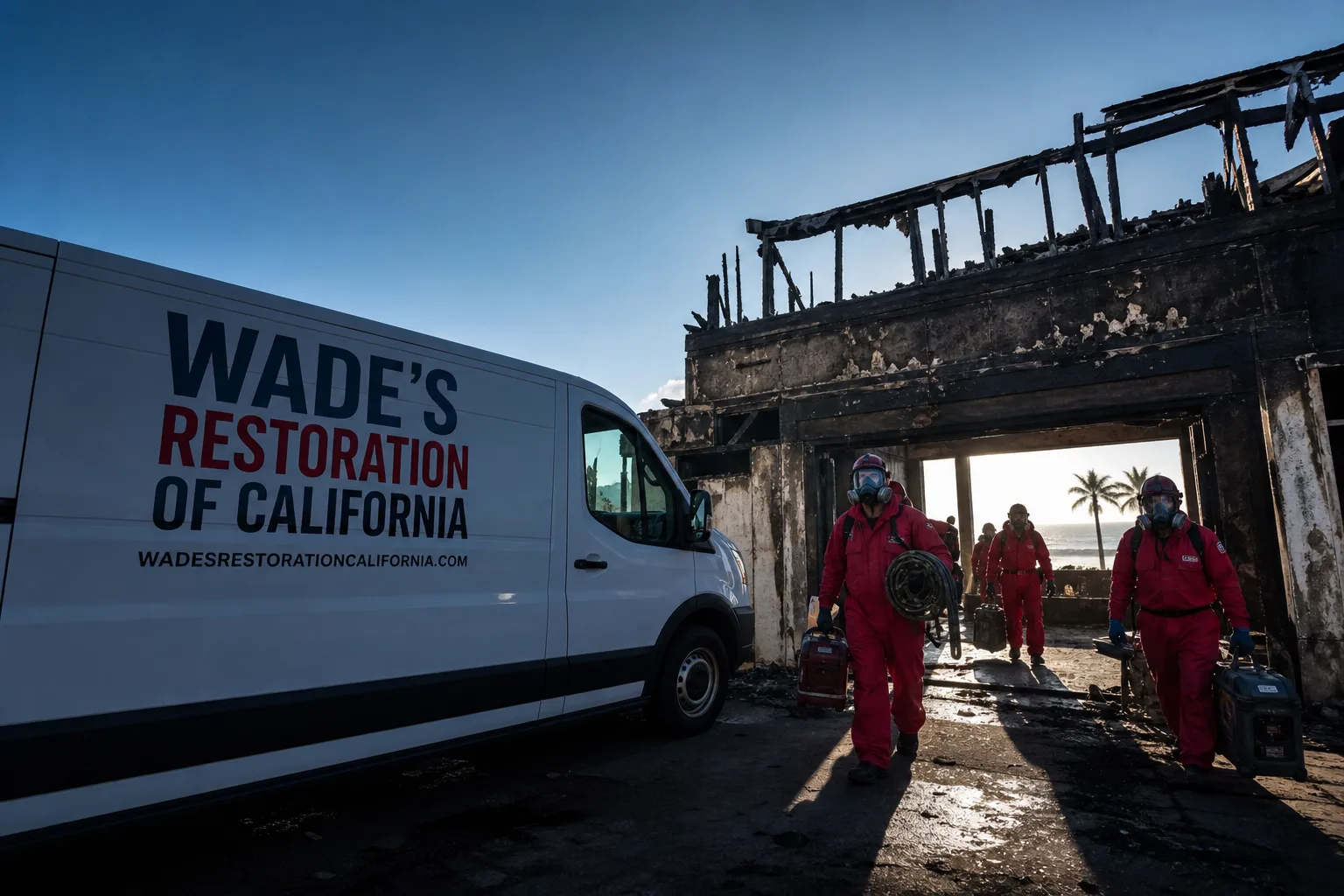
Wade’s crew shows up in uniform, background-checked, and carrying equipment from Dri-Eaz and Phoenix, because dehumidification in the Basin heat requires desiccant-level drying, not a box fan and a prayer. Every mold job gets daily moisture readings that you see, in writing, at the end. That log is yours to keep, and almost nobody else in this trade hands one over. If it’s not done right, our 90-Day Done Right Promise says we make it right, stamped on the contract. One call brings Wade back.
Our Mold Remediation Services in Walnut Park
We don’t do drive-by mold work. Every job here gets scoped, permitted, contained, dried, and clearance-tested before we call it done.
Mold Inspection & Testing
In Walnut Park, a visible patch is rarely the whole story. The 90255 housing stock is dense with 1920s-1950s wood-frame bungalows and court apartments where one “new” leak has often been feeding hidden colonies inside lath-and-plaster walls for months. We test air and surfaces, map moisture with thermal imaging, and hand you a written report that says exactly what we found, where, and how wet it is. No scare tactics, no upsell. If you only need a cleanup, we’ll tell you that.
Mold Removal
Containment comes first, always. We seal the affected rooms with negative air pressure, remove the mold-damaged drywall, plaster, or framing, and bag it for disposal under LA County rules. Then we dry the cavity to a measurable standard using Phoenix desiccants or Dri-Eaz low-grain refrigerant units, because the hot, dry Basin air outside misleadingly suggests the inside is dry when it isn’t. We finish with HEPA vacuuming and antimicrobial treatment of the framing that stays.
Black Mold Remediation
Stachybotrys, the black mold people fear, loves cellulose: old plaster, paper-faced drywall, and the original fir framing under Walnut Park’s flat-roofed court apartments. When we open a wall and find it, we don’t just spray and paint. We remove the food source, dry the cavity below 15% moisture content, and run clearance air sampling before we break containment. A surface wipe-down on black mold is a return visit waiting to happen, and our 90-Day Done Right Promise means we don’t want that any more than you do.
Air Quality Restoration
After the structure is clean, the air needs to be clean too. We run HEPA air scrubbers throughout the drying phase, then sample the air before and after to confirm spore counts have dropped back to normal, healthy levels for Walnut Park’s interior environment. You get the lab report, not a verbal assurance.
Trusted Brands We Service in Walnut Park
We’re not married to one manufacturer’s shelf; we use what works for each situation. Our drying trailers and equipment are from Dri-Eaz and Phoenix, two names that hold up to the humidity challenges of Southeast LA Basin court apartments. Our team carries IICRC certifications and stays current through RIA, so when the rules change, we know before the inspector shows up. We keep a stocked inventory of filters, containment materials, and antimicrobials, so we’re not waiting on a supply house in Commerce while mold keeps growing in your wall. If we need a part, we get it fast, because Walnut Park is our home territory, not a satellite route.
Common Mold Remediation Problems We See in Walnut Park Homes
- County-track permit stall: A contractor files with the wrong jurisdiction, assuming Walnut Park follows Huntington Park or South Gate rules. It doesn’t. Permits here run through LA County Building & Safety, and filing wrong costs days while mold spreads. We file the county track from the first phone call.
- Hidden mold behind stucco or plaster: Decades of deferred maintenance on flat-roof court apartments and original stucco bungalows let moisture drive mold deep into framing. A quick surface wipe-down fails clearance testing, and the mold returns in weeks. We open the wall, dry the cavity, and verify with air samples.
- Wrong drying assumptions in the Basin heat: Walnut Park’s interior heat and dry air mask high relative humidity inside closed wall cavities. A crew that skips a Phoenix or Dri-Eaz desiccant phase leaves enough moisture for mold to rebound. We dry to a measurement, not a hunch.
- Old galvanized supply lines hiding the real source: Many 1920s-1950s bungalows still carry original galvanized plumbing. A pinhole leak behind a wall can feed mold for months before anyone sees staining on the plaster. We pressure-test and inspect the plumbing as part of the scope, because fixing the drywall without fixing the pipe is just renting time.
Pricing for Mold Remediation in Walnut Park, CA
Here are honest numbers for the Walnut Park market. A mold inspection with air sampling and a written report runs $350-$650. Contained mold removal in a single room typically lands between $1,800 and $3,500. A whole-bathroom or crawl-space remediation with structural drying and framing replacement runs $4,000-$6,500. Black mold jobs with multiple affected rooms and clearance testing can reach $8,000-$12,000 depending on square footage and how far the damage extends. What moves the price: how long the water source has been active, how much drywall or plaster must come out, and whether the LA County permit process requires additional inspections. Call (855) 915-0646 for a free estimate, and ask about our Free Second Opinion on any written estimate you already have. We’ll match the scope line by line.
We Also Serve Cities Near Walnut Park
Our crews work throughout the Southeast LA Basin. Beyond Mold Remediation in Walnut Park, we regularly handle calls in Huntington Park, Bell, Cudahy, and Maywood, plus the surrounding blocks of 90255. Same owner, same promise, same county-permit fluency.
Serving Walnut Park, CA - Our Local Coverage Area
We’re based in the Walnut Park area and know this community well. Use the map below to see our service coverage - if you’re nearby, we can almost certainly help.
FAQs - Mold Remediation in Walnut Park
It changes the entire jurisdiction. Because Walnut Park is an unincorporated community governed by Los Angeles County, your permit goes through LA County Building & Safety, not a city building department like the ones in Huntington Park or South Gate. Inspectors, timelines, and fee schedules all follow county tracks. A crew that files with the wrong jurisdiction can stall a job by days. We file the county sequence from the first call, which is one reason Walnut Park homeowners don’t end up waiting on us. Call (855) 915-0646 and we’ll tell you exactly where your permit stands.
Because the leak repair usually stopped water at the roof membrane, not at the wall cavity. Walnut Park’s 1930s-1950s court apartments have flat or built-up roofing that ponds water, and the original drains are often undersized. Once water gets past the membrane, it travels into wall cavities and sits there, feeding mold on old lath-and-plaster and fir framing. A roofer patching a membrane never opens the wall to dry it. We do, and we dry it to a standard that passes clearance testing. If you’ve had repeated “surface” mold after a roof repair, call (855) 915-0646 for a cavity-level assessment.
Yes, and they often do. Many of the 1920s-1950s wood-frame bungalows in Walnut Park still carry original galvanized supply lines. These pipes corrode from the inside, develop pinhole leaks, and saturate the wall or subfloor slowly enough that no one notices until mold appears on the plaster or the floor feels soft. When we open a wall in one of these homes, we don’t just remediate the mold; we inspect the plumbing. If a pipe section has failed, we replace it, because leaving a leaking source behind guarantees a callback. Call (855) 915-0646 with the age of your house and we’ll tell you what to expect.
Plan on 3-5 days for a standard contained removal in a single room, and up to 7-10 days for a whole floor or multiple affected areas. The unincorporated LA County permit process can add a day or two if inspections are required, which is why we file immediately. Drying takes what it takes, because we don’t sign off on a moisture reading until it’s actually low. You get daily moisture logs, so you can see the progress yourself instead of taking our word for it. For a specific timeline on your property, call (855) 915-0646 and Wade or one of his crew will walk you through it.
Stop accepting surface treatments. If mold keeps returning to the same wall, ceiling, or closet in your Walnut Park rental, the water source is still active, the cavity was never properly dried, or the original remediation didn’t include containment and clearance testing. Under Los Angeles County rules, tenants have the right to request inspection and documentation. We can provide a written assessment with moisture readings and air samples that spells out exactly what’s happening. Landlords and tenants both appreciate that we don’t guess. Call (855) 915-0646 and ask for a mold inspection with written report.
A Walnut Park Mold Story Worth Knowing
We opened a wall in a 1940s wood-frame bungalow near the 90255 flats after a “new” roof leak, only to find months of hidden black mold feeding on original lath-and-plaster and a corroded galvanized supply line behind it all. The roof patch had stopped water at the membrane, but the wall cavity had been wet for a long time. Our crew ran the county permit track through LA County Building & Safety, set up a Dri-Eaz containment with negative air, and replaced the failed pipe section and the mold-damaged framing. The property left with passing post-remediation air samples and a homeowner who finally knew the full story, not just the visible patch. That’s the difference between a cleanup and a cure.
How Walnut Park’s Climate and Construction Change Mold Work
Walnut Park sits in the interior Southeast LA Basin, insulated from the coastal marine layer by surrounding urban density. Summers run hotter and drier here than on the coast, and that dryness plays tricks on moisture meters and human judgment alike. A crew that dries a wall cavity by feel assumes the hot air did the job. It didn’t. The cavity’s relative humidity stays stubbornly high, and mold rebounds weeks after the job is done. That’s why we run Phoenix desiccants and Dri-Eaz low-grain units on nearly every Walnut Park job, and why we record daily moisture readings until the wood itself tells us it’s dry. The other local factor is the housing stock: dense, wood-frame bungalows and multi-unit court apartments from the 1920s through early 1950s, many with original galvanized plumbing and flat or built-up roofs that pond water. During El Niño wet seasons, the flat roofs and undersized drains on those court apartments fail in clusters. We know the pattern, and we know which buildings on which blocks are likely candidates before the first wall even gets opened.
Written by Wade Ferris, Owner at Wade’s Restoration of California, serving Walnut Park since 2007.