
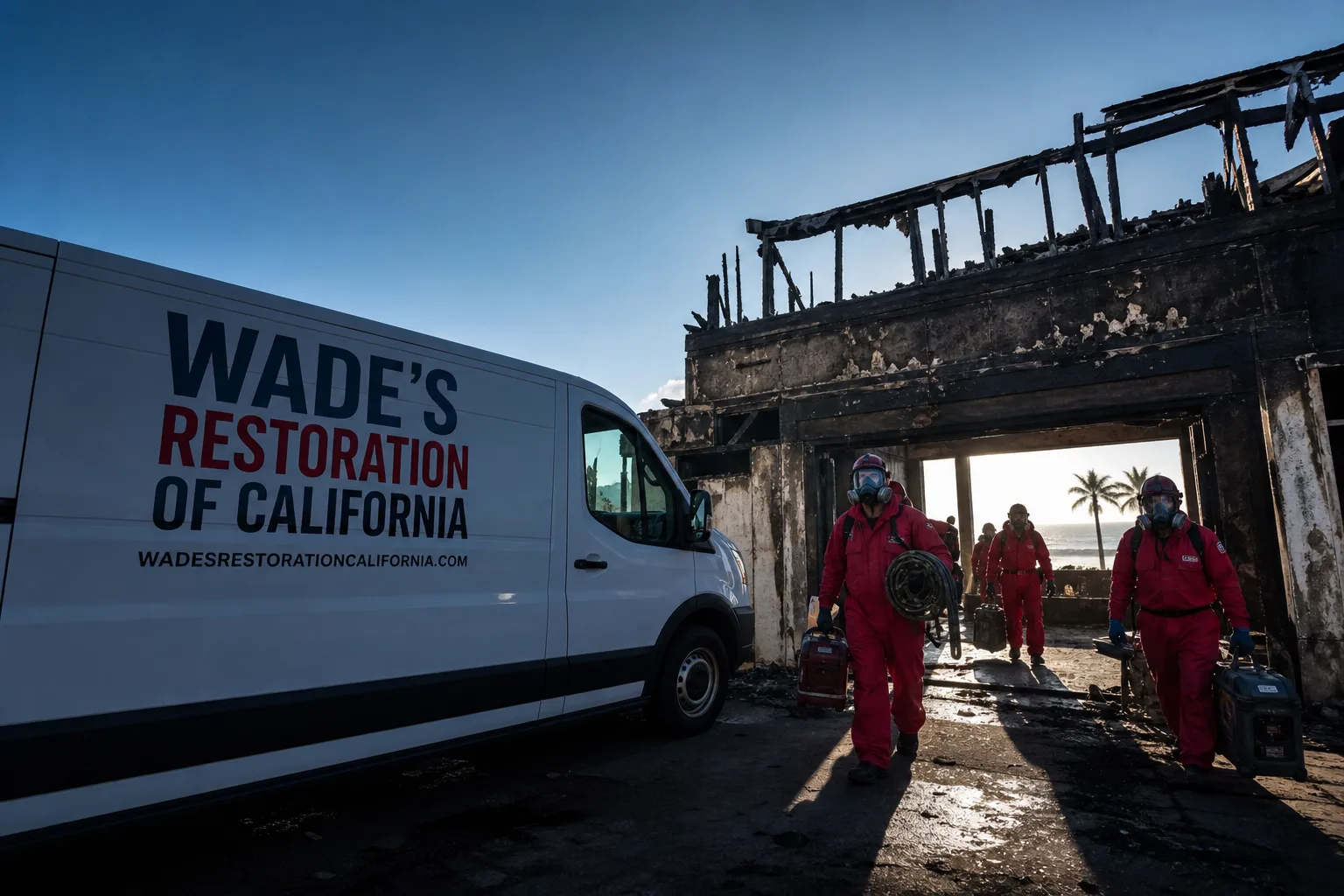
Fast, Reliable Mold Remediation Across Topanga
Mold remediation in Topanga almost always starts with moisture, and moisture in Topanga rarely behaves the way it does in the rest of Los Angeles County. Between the marine layer that settles into the canyon overnight, the septic systems that most homes here depend on, and the post-and-pier cabins that were never designed for modern humidity loads, mold gets a foothold faster than people expect. Worst case, what starts as a musty smell in a crawl space becomes a full contamination event that threatens the framing itself. If you see staining, smell mustiness, or just bought a home in Topanga and want to know what you’re walking into, call Wade’s Restoration of California at (855) 915-0646. Wade Ferris answers his own phone, and he’ll tell you honestly whether you need full remediation or just a targeted fix.
Why Wade’s Restoration of California Is Topanga’s Preferred Mold Remediation Company
Topanga isn’t a neighborhood you can service well from a distance. The canyon has one main artery in and out, the housing stock predates modern building codes by decades, and the moisture problems are different from what you’d find 15 minutes away in Woodland Hills. So when someone in Topanga calls about mold, the person who shows up needs to understand the terrain before he even opens the door. That’s the work Wade’s Restoration has done here for years. Homeowners up and down Topanga Canyon Boulevard, off Old Topanga Canyon Road, and in the hills above Fernwood know that Wade publishes his name and address and shows up himself, not just a crew someone else dispatched. Reviews from Topanga customers consistently mention two things: that Wade took daily moisture readings and handed over the full log at the end of the job, and that he dealt with the insurance adjuster directly so the homeowner didn’t have to become the middleman. The second thing matters more than people realize, because mold claims get denied or underpaid when documentation is thin, and almost nobody in this trade hands over a moisture log like Wade does.
Response time to Topanga is real. If you’re in 90290 and you call at 2 a.m. because a water heater let go and you can already smell mold starting, Wade is on the road. He lives by the same canyon conditions his customers do, and he knows the difference between a job that can wait until morning and one that needs someone there before the marine layer sets in again. That’s not a corporate promise. It’s the same accountability anyone gets when the person on the phone is the person whose name is on the truck.
Our Mold Remediation Services in Topanga
Mold Inspection & Testing
You can’t fix what you haven’t identified, and in Topanga, what you can’t see is usually the problem. Air sampling, surface swabs, and moisture mapping tell us whether the mustiness in your living room is coming from a visible patch of growth or from something colonizing the wall cavities and subfloor. Many Topanga homes have mold that starts in the crawl space and spreads upward through the framing without ever showing visible growth on drywall. A proper inspection is the difference between cleaning a small area and discovering you need structural remediation. We test, we document, and we show you exactly what we found before we ever recommend a dollar of work.
Mold Removal
Once mold is identified, removal isn’t about spraying something and walking away. It’s about containment, HEPA filtration, removing and bagging colonized material, and then treating the surrounding surfaces so the colony doesn’t reestablish itself. In Topanga, where many homes are wood-frame with post-and-pier foundations, mold removal often extends below the floor and into the crawl space, where hidden growth keeps feeding the problem. Our crews build proper containment chambers so spores don’t spread through the rest of the house while work is underway.
Black Mold Remediation
Stachybotrys, the mold people usually mean when they say “black mold,” is a genuine health concern, not a scare tactic. In Topanga’s chronically humid crawl spaces and poorly ventilated cabins, Stachybotrys finds the conditions it needs: cellulose, moisture, and darkness. Remediation for black mold requires full containment, negative air pressure, and careful disposal of contaminated material under RIA protocols. This isn’t a bleach-and-paint job. If you have confirmed or suspected black mold, this is the part where you don’t wait and you don’t try to handle it yourself.
Air Quality Restoration
After the mold is gone, the air in your home has to be restored. Spores, mycotoxins, and the particulate matter from remediation itself need to be scrubbed out. We use HEPA air scrubbers and negative-air machines to bring the indoor air back to a clean baseline, and we retest before we say the job is done. In Topanga, where homes are often sealed up against the heat and the canyon winds, air quality can stay bad for a long time without active remediation. This is the step that makes the difference between “the smell went away for a couple weeks” and “the problem is actually gone.”
What happens when you call
- 1
A real person answersNo phone trees - you reach a local pro.
- 2
You get an upfront price rangeHonest numbers before anyone is dispatched.
- 3
A background-checked tech heads outLicensed & insured, dispatched right away.
- 4
You approve before work beginsNothing starts until you say go.
Trusted Brands We Service in Topanga
We run professional-grade equipment on every Topanga job: Dri-Eaz dehumidifiers, XPOWER air movers, and HEPA filtration systems that meet the standards set by the IICRC and RIA. The difference matters when you’re drying out a 1960s cabin and the stud bays don’t match any modern blueprint. The equipment has to be sized right and placed right, and the person running it has to know how the marine layer changes the drying curve. That’s what happens when the owner is on the job and the company’s reputation rides on every reading logged.
Common Mold Remediation Problems We See in Topanga Homes
- Septic saturation feeding crawl space mold. Topanga has no municipal sewer in most of the canyon, so homes rely on septic systems and drain fields. When a hillside saturates or a drain field fails, the crawl space becomes a breeding ground, and mold remediation that doesn’t address the moisture source fails within weeks. We check the bigger picture before we start pulling material out.
- Marine-layer humidity defeating standard moisture meters. The overnight fog that settles into Topanga Canyon keeps indoor humidity elevated even when a home “feels” dry. A technician using a standard moisture meter without accounting for that baseline will get false “dry” readings and leave mold alive inside wall cavities. Our protocols account for Topanga’s specific humidity profile.
- Road closures delaying access after storms and fires. Topanga Canyon Boulevard closes during the exact emergencies that generate mold calls: atmospheric-river storms and wildfires. If a company can’t reach you for weeks, mold that started as a small patch becomes a full contamination event. Our scheduling works around the canyon’s real-world access windows.
- Post-and-pier framing hiding mold between joists. Older Topanga cabins often have no sealed crawl space, no vapor barrier, and no subfloor insulation. That means mold can colonize the underside of the floor and the tops of the joists while the living space above looks completely normal. You don’t see it until the floor starts to feel soft or someone starts getting sick.
Pricing for Mold Remediation in Topanga, CA
We Also Serve Cities Near Topanga
Wade’s Restoration of California covers Topanga and the surrounding communities, including Las Flores, Calabasas, Woodland Hills, and West Hills. If you’re just outside the canyon and dealing with water, fire, or Mold Remediation issues, the same owner-operator standard applies: Wade answers the phone, Wade shows up, and Wade stands behind the work.
Serving Topanga, CA - Our Local Coverage Area
We’re based in the Topanga area and know this community well. Use the map below to see our service coverage - if you’re nearby, we can almost certainly help.
FAQs - Mold Remediation in Topanga
How does Topanga’s septic-dependent housing affect mold remediation?
Septic-dependent housing means mold remediation often has to run alongside Category 3 sewage contamination, because saturated or damaged drain fields in Topanga’s hillsides push sewage-tainted water into crawl spaces and subfloor systems. That requires hazmat protocols, dual-suit containment, and keeping sewage-contaminated materials completely separate from clean surfaces. A company that treats the mold as a standalone issue will hand you a house that re-contaminates within weeks. Call (855) 915-0646 and Wade will assess the whole picture, not just the visible mold.
Can you still reach my house if Topanga Canyon Boulevard is closed after a storm or fire?
Yes, but only if you choose a company that plans for the canyon’s access reality. Wade lives with the same road closures his customers do, and he schedules work around the windows when Topanga Canyon Boulevard is actually passable. If a crew misses that window, you’re waiting until the next reopening while mold keeps spreading. We plan for the canyon, not around it. Call (855) 915-0646 to talk through access and timing for your specific address.
Why does Topanga’s marine layer make mold worse in older cabins?
The marine layer that settles into Topanga Canyon overnight keeps indoor humidity in the 60-70% range even when the daytime air feels dry. In older cabins that lack vapor barriers and proper ventilation, that chronic humidity gives mold the moisture it needs to establish itself even without a visible leak. Standard drying protocols from outside the canyon often declare a job done when the real moisture profile is still feeding hidden growth. Our readings account for Topanga’s baseline, not a Valley baseline.
How do you handle mold in a post-and-pier crawl space on a steep hillside?
We recently remediated a 1960s post-and-pier cabin off Old Topanga Canyon Road where a failed hillside drain field had saturated the crawl space and spread Stachybotrys into the floor joists. Our techs used Dri-Eaz dehumidifiers, XPOWER air movers, and a HEPA-filtered containment chamber, while RIA-standard protocols kept the sewage-contaminated materials separate from clean surfaces. The steep slope meant working with limited access and extra containment, but the job took the same approach every Topanga job does: find the moisture source first, then remediate, then verify with repeat readings.
Do I need to test for black mold if I smell mustiness but see no visible growth?
Yes. A musty smell that has no visible source means the mold is hidden, and in Topanga that usually means the crawl space, the wall cavities, or the subfloor. Air sampling tells us whether Stachybotrys spores are present and at what concentration, which determines whether you need containment or just targeted cleaning. Skipping the test because you can’t see the mold is how small problems become structural ones. Call (855) 915-0646 for an inspection quote, and remember there’s no trip charge for Topanga.
If you’re dealing with mold in Topanga and you want a straight answer from someone who knows the canyon, call (855) 915-0646 right now. Wade Ferris answers his own phone, and he’ll tell you honestly what you’re up against and what it takes to fix it. Estimates are free, the moisture log is yours to keep, and the work comes with a 90-Day Done Right Promise in writing. If it’s not done right, Wade makes it right.
Written by Wade Ferris, Owner at Wade’s Restoration of California, serving Topanga and the surrounding canyon communities.