
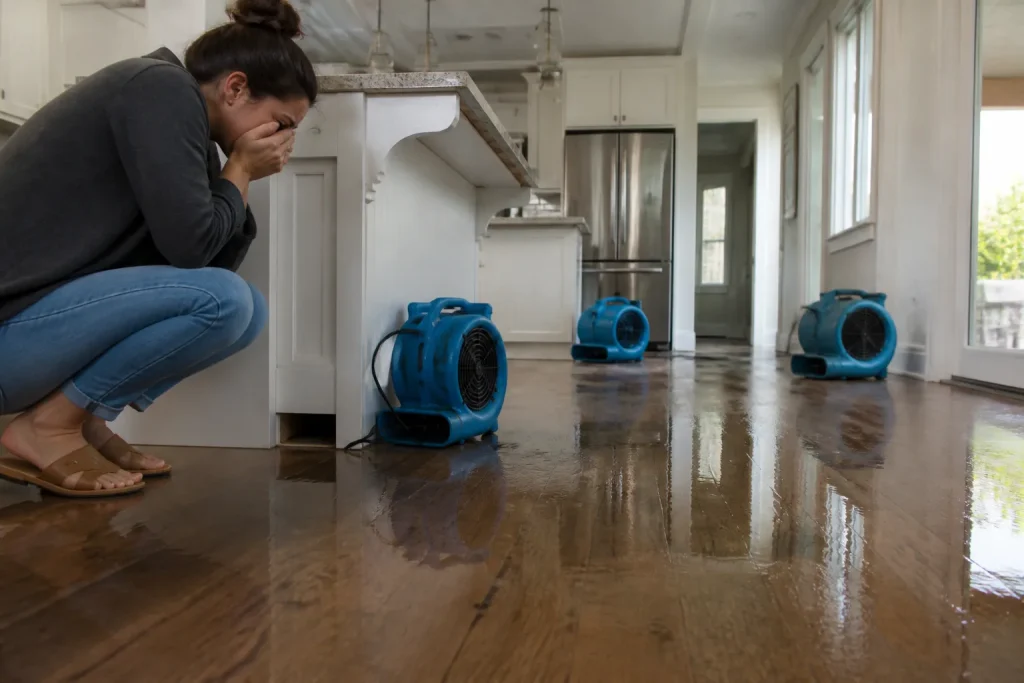
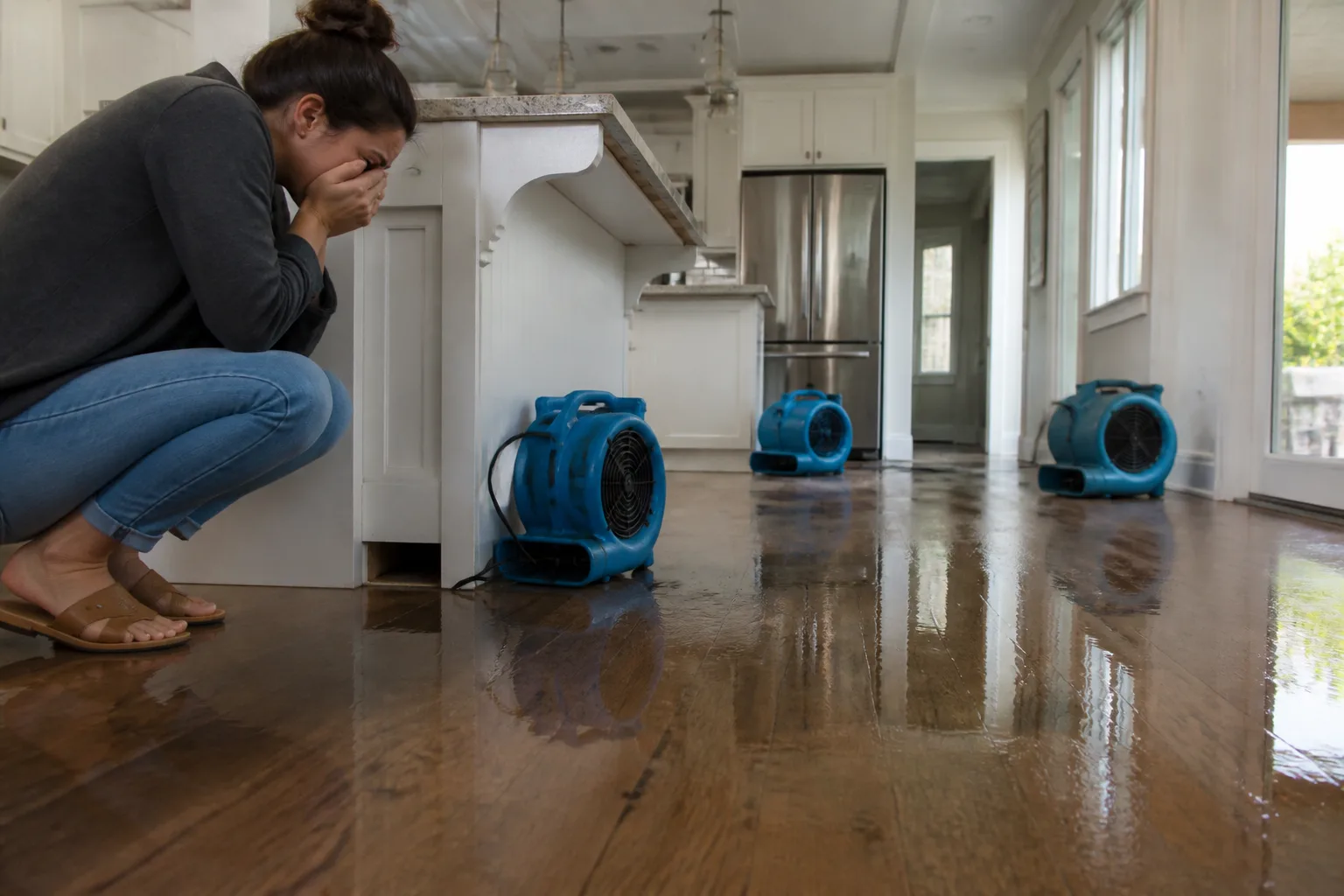
Emergency Water Damage Restoration Near Me: What San Diego Homeowners Should Do First
If you have standing water in your San Diego home right now, here is the straight answer: shut off the water source if you can do it safely, cut power to the affected area, and call (855) 915-0646. The first 60 minutes will determine more about your repair cost, your mold risk, and your insurance claim than anything the restoration crew does after they arrive. If you would rather not handle the first steps alone, call us now and Wade Ferris will walk you through them on the phone while he heads your way.
The First 60 Minutes: A Minute-by-Minute Action List for San Diego Homes
By the time a restoration crew pulls into your driveway, mold spores have already had 60 minutes of ideal growing conditions. What you did, or did not do, in that window will show up in your moisture readings, your insurance adjuster’s report, and possibly your air quality test 90 days from now. Here is what to do, in order, starting the moment you see water.
Minute 1 to 5: Stop the source if you can. For a burst supply line, shut the valve at the fixture. For a slab leak or mystery water, kill the main shutoff at the meter. San Diego homes built before 1980 often have the main valve at the front curb under a concrete lid, and it can take a water key and some muscle. If you cannot turn it, do not burn 20 minutes fighting it. Move to the next step and leave the valve for the person you call.
Minute 5 to 15: Cut power to the affected rooms at the breaker panel. Water and electricity do not mix, and you do not need to be the person who proves it. If the panel is in a wet area, leave it alone and tell the dispatcher on the phone. Then get air moving. Not ceiling fans, which drive moisture into the subfloor, but box fans at floor level pointed out an open door or window. San Diego’s marine air can be humid in the morning, so if it is one of those gray June days, run the fans anyway. Moving air beats still air, always.
Minute 15 to 30: Start photographing. But photograph with a system, because an insurance claim is only as good as the order of your photos. More on that below.
Minute 30 to 60: Call your insurance company, and call a restoration company that answers with a live person. We will get to what to say on both calls.
What to Photograph and in What Order Before You Touch Anything
Insurance adjusters are trained to look for cause, scope, and pre-existing damage. Your photos should walk them through exactly that, in that order. This is the one thing most San Diego homeowners get backwards. They take 40 close-up shots of the puddle, and zero shots of the room before anything was moved.
Here is the sequence we recommend:
- The source, first. The burst pipe, the failed water heater fitting, the overflowing washer drain. If the water came from outside, the point where it entered, whether that is a door threshold or a foundation crack.
- The whole room, standing back. Wide shots from all four corners. These establish context, furniture placement, and what materials were wet. Do not crop out the baseboards.
- The water line. If there is a visible water line on drywall, shoot a tape measure or a dollar bill next to it for scale. This proves depth of exposure.
- The contents, before moving anything. Furniture legs, bottom shelves, boxes on the floor. Crouch down and shoot underneath things.
- Then, and only then, move what you must to protect it. Take photos of the wet subfloor or padding as you lift carpet, and the back side of baseboards if they are swelling.
One more tip from jobs we have walked in San Diego: photograph the label on any failed appliance or fixture. A serial number and model can matter later. And if you have a whole-house water shutoff outside, photograph that too, especially if it is difficult to access. It proves you did not neglect maintenance.
We hand every homeowner a documented moisture log at the end of a job. Most of the industry does not. But your photos from the first hour are evidence no one can argue with. On the Wade’s Restoration of California home page, we lay out how we document every stage, and why that matters when an adjuster calls.
The Single Biggest Mistake San Diego Homeowners Make in the First Hour
We see it at least twice a month, usually in Clairemont, Pacific Beach, and older Mission Valley condos: a homeowner discovers a water leak at 11 p.m., mops up what they can, and turns on the ceiling fan in the affected room before going to bed. The fan runs all night. The carpet feels drier in the morning, so they think they dodged a bullet.
What actually happened is worse than doing nothing. A ceiling fan pulls air up and across the surface, which evaporates moisture from the top of the carpet and the face of the drywall. But the water never evaporated. It moved. Down into the carpet pad, into the subfloor, into the bottom plate of the wall framing. The surface dried while the structure behind it got wetter. That is how you get mold inside a wall cavity with no visible signs, and a smell that comes back every time the Santa Anas blow through.
If you must run a fan, run a box fan or floor blower at floor level, pointed toward an open exterior door. Even better, call someone who has the right equipment. Wade’s crew runs professional-grade Injectidry systems and Dri-Eaz dehumidifiers that pull water out of materials rather than just moving it around. We are IICRC-certified, which sounds like alphabet soup until you are staring at a wet wall at midnight and need someone who knows what they are looking at.
How to Evaluate a Midnight Emergency Call: Three Questions for the Dispatcher
It is 2 a.m. in San Diego. You have water spreading across your kitchen floor. You search “emergency water damage restoration near me San Diego” and start dialing. The first company has a polished recording. The second puts you on hold. The third picks up on the second ring.
Here is what to ask whoever answers, before you agree to anything:
- “Who am I talking to, and will you be the person coming out?” If the answer is “a dispatcher,” ask if you can speak to the owner or the on-call tech directly. We answer our own phone, 24 hours a day. Wade Ferris has answered his own phone at 3 a.m. more times than he can count. That is the job.
- “What equipment will you bring on the first truck?” You want to hear actual names: extractor, dehumidifier, air mover, moisture meter. If they say “everything we need,” that is a call center script. Ask to be specific. Our vans carry Dri-Eaz, Phoenix, XPOWER, and B-Air gear, because we own it and we maintain it.
- “Is your estimate free, and is the price you quote now the price I will pay?” If there is any hesitation, hang up. We quote a price before work starts, and it does not change because the tech found “extra damage.” No trip charge inside our own county, either.
There is a reason the big national chains have 800 numbers and hold music. They are not based here. They will not be at the hardware store on a Saturday. Wade has lived and worked in San Diego since 2007. His name, address, and license number are published, and he is going to run into you again. That is the oldest accountability mechanism there is.
What to Tell Your Insurance Company on the First Call (and What Not to Say)
Your first call to the insurance company is not the time to be chatty. You are establishing a claim, not narrating a story. Say the facts: what happened, when you noticed it, and that you have photos. Then say you will have a restoration company assess the scope.
Here is what to avoid saying on that first call:
- “It looks like it was leaking for a while.” You may think you are being honest, but policies can limit coverage for long-term seepage. Let a pro determine how long water was present, and let the moisture readings do the talking.
- “I think it is just a small amount.” Water hides. Say “we are still assessing the extent.”
- “I will handle the cleanup myself.” Even if you plan to, do not say it on record. Let the adjuster see the documentation first.
- “The repair should be pretty cheap.” You do not know yet, and you have no reason to negotiate against yourself.
Here is the thing about insurance calls that nobody tells San Diego homeowners: the first phone call becomes part of the claim file. Statements you make in a panic can be used to limit your coverage before a restoration company has even documented the full damage. We deal with adjusters directly, and we have worked with most of the major carriers on Water Damage Restoration in San Diego claims. We will send the adjuster our moisture logs, our photos, and our scope of work, so you are never the one stuck relaying information between two sides.
When to Call a Pro (and When You Can Handle It Yourself)
Here is the honest rule we use when friends call us with water damage and ask if they really need us.
You can probably handle it yourself if: the water is from a clean source like a supply line, the affected area is smaller than a bath mat, you caught it within minutes, and the flooring is tile or concrete with no wood or carpet. Dry it, dehumidify, watch it for a few days.
Call a pro if: the water came from a drain, toilet, or sewage line; the affected area covers more than one room; water touched drywall, baseboards, or flooring with any wood or fiber content; or the water was present for more than an hour. Sewage water carries bacteria. Gray water from a washing machine carries whatever was in the machine. And any water in a wall cavity in warm, humid San Diego air is a mold incubator. We do Mold Remediation in San Diego for exactly this reason, and we would rather prevent it than treat it.
If you are on the fence, call us at (855) 915-0646. A conversation costs nothing, and we will tell you straight if we think you can handle it with a shop vac and a fan. No charge for that.
The Bottom Line
The first 60 minutes after a water loss in your San Diego home is when the outcome is really decided. Shut off the source, cut power, photograph in order from source to scope, and call a restoration company that answers with a live person. Do not run ceiling fans over wet flooring. Do not make sweeping statements to your insurance company before the damage is documented. And do not let a call center in another state be the one who decides how fast help arrives.
Wade’s Restoration of California has been serving San Diego since 2007. Wade Ferris answers his own phone, arrives with professional equipment, documents every moisture reading, and stands behind every job with a 90-Day Done Right Promise in writing. If you need Fire & Smoke Damage Restoration in San Diego, water extraction, mold remediation, or just an honest opinion about a wet floor, call (855) 915-0646 for a free estimate. We are here, and we are local.
Frequently Asked Questions
If you call Wade’s Restoration of California, you are talking to Wade Ferris himself, not an answering service. He can usually have extraction running inside the hour, depending on where you are in the county. Call (855) 915-0646 and find out before the water spreads further.
Most San Diego homeowner policies cover sudden and accidental water damage, like a burst pipe or an overflow. Coverage for slow leaks or flooding from outside depends on your policy and whether you have flood insurance. The best move is to document everything and let us deal with your adjuster directly. Our moisture logs and photos make the claim process a lot smoother.
If water touched drywall, baseboards, carpet, or any wood product, fans alone will not dry the inside of the materials. Surface drying traps moisture inside wall cavities and under flooring, which is how mold starts. We would rather you call us for a free assessment than find out 90 days later that you needed full Mold Remediation in San Diego because the structure never actually dried.
We deal with the adjuster directly. You should never be the person stuck relaying information between your insurance company and a restoration crew. We send our documented moisture logs, photos, and scope of work straight to the adjuster, and we have worked with most major carriers on San Diego water damage claims. Call (855) 915-0646 and we will help you figure out the first step.
Written by Wade Ferris, Owner at Wade’s Restoration of California, serving San Diego since 2007.
Need Damage Restoration Help?
Call Wade's Restoration of California - licensed & insured, here with fast after-hours help in San Diego.
(855) 915-0646