
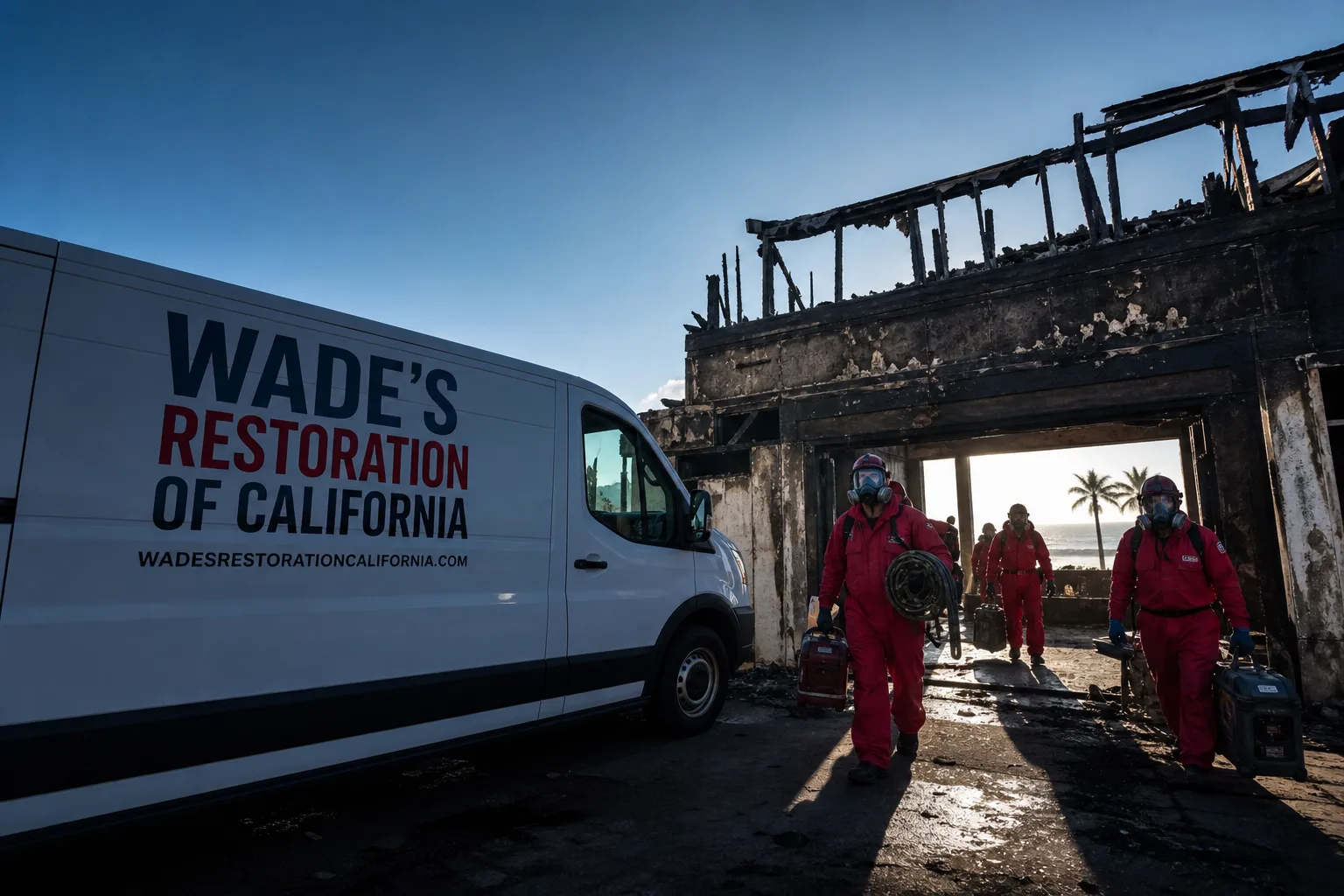
Fast, Reliable Storm & Disaster Restoration Across Pleasant Hill
When a storm tears through Pleasant Hill, most homeowners are looking at two problems at once: the damage they can see, and the water that’s already moving through cracks they never knew existed. Wade’s Restoration of California has been working in this town long enough to know that the wind that rattles a patio door on Cleaveland Road is the same wind that sends rain sideways under a roofline, and that the slab crack under your living room wall was probably there long before the storm ever hit. We’re not a national chain. We’re Wade Ferris and his crew, out of Contra Costa County, and we answer the phone ourselves. If you’re standing in water or looking at a roof that’s open to the sky, call us at (855) 915-0646 right now, and we’ll be on the road to Pleasant Hill within the hour.
Here’s what this page will tell you: why storms hit Pleasant Hill harder than most people expect, what it actually costs to fix that damage, and what a real restoration crew does differently on a clay-heaved slab foundation that’s been cracking for fifty years. This is not a generic guide. It’s what we see every winter, every Diablo wind season, and every time the Concord fault gives this valley a nudge.
Why Wade’s Restoration of California Is Pleasant Hill’s Preferred Storm & Disaster Restoration Company
Most restoration companies show up, extract water, cut drywall, and leave. We stay until the shift in your slab that let the water in is properly addressed, because we know that in Pleasant Hill, that’s the difference between a one-time repair and a three-time repair. Homeowners along Grayson Creek and in the older ranch neighborhoods know what we mean: the water comes back through the same seam, the same cracked sill, the same joint that’s been patched before. We’re able to answer the phone at 2 a.m. because Wade Ferris is the one holding it. That’s not a customer-service line. It’s his cell. When you call, the person who answers is the same person who will be standing in your living room.
We hold IICRC certification and carry professional-grade drying equipment from Dri-Eaz and Phoenix, but the thing that matters more on a Pleasant Hill call is that we’ve seen the same failure modes happen in these exact houses. A 1958 slab-on-grade ranch off Contra Costa Boulevard behaves differently than a hillside home on Pleasant Hill’s eastern ridge. We know both. We also know the difference between storm water that just arrived and moisture that’s been riding a foundation crack since the last wet season. That local understanding is not something you can franchise.
Our Storm & Disaster Restoration team is owner-operated, not a revolving door of subcontractors. We carry background-checked, uniformed technicians, we hand every homeowner a written moisture log at the end of every drying job, and we back every restoration contract with a 90-Day Done Right Promise in writing. If it’s not done right, we make it right, and you talk to Wade directly to make that happen.
Our Storm & Disaster Restoration Services in Pleasant Hill
Emergency Board-Up
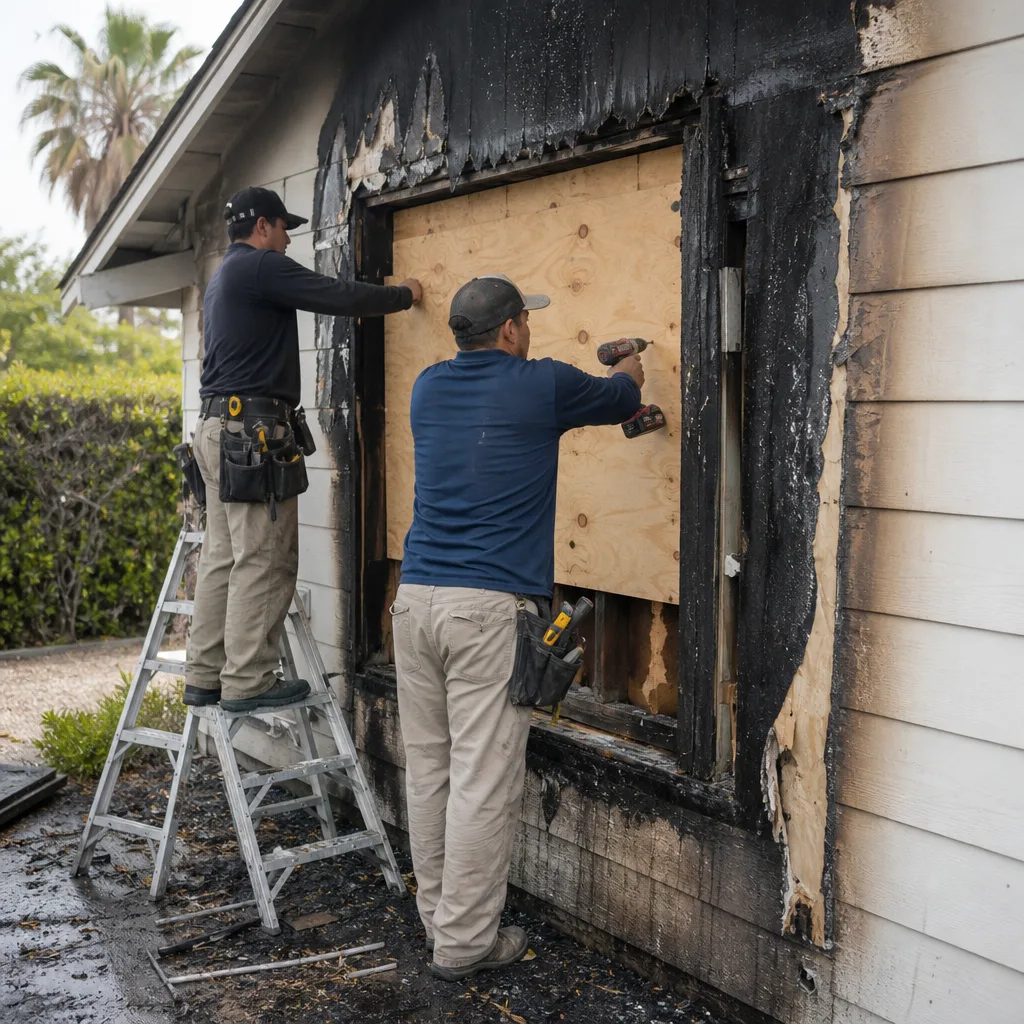
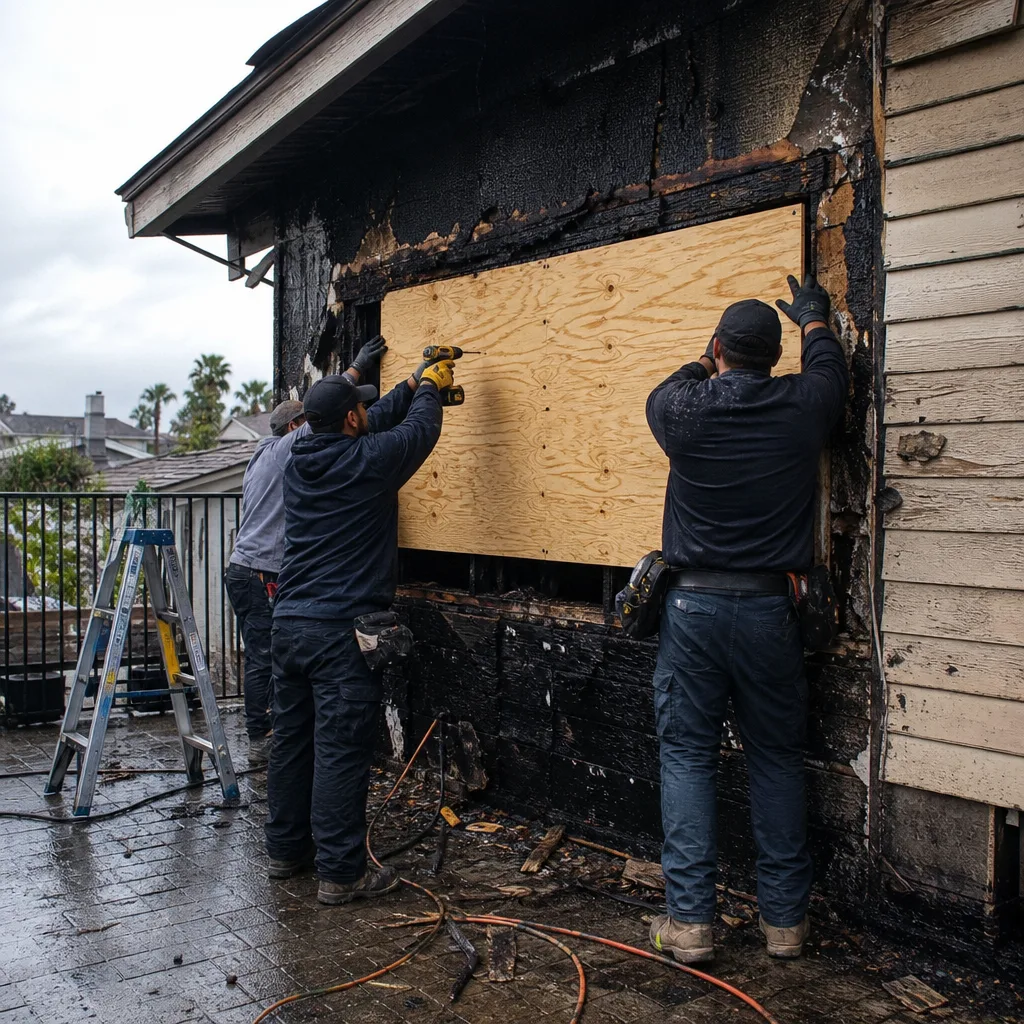
When a tree limb or a Diablo wind gust takes out a window or blows a door off its track, the first job is keeping the next storm out of your house. In Pleasant Hill, where wind events come in bursts and the next front can arrive before the first one fully clears, an exposed opening quickly becomes a water-logged interior. We board up with plywood secured to framing, not just wedged against trim, and we photograph everything for your adjuster so the initial emergency response is documented for the claim.
Roof Tarping
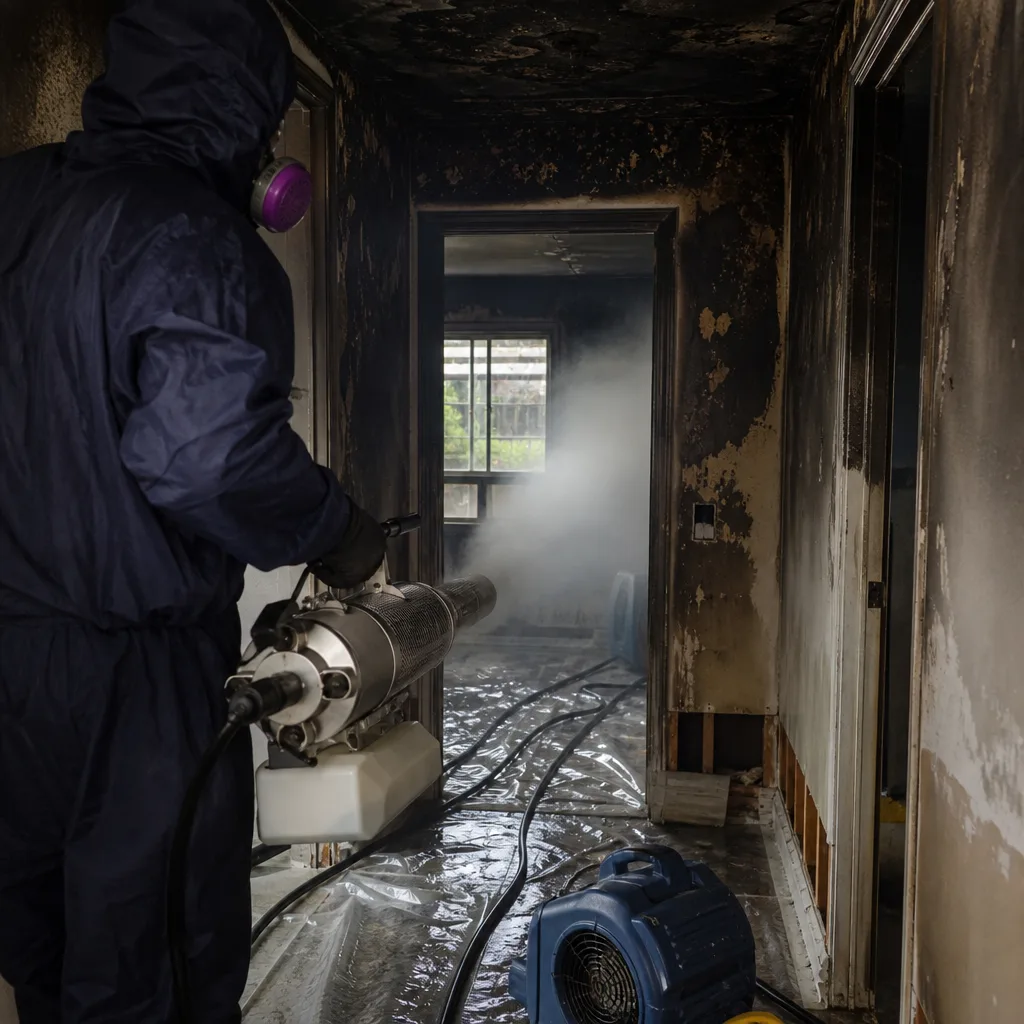
Roof tarping in Pleasant Hill is a different job than it is in coastal towns. Up against the hills, wind gusts funnel through the Diablo Valley with enough force to tear an improperly secured tarp clean off. We anchor with furring strips along every edge, lapped and sealed, and we weigh the sequence so the tarp holds through the next wind event while you schedule permanent repairs. Expect $450-$1,100 for a typical single-family ranch roof tarp in Pleasant Hill, depending on pitch and access.
Flood Damage Restoration
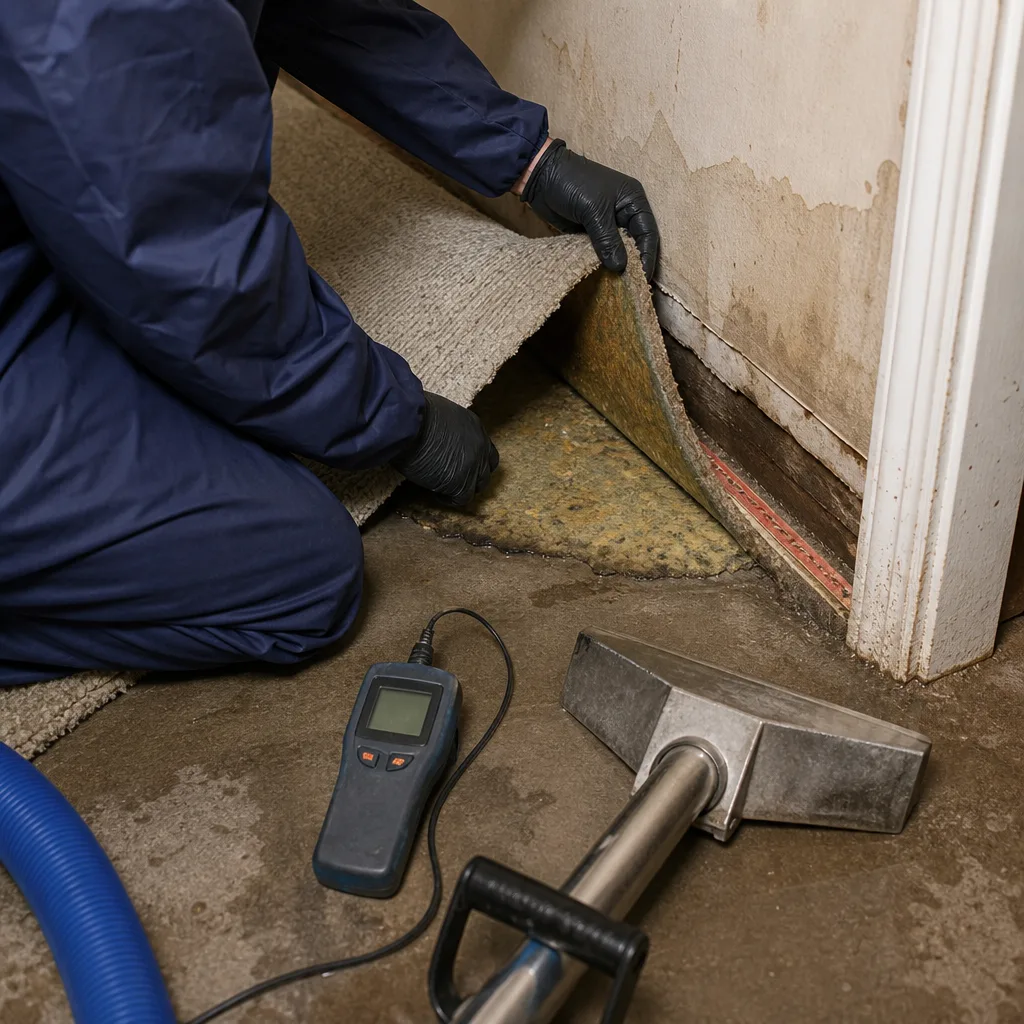
When Grayson Creek overflows or a storm drain backs up, the water in a Pleasant Hill basement doesn’t just sit there. It works its way into clay, swells the soil beneath the slab, and starts moving through any existing crack. Our flood response removes standing water, reads moisture levels every day with professional instruments, and dries the structure to specific standards before any reconstruction begins. On these older slab homes, that drying loop often runs longer than national averages because the clay holds moisture. We don’t rush the drying phase, because a rushed dry is a mold problem waiting for spring.
Wind Damage Repair
Wind damage in Pleasant Hill rarely shows up as a missing roof. It shows up as a fence leaning into a gate, a patio door frame that’s now 3/16 of an inch out of square, and a roofline that’s lost shingles along the gable. We straighten, reinforce, and seal, but we also check what the wind was using to get in: a window that no longer closes tight, a door threshold that wasn’t seated correctly, a vent that’s been rattling for years. That’s the difference between repairing a symptom and fixing what the next storm will target.
What happens when you call
- 1
A real person answersNo phone trees - you reach a local pro.
- 2
You get an upfront price rangeHonest numbers before anyone is dispatched.
- 3
A background-checked tech heads outLicensed & insured, dispatched right away.
- 4
You approve before work beginsNothing starts until you say go.
Trusted Brands We Service in Pleasant Hill
We work on whatever’s already in your house, from original aluminum-frame windows on 1960s ranches to newer vinyl replacements on the hillside homes. Our most common restoration work involves patio doors, roof sheathing, drywall, and baseboard assemblies, but we also service and inspect the mechanical drying equipment we place during any water-loss recovery. We keep a stock of common materials for Pleasant Hill homes on hand: moisture membranes, sill plates, baseboard profiles, and door seals that match the mid-century make-up of this town’s housing. No nationwide parts delay, no excuses about a supplier.
Common Storm & Disaster Restoration Problems We See in Pleasant Hill Homes
- Water through slab cracks, not just through roofs. The expansive Montmorillonite clay under Pleasant Hill moves every winter and every summer. When the ground swells, a slab crack opens just enough to let flood water in from below. It looks like a flooding problem, but it’s actually a soil heave problem.
- Patio doors and window frames knocked out of square by wind or a shift. After a storm, the door still closes, but not well. The gap at the threshold lets the next rain ride straight in. We re-set frames and replace weather stripping, and we check the sill for movement.
- Roof tarps that fail in the next Diablo wind event. You’d be surprised how many emergency tarps we see pulled back on the corners after a hot offshore wind. If the tarp can’t hold in a 45 mph gust from the northeast, it’s not doing its job.
- Asbestos-containing materials exposed by storm damage. A lot of these 1950s and 1960s ranch homes still have original vinyl-asbestos floor tiles and drywall texture. When storm damage exposes those materials, we bring in certified abatement before we start demolition. It’s not optional, and it adds time, but it’s the legal and safe way to work.
Pricing for Storm & Disaster Restoration in Pleasant Hill, CA
Here are the numbers we typically see in Pleasant Hill right now. Emergency board-up runs $280-$600 per opening, depending on size and whether the frame is intact. Roof tarping runs $450-$1,100 for most single-story ranch homes, more on two-story homes with steep pitches. Storm water extraction and drying starts around $1,500 for a single room with wet drywall and carpet, and a full flood-dry of a basement or crawl space typically runs $2,800-$5,500 based on how far the water traveled and how long it sat. Wind damage repair to a door frame or window jamb is generally $350-$900 per opening plus materials. If you have a written estimate from another company, bring it in and we’ll give you a free second opinion. No trip charge inside Contra Costa County. Call (855) 915-0646 and we’ll schedule a look at your place before the next storm front comes through.
We Also Serve Cities Near Pleasant Hill
We run crews into Contra Costa Centre, Waldon, Concord, and Walnut Creek from our Bay Area office, and we know the roads between them well enough to give you a straight answer on arrival time. If you’re in any of those neighboring towns and dealing with storm damage from the same valley winds, the same clay, or the same aging housing stock, we’ll treat your home like it’s our own block. Call the same number: (855) 915-0646.
Serving Pleasant Hill, CA - Our Local Coverage Area
We’re based in the Pleasant Hill area and know this community well. Use the map below to see our service coverage - if you’re nearby, we can almost certainly help.
FAQs - Storm & Disaster Restoration in Pleasant Hill
They make the job different from coastal cities. The Montmorillonite clay under Pleasant Hill heaves in winter and contracts in summer, which means slab-on-grade ranch homes here crack and re-crack on a yearly cycle. After a storm, water that appears to come in through a wall or a door often actually traveled through a foundation crack that opened during the wet season. A proper restoration has to trace the moisture path back to the slab, not just dry the visible interior damage. If the slab crack isn’t addressed with a full waterproof membrane, you’ll be calling us again next winter. Call (855) 915-0646 for a look at your place before it gets worse.
For most doors on Pleasant Hill homes, you want something rated for at least 100 mph wind gusts under the current International Residential Code for the East Bay’s exposure category, but on hillside lots that channel Diablo winds, we typically recommend upgrading to impact-rated door assemblies that hold up to debris. That means a door that’s tested to withstand both pressure and impact, not just a standard patio slider. We can evaluate the current door and tell you whether it’s worth reinforcing or replacing. Call (855) 915-0646 and we’ll give you a straight answer.
Yes. Most Pleasant Hill homes built in the 1950s through the 1970s still contain asbestos in vinyl floor tiles, popcorn ceilings, drywall joint compound, and HVAC duct insulation. If your storm damage requires cutting into those materials, a certified inspector has to test first. We coordinate that testing and any required abatement as part of the restoration, and we document it for your insurance adjuster. You don’t want anyone cutting into a 1965 ceiling without knowing what’s in it. Call (855) 915-0646 to talk through your specific situation.
In Pleasant Hill, the answer is almost always the same: the crawl space isn’t drying the way it should because the hillside water table rises each winter and the clay under the foundation holds moisture against the floor joists. Even when the visible leak is fixed, the seasonal moisture from the surrounding hills and the changing water table keeps the subfloor damp. We address that with proper vapor barriers, drainage correction, and often a sump pump system, not just a cleaning and a new run of plastic. Call (855) 915-0646 and we’ll send someone out to take moisture readings under your house.
Within 72 hours, and before the next rain arrives. A Diablo wind event is hot and dry, but the damage it does to shingles, flashing, and vents leaves the roof exposed to the wet season that follows. A lifted shingle from an October wind event turns into a leak by December. We regularly inspect roofs on Pleasant Hill ranches after wind events and find damage that was invisible from the ground. If you call (855) 915-0646, we’ll put you on the schedule and tell you what’s actually up there.
Pleasant Hill’s Storm Damage Cycle Is Different. Here’s Why.
Pleasant Hill sits squarely in the Diablo Valley atop well-documented expansive Montmorillonite clay soils, and the active Concord fault runs through the broader corridor just east of town. That combination means the predominantly 1950s-1970s slab-on-grade ranch homes here are subjected to both seasonal soil heave during wet winters and seismic micro-movement year-round. The result is a foundation that doesn’t stay put. Cracks open, patches fail, and storm water finds its way back in through the same seams, season after season. Restoration work in Pleasant Hill is rarely a one-and-done event. The same structural cracks that let water in after January rains are the same ones flagged after the next tremor. If you’ve had water intrusion more than once in the same spot, the pattern is telling you something about the ground your house sits on, not just the weather outside.
We responded to a January storm call on Cleaveland Road where wind-blown rain was entering through a failed patio door. After an emergency board-up, our crew sealed the opening, then traced moisture to a heaving slab crack that had been patched twice before. We installed a full waterproof membrane along the sill and realigned the door frame to meet current wind-load requirements. That is what a real restoration looks like in this town. It’s not a drywall patch and a coat of paint. It’s finding the crack in the slab that has been telling the same lie for twenty years, and fixing it while we’re in there.
What Makes This Page Different From Every Other Pleasant Hill Restoration Page
Most storm restoration pages for Pleasant Hill talk about water extraction and mold. They skip the geology. They skip the fact that a slab-on-grade ranch home on Montmorillonite clay behaves differently than a raised-foundation home in Walnut Creek. They skip the Diablo wind events that peel tarps and rattle patio doors in October and November, months before the first real rain. This page explains how clay heave, slab foundations, and offshore wind gusts create a unique storm-damage cycle in Pleasant Hill that generic restoration guides miss. A homeowner who reads this page should walk away knowing that the water puddle in the corner of the garage in February might have started as a foundation crack last summer, and that a door that doesn’t close right after a windstorm is a water leak waiting for the rainy season. That’s the kind of information you can only get from people who work here every week. We do.
Call Wade’s Restoration of California for Storm & Disaster Restoration in Pleasant Hill
If you’ve read this page and you’re looking at a wet floor, a cracked wall, or a ceiling that’s bulging, don’t wait. Call (855) 915-0646 now. Wade Ferris answers his own phone, and he’ll tell you straight what we can do, what it’ll cost, and whether you’re safe to wait until morning. No answering service, no call center, no estimating from a photograph in another state. We serve Pleasant Hill with crews that know this town, and we’ll be there before your next storm hits.
Written by Wade Ferris, Owner at Wade’s Restoration of California, serving Pleasant Hill with storm and disaster restoration since 2007.