
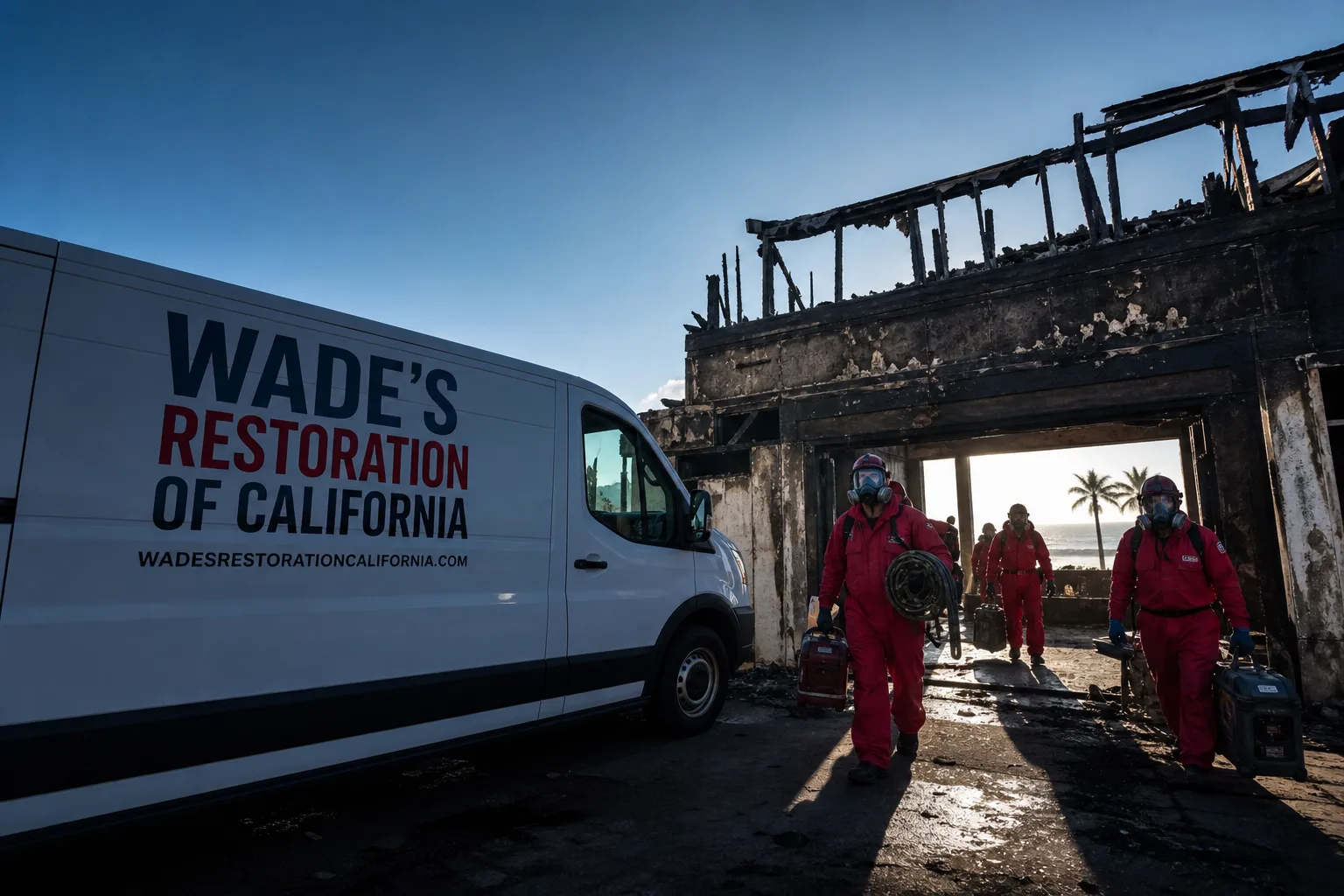
Fast, Reliable Storm & Disaster Restoration Across Communications Hill
Storm damage on Communications Hill hits different than it does down in the flatlands. The wind-driven rain off the South San Jose basin slams into those EIFS-clad townhome stacks on 15 to 20 percent grades, and water that gets behind synthetic stucco travels vertically through shared framing before anyone sees a stain. That’s why you need a crew that knows this hill, not a national chain that treats Communications Hill like any other ZIP. We’re Wade’s Restoration of California, and Wade Ferris answers his own phone at (855) 915-0646, day or night. When a January storm sequence rips through 95136, we’re the ones hand-carrying extraction gear up Heights Drive because the truck can’t make the grade.
Why Wade’s Restoration of California Is Communications Hill’s Preferred Storm & Disaster Restoration Company
Ask anyone on your street. We’ve been pulling water out of Communications Hill townhomes since 2007, and Wade’s name is on the truck, not a franchise logo. The difference matters when you’re dealing with a multi-unit HOA claim and three owners want answers. Wade deals with adjusters directly, hands homeowners complete moisture logs, and stands behind every storm job with the 90-Day Done Right Promise, in writing.
Response time to Communications Hill is measured in the time it takes to get up the hill, not across town. Our crews know Cahalan Avenue, Hillsdale Avenue, and the switchbacks that make staging equipment a genuine problem. When a wind-driven rain event breaches a weep screed on a third-floor unit, we’re not spending the first hour figuring out where to park the desiccant. We already know.
We’ve rebuilt enough Communications Hill units to understand the politics of shared-wall water damage. The homeowner sees a ceiling stain. The HOA sees a liability question. The neighbor two floors down sees wet flooring. We document the vertical moisture path in every affected unit, which is the only thing that keeps a three-party claim from becoming a three-party fight.
Our Storm & Disaster Restoration Services in Communications Hill
Storm Damage Cleanup
Wind-driven rain on Communications Hill doesn’t just wet the outside of a building. It finds the builder-grade flashing and weep screeds that were never meant for this kind of exposure. Storm cleanup here means opening up EIFS walls, drying framing that’s been wet for weeks, and making sure mold hasn’t taken hold behind the stucco before we close anything up. We use Dri-Eaz desiccants and Injectidry mats sized for the job, and we log moisture readings every single day until the structure is dry.
Flood Damage Restoration
Flood damage in Communications Hill comes from two directions: storm water pushed against lower-elevation foundation walls and garage entries by the hill’s aggressive drainage, and plumbing or appliance failures inside units that send water through shared framing into neighboring ownerships. Either way, speed matters. We get extraction running inside the hour when Wade heads out, and our framing-level drying approach means the unit below yours stays dry while we work. For multi-unit events, we coordinate directly with HOA insurers so nobody’s left relaying messages between three different adjusters.
Emergency Board-Up
When a storm blows out a window or door on a Communications Hill townhome, the exposed opening faces the same wind that did the damage in the first place. We board up fast, but we do it right: weather-stripped, sealed, and anchored for a 20 percent grade. On stacked flats, we also check adjacent units for impact damage from the same wind event because glass and debris travel sideways on this hill more than anywhere in San Jose’s flatland neighborhoods.
Roof Tarping
Roof tarping on Communications Hill is a high-wind job, not a flatland job. Shared roof structures mean one section of lifted membrane or cracked flashing threatens multiple units below. We tarp immediately to stop active intrusion, then document the covered area thoroughly for the HOA and unit owner’s carriers. Where access requires working on a 15 to 20 percent grade, we stage materials on the nearest level section, often Cahalan Avenue or a flat driveway apron, and hand-carry everything up. It adds hours. It’s the only safe way.
Trusted Brands We Service in Communications Hill
We’re IICRC-certified and RIA-affiliated, and we run professional-grade equipment, not rental-store gear. Our trailers carry Dri-Eaz desiccants, Injectidry drying mats, and XPOWER air movers sized for multi-room residential extractions. What that means for a Communications Hill homeowner is simple: the equipment matches the scope, whether it’s a single unit on Heights Drive or a three-unit vertical moisture event. We keep common parts and materials in local stock specifically for the townhome stacks and stacked flats up here, so we’re not waiting on a warehouse run when your ceiling is dripping.
Common Storm & Disaster Restoration Problems We See in Communications Hill Homes
- EIFS stucco traps moisture for weeks. The synthetic stucco on Communications Hill’s 2000s and 2010s townhomes is great at shedding rain until a crack forms, then it becomes a moisture barrier that holds water against the framing. By the time a stain shows on an interior wall in February, mold has often been growing since December.
- Wind-driven rain breaches window frames and weep screeds first. Hilltop exposure means storm water hits window frames at angles builders never tested for. We routinely find original flashing that was never sealed properly at installation, and the first big November storm finds it.
- Vertical water migration through shared walls turns one claim into three. In three- and four-story attached stacks, water travels down through engineered lumber and delaminates engineered wood flooring two or three floors below the source. We’ve documented this pattern repeatedly on Communications Hill, and it changes how the HOA carrier, the unit owner’s carrier, and the affected neighbor’s carrier all scope the loss.
- Steep-grade access complicates every stage of restoration. Desiccant units, air movers, and extraction mats don’t roll up 15 to 20 percent grades. Our crews hand-carry equipment up exterior stairs on nearly every job on Communications Hill, and any dumpster or pod staging has to happen a block away on level ground. It adds hours and it adds cost, so we plan for it from the first call instead of discovering it on day two.
Pricing for Storm & Disaster Restoration in Communications Hill, CA
Storm damage cleanup in Communications Hill typically runs $1,800 to $4,200 for a single-unit intrusion that requires opening walls, drying framing, and replacing affected drywall and insulation. Flood damage restoration from a plumbing burst or appliance failure inside an attached townhome runs $2,500 to $9,000 depending on how many ownership units the water traveled through before detection. Emergency board-up is typically $350 to $850 per opening, and roof tarping on a shared Communications Hill roof structure runs $500 to $1,500 depending on the area covered and the wind exposure during installation. The hill’s access challenges add 10 to 20 percent compared to flatland San Jose restoration work because of the hand-carrying and staging hours. We offer free estimates and we’ll put the scope in writing before any work starts. Call (855) 915-0646 and Wade will walk you through it.
We Also Serve Cities Near Communications Hill
Our crews work all over Communications Hill and the surrounding South Bay. We also serve San Jose, Campbell, Alum Rock, and East Foothills. If you’re on the hill or just below it, the same local crew that knows 95136 is the crew that shows up. Same owner, same phone number, same 90-Day Done Right Promise in writing.
Serving Communications Hill, CA - Our Local Coverage Area
We’re based in the Communications Hill area and know this community well. Use the map below to see our service coverage - if you’re nearby, we can almost certainly help.
FAQs - Storm & Disaster Restoration in Communications Hill
When water migrates through shared framing into multiple units, you need a restoration report that documents the exact moisture path from source unit to affected neighbors. We map the vertical migration, take moisture readings in every affected unit, and provide the same documentation to the HOA carrier, your carrier, and your neighbor’s carrier. Wade deals with adjusters directly so you’re not the one relaying information between three parties. Call (855) 915-0646 and we’ll start the documentation before the water spreads further.
Yes, but it’s a logistical problem we plan for from the first call. Trucks and trailers stage on the few level sections like Cahalan Avenue or flat driveway aprons, and our crew hand-carries desiccant units, air movers, and extraction mats up exterior stairs to reach the affected unit. It adds hours to every job, which is why our Communications Hill estimates account for hill access rather than pretending it’s a standard driveway drop. We’ve done this enough times that the crew knows exactly which switchbacks work and which ones don’t.
EIFS stucco creates a synthetic exterior layer that keeps water out until it doesn’t, and then it holds moisture against the framing instead of letting it evaporate. Wood-sided homes show water damage quickly through cracked paint and visible rot. On Communications Hill, where wind-driven rain pounds the hilltop exposure from November through March, moisture can sit behind EIFS for weeks before anyone sees a stain. By the time it shows, the mold remediation scope is almost always larger than it would have been with wood siding. We check stucco cracks every time we’re on the hill because we know what hides behind them.
Wind-driven rain breaching builder-grade flashing and weep screeds at window frames and garage entries. The hill’s exposed position above the South San Jose basin means storm water hits these weak points at angles and velocities that flatland homes never experience. Once water gets behind the EIFS, it travels vertically through shared framing and delaminates engineered wood flooring two or three floors below the source. The biggest risk is not the first intrusion but the weeks of undetected moisture migration that follow.
Yes, and the tarping is almost always a shared-responsibility issue between the HOA and the affected unit owners. A section of lifted membrane or cracked flashing on a shared Communications Hill roof threatens every unit below it, and the first step is stopping active intrusion immediately. We tarp the affected area, document the condition thoroughly for the association’s insurer, and provide the same report to each affected unit owner’s carrier. Waiting for a committee decision while water keeps coming in only multiplies the restoration scope. Call (855) 915-0646 and we’ll start tarping now while the paperwork catches up.
Why Local Knowledge on Communications Hill Changes Everything
Here’s what we mean by local knowledge. On a January storm sequence a few years back, our crew staged a Dri-Eaz desiccant and Injectidry mats a block away on Cahalan Avenue because the truck couldn’t make the grade to Heights Drive. We hand-carried everything up exterior stairs to a third-floor unit where wind-driven rain had penetrated a weep screed crack and delaminated engineered wood flooring two floors below. By the time the HOA located the source, the moisture had already traveled through three ownership units. We documented the vertical path in all three units for the association’s insurer and dried the framing in place rather than ripping out half the building. That’s the kind of job that doesn’t happen on flatland San Jose streets, and it’s the kind of job we’ve learned to do well because Communications Hill keeps teaching us.
This page is the only storm and disaster restoration resource written specifically for Communications Hill’s steep, attached, EIFS-clad townhome stacks. The multi-unit moisture migration and hill-access logistics change every scope of work up here, and if you’re reading this on a day when water is actively moving through your walls, don’t wait. Wade Ferris answers his own phone at (855) 915-0646, and the 90-Day Done Right Promise is in writing on every storm job. Free estimates, no trip charge inside our own county, and a Senior & Veteran 10% discount that’s permanent, not a promo.
Written by Wade Ferris, Owner at Wade’s Restoration of California, serving Communications Hill since 2007.