
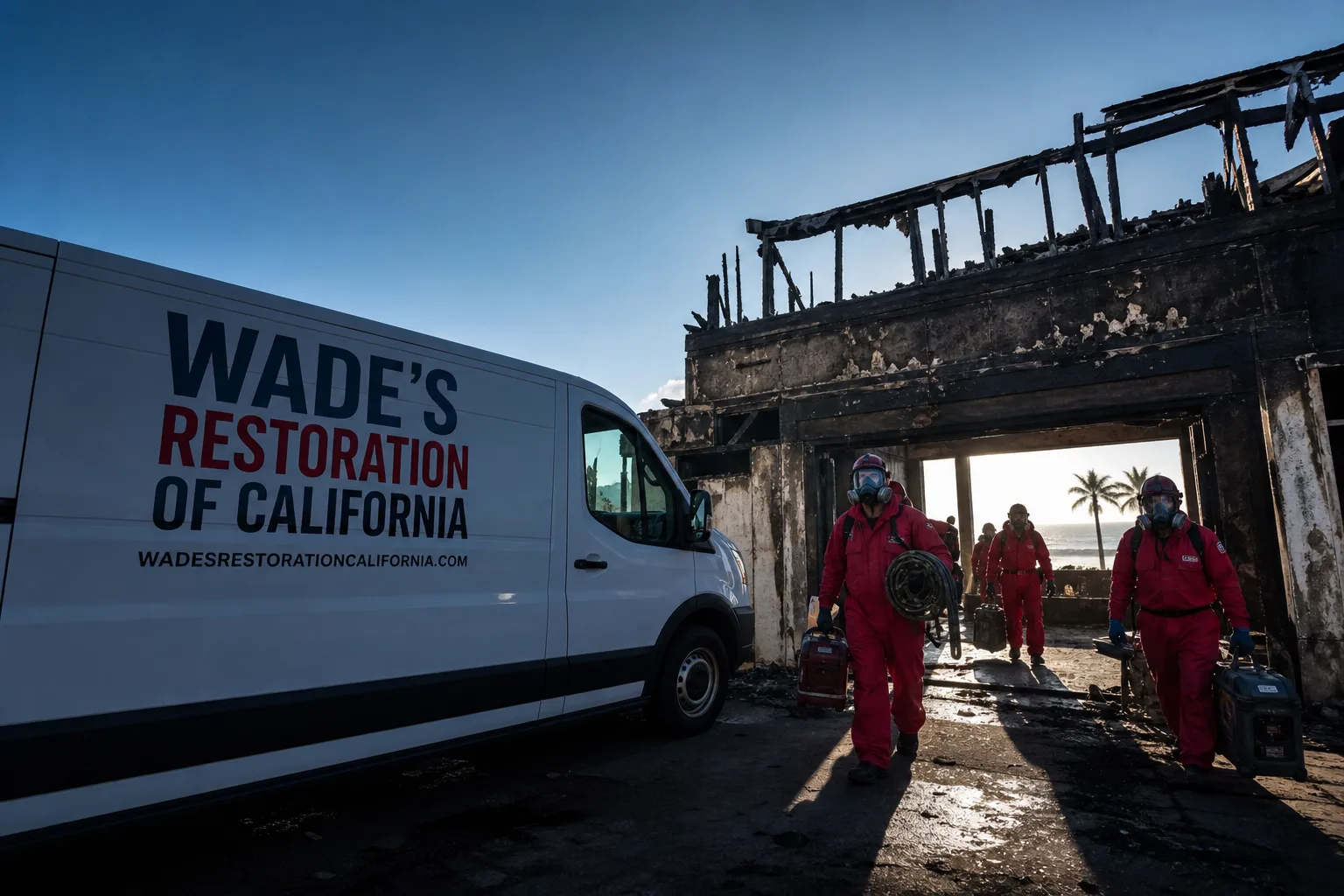
Fast, Reliable Storm & Disaster Restoration Across Belmont
Storm damage in Belmont rarely announces itself politely. It shows up at 2 a.m. when a eucalyptus limb punches through a roof off Hastings Drive, or when an atmospheric river soaks the hillsides above Ralston Avenue and groundwater starts forcing its way through your foundation walls. Here’s the straight answer: storm and disaster restoration in Belmont typically runs $800 to $4,500 for emergency extraction and board-up, $2,500 to $12,000 for full flood damage restoration depending on square footage, and we can usually have a crew on your street inside the hour. When you call (855) 915-0646, Wade Ferris himself answers the phone. Not a call center. Not a queue.
Why Wade’s Restoration of California Is Belmont’s Preferred Storm & Disaster Restoration Company
Wade’s Restoration has been owner-operated since 2007, and the owner’s name is on the truck, the license, and the phone that rings at midnight. That matters in Belmont, where the houses climb into the Santa Cruz Mountain foothills and the storm problems are genuinely local: slope-driven water intrusion, fog-trapped moisture in vented crawl spaces, and mid-century drainage systems that were never built for the rainfall we’ve seen in the 2016-17 and 2022-23 atmospheric river seasons. We’ve worked on enough Belmont hillside homes to know that the visible damage is often downstream of something uphill.
Local reputation matters more than any marketing claim. Ask anyone on your street off Ralston Avenue or in the 94002 zip code. Belmont homeowners talk to each other, and word travels when a restoration crew shows up on time, documents everything, and doesn’t oversell the work. Wade’s crew is background-checked and uniformed, we carry IICRC certification and RIA affiliation, and every storm restoration job gets the 90-Day Done Right Promise. In writing. If it’s not done right, Wade comes back and makes it right.
Response time to Belmont is typically under an hour from the moment you call. Wade coordinates crews from the Bay Area office, but the people who show up know Belmont’s streets: Ralston, Alameda de las Pulgas, El Camino Real. They know which hillside blocks get the worst groundwater push after a heavy rain sequence, and they bring the right equipment from Dri-Eaz and Phoenix to start extraction immediately.
Our Storm & Disaster Restoration Services in Belmont
Storm Damage Cleanup
Storm damage cleanup in Belmont usually means more than hauling wet drywall. It means tracing the moisture source first, because the piece of water you can see is rarely the whole story. Whether it’s a downed tree on a Twin Pines yard, a blocked hillside drain sending sheet water toward a daylight basement, or a wind-torn section of roof, we secure the site, extract standing water, and dry the structure before reconstruction starts. Storm cleanup in Belmont’s older housing stock also means checking the crawl space, where fog-trapped humidity turns hidden moisture into mold fast.
Flood Damage Restoration
Flood damage restoration in Belmont runs into a specific problem on the hillside streets above Ralston Avenue: hydrostatic pressure. When winter storms saturate the soil above these sloped lots, water pushes against foundation and stem walls, forcing its way through cracks and joints into the lower level. You see wet drywall and buckled floors, but the source is outside and uphill. We start with extraction and drying, then we trace the slope drainage and correct it, because interior drying alone won’t hold if the groundwater keeps coming. Every flood job is covered by the 90-Day Done Right Promise, in writing.
Emergency Board-Up
When a storm opens your Belmont home to the weather, speed is the whole game. A broken window off San Juan Boulevard or a compromised garage door after a wind event needs board-up fast, before the next rain band arrives. We answer calls live 24/7, Wade heads out himself, and we can board up and tarp the exposed areas the same night. Then we document everything with photos for your insurance file, and we work with your adjuster directly, so you’re not stuck relaying information between two sides.
Roof Tarping
Roof tarping in Belmont buys you time after a tree limb or wind gust tears shingles off a mid-century ranch on a hillside lot. We install the tarp within hours, seal the perimeter to keep water out, and photograph the installation for your claim. The goal is to stop the damage from spreading before the full roof repair is scheduled. And because Belmont homes are old enough that original roof decking is common, we check the deck for saturation while we’re up there, so you know what you’re looking at before a contractor gives you a number.
What happens when you call
- 1
A real person answersNo phone trees - you reach a local pro.
- 2
You get an upfront price rangeHonest numbers before anyone is dispatched.
- 3
A background-checked tech heads outLicensed & insured, dispatched right away.
- 4
You approve before work beginsNothing starts until you say go.
Trusted Brands We Service in Belmont
Wade’s crew uses professional-grade equipment from Dri-Eaz, Phoenix, and Injectidry, and we stock the fittings, hoses, and vapor barrier materials that Belmont hillside jobs require. That means you’re not waiting on a supply house run while your crawl space keeps wicking moisture. We’re IICRC-certified and affiliated with RIA and IFA, but the credentials matter less than the daily moisture readings we take and hand you at the end of every flood restoration job. Almost nobody in the trade does that. Wade does, because he wants you to see exactly when the drying curve flattened and why the structure was ready to close up.
Common Storm & Disaster Restoration Problems We See in Belmont Homes
- Slope-driven water intrusion through foundation and stem walls. Belmont’s hillside neighborhoods, especially the 1950s-70s split-level and daylight-basement homes above Ralston Avenue, fail from hydrostatic pressure after atmospheric river saturation. The visible interior damage is the downstream symptom of groundwater that has to be cut off at the slope.
- Fog-trapped humidity turning hidden moisture into mold. Belmont sits in a geography that funnels marine layer fog between the foothills and the Bay, keeping relative humidity high. After a storm, unventilated crawl spaces in mid-century homes become mold incubators within days, even without standing water.
- Failed retaining walls and French drains re-saturating foundations. On one sloped lot off Ralston Avenue, our crew traced buckled hardwood and wet drywall in a 1960s split-level to a retaining wall that had failed uphill. We cut off the slope source, extracted with Phoenix and Dri-Eaz equipment, and installed a sealed vapor barrier before rebuilding the interior. Without that uphill correction, the drying work would have failed within weeks.
- Original galvanized supply lines and undersized drainage overwhelmed by concentrated rainfall. Homes built in the 1950s through early 1970s often still have original galvanized supply lines and drainage systems designed for lighter loads. The concentrated downpours of atmospheric river sequences push these systems past their limit, causing slab and crawl space intrusion that newer drainage would have handled.
Pricing for Storm & Disaster Restoration in Belmont, CA
We Also Serve Cities Near Belmont
Beyond Belmont, Wade’s Restoration handles Storm & Disaster Restoration for homeowners in Belmont and the surrounding Peninsula communities, including San Carlos, San Mateo, Redwood Shores, and Foster City. If you’re in one of those neighboring cities and dealing with storm damage, the same crew and the same 90-Day Done Right Promise apply. Call (855) 915-0646.
Serving Belmont, CA - Our Local Coverage Area
We’re based in the Belmont area and know this community well. Use the map below to see our service coverage - if you’re nearby, we can almost certainly help.
FAQs - Storm & Disaster Restoration in Belmont
Why does water keep coming back into our Belmont hillside basement after each winter storm, even though we dry it out every time?
Because the moisture source is uphill and outside, and surface drying never addresses it. In Belmont’s hillside neighborhoods above Ralston Avenue, hydrostatic pressure builds in saturated soil after atmospheric river events and forces groundwater through foundation and stem walls. Drying the interior without correcting the slope drainage, failed retaining wall, or clogged French drain that’s feeding the water means the problem returns with the next storm. Wade’s crew traces the source, cuts it off at the slope, and then dries and rebuilds the interior. Call (855) 915-0646 for a free assessment.
How do Belmont’s marine layer fog and high humidity affect storm damage restoration in crawl spaces?
Belmont’s position between the foothills and the Bay funnels and traps marine fog, keeping crawl space humidity elevated even on dry days. After a storm, that means a vented crawl space in a 1960s home will hold moisture longer and mold can colonize within days, not weeks. We address this by checking crawl space moisture levels on every flood restoration job, using Phoenix and Dri-Eaz equipment to dry the space, and recommending vapor barrier installation where the original 1950s-70s construction never had one.
What’s different about storm restoration for a 1960s split-level on a Belmont hillside versus a newer home on flat ground?
The failure mode is different. A newer home on flat ground in San Carlos or San Mateo typically deals with roof leaks, gutter overflow, or surface water pooling. A 1960s split-level on a Belmont hillside deals with gravity and groundwater: saturated soil pushing against foundation walls from the uphill side. That requires equipment and experience specific to slope drainage correction, not just interior extraction. Wade’s crew has worked enough of these homes to know that the uphill correction has to happen before any interior drying will hold.
After heavy rain, our Belmont home’s lower level has wet drywall but the roof is fine - where is the water coming from?
From groundwater, in most cases. On Belmont’s hillside streets, the water isn’t falling on your roof, it’s saturating the soil above your foundation and pushing through the stem wall or slab joint. The tell is wet drywall at the base of walls on the downhill side of the house, often with no corresponding roof leak. Wade’s storm restoration team will trace the moisture source uphill, check the retaining walls and drainage, and fix the entry point before drying. Call (855) 915-0646 and Wade himself will come out and look.
Do we need to worry about mold in our Belmont crawl space after just one storm, even if the water drained away?
Yes, especially in Belmont’s fog-trapped microclimate. Even after standing water drains, the crawl space humidity stays elevated far longer than you’d expect, and mold can take hold within days on saturated framing and subfloor. Mid-century Belmont homes with vented crawl spaces and no vapor barrier are the most vulnerable. We check crawl space moisture on every storm restoration job, and we’ll tell you honestly whether you need full remediation, a vapor barrier, or just drying. Call (855) 915-0646 for a straight answer.
Written by Wade Ferris, Owner at Wade’s Restoration, serving Belmont and the surrounding Peninsula communities since 2007.