
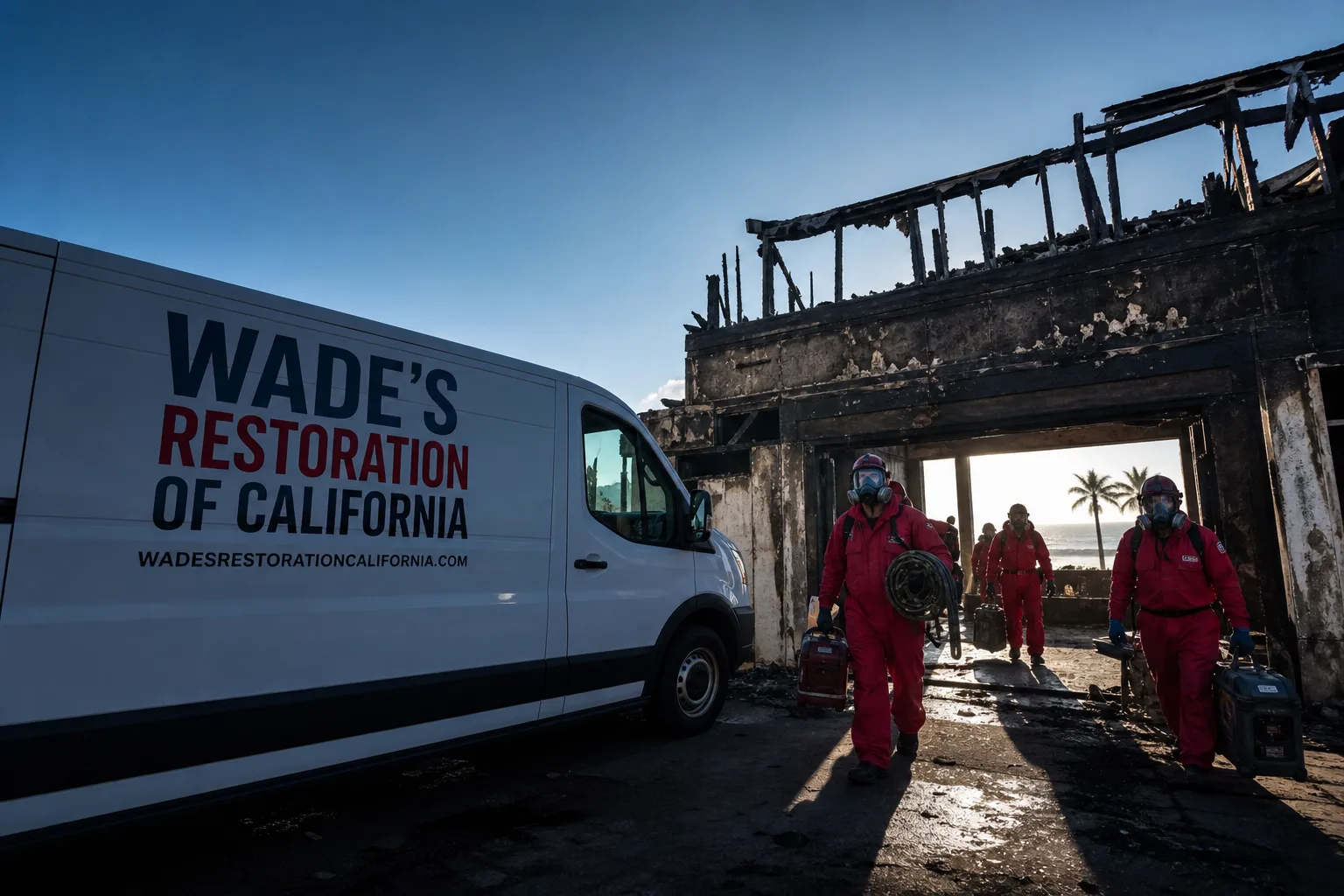
Fast, Reliable Sewage Cleanup Across Koreatown
A sewage backup in Koreatown is rarely just one unit’s problem. Our crews know this neighborhood’s buildings, and we respond to sewage calls across 90005 with the assumption that a ground-floor backup usually means contaminated water is already moving through shared wall cavities, a crawl space, or the units below. Call (855) 915-0646 and you’ll reach a live person who can have a crew heading your way from the Los Angeles office within the hour. Wade Ferris answers his own phone, and he will be the one making sure the job gets scoped correctly before anyone starts tearing out drywall.
Why Wade’s Restoration of California Is Koreatown’s Preferred Sewage Cleanup Company
Koreatown property managers and owners call us because we understand what a sewage loss here actually involves. When a cast-iron waste stack fails in a 1930s courtyard building on South Oxford Avenue, the contaminated water doesn’t respect unit lines. We’ve been called into buildings where a single clogged main sent black water up through ground-floor toilets while second-floor tenants had no idea anything was wrong. That’s not a one-bathroom mop-up. That’s a multi-unit containment job, and our Sewage Cleanup team approaches every Koreatown call that way from the first assessment.
Our reputation in Koreatown comes from showing up when the problem is still spreading. Wade’s trucks carry Dri-Eaz extractors, XPOWER air movers, and Phoenix dehumidifiers sized for the long hallways and tight courtyard access that define so many buildings here. We coordinate directly with insurance adjusters, so a landlord dealing with two affected units and three carriers isn’t stuck relaying paperwork between everyone. Every job gets a written scope before work starts, and the 90-Day Done Right Promise applies in writing. If something isn’t right, Wade comes back and makes it right.
Our Sewage Cleanup Services in Koreatown
Sewage Cleanup work in Koreatown almost always runs deeper than the visible spill. Here’s what we handle most often.
Sewage Backup Cleanup
When a main line clogs in a dingbat-style walk-up on Wilshire or a courtyard building off Western, sewage follows gravity to the lowest drains first. That means a ground-floor unit gets the worst of it while upper floors may only notice odors. We extract the standing black water, remove contaminated drywall and flooring, and set up containment so the contamination doesn’t spread through open stairwells and shared hallways. Koreatown’s tightly stacked units mean we’re almost always working around occupied apartments, so we set up negative air pressure and plastic barriers fast.
Toilet Overflow Cleanup
A toilet overflow in one Koreatown unit can leak through original tongue-and-groove subflooring into the unit below. In 1920s and 1930s buildings, those subfloors are often layered with decades of repair patches, and black water finds every gap. We remove the affected flooring, dry the framing with Phoenix dehumidifiers, and sanitize with an EPA-registered antimicrobial. We don’t just dry the visible floor and call it done. That approach leaves contamination sealed inside the floor assembly, and Koreatown’s warm weather makes the odor come back fast.
Septic Failure Cleanup
Some older Koreatown properties still tie into aging septic systems, and when a leach field fails, the backup can push sewage through basement drains and crawl spaces. We locate the failure, extract the sewage that’s already inside, and dry the affected areas. In a stacked building, we also check the adjoining units’ crawl space venting, because septic gas and moisture migrate horizontally through shared foundation openings.
Black Water Extraction
Black water, the technical term for sewage-contaminated liquid, requires more than a wet vac and some fans. Our crews use truck-mounted Dri-Eaz extractors to pull standing water and sewage fast, then move into structural drying. In Koreatown’s concrete-and-wood hybrids, black water saturates subfloor assemblies and wall cavities quickly. We remove contaminated materials, dry what can be saved, and document every step with photos for the adjuster.
Crawl Space Sewage Removal
Koreatown’s older buildings often have shallow crawl spaces under the rear units, and when a waste line breaks, sewage pools there for days or weeks before anyone notices the smell. We send crew members in with proper PPE to extract the waste, remove contaminated soil, and install temporary ventilation while the structure dries. We also pressure-test neighboring sections of the waste line so you’re not back in the same crawl space a month later.
Sanitization & Disinfection
After extraction and removal, every affected surface gets treatment with an EPA-registered antimicrobial. In multi-unit Koreatown buildings, that includes shared spaces, because sewage backups under one unit often push contaminated air into hallway chases and utility closets. We write the sanitization scope into the original estimate, not as a surprise add-on after the fact.
What happens when you call
- 1
A real person answersNo phone trees - you reach a local pro.
- 2
You get an upfront price rangeHonest numbers before anyone is dispatched.
- 3
A background-checked tech heads outLicensed & insured, dispatched right away.
- 4
You approve before work beginsNothing starts until you say go.
Trusted Brands We Service in Koreatown
We’re certified through IICRC and affiliated with RIA, and our crews work with professional-grade equipment from Dri-Eaz, XPOWER, and Phoenix. That matters here because Koreatown’s older buildings need drying equipment sized for long runs of framing and tightly stacked floor plates. Store-bought dehumidifiers can’t move enough air to dry a saturated subfloor assembly spanning two units. Our equipment can, and we bring the moisture logs to prove it.
Common Sewage Cleanup Problems We See in Koreatown Homes
- Shared cast-iron waste stacks failing at bell joints. Koreatown’s 1920s-40s courtyard apartments often run one vertical waste line for multiple stacked units. A crack at a bell joint leaks sewage into the wall cavity where it spreads into adjoining units before any surface sign shows.
- Ground-floor backups in soft-story buildings. A clogged main in a 1960s dingbat sends sewage up through the lowest drains first. The ground-floor unit floods while upper-floor tenants smell something wrong but see nothing.
- Post-retrofit penetrations through original framing. LA’s soft-story seismic retrofit ordinance required new framing connections through old wood. Those penetrations sometimes become new channels for sewage-tainted moisture, hiding contamination until mold is established.
- Mineral-heavy water corroding galvanized supply and drain lines. LA water leaves scale and mineral deposits that eat through galvanized pipe from the inside. In Koreatown’s older buildings, those pipes run inside shared walls, so the failure point is hidden until the leak crosses a unit line.
Pricing for Sewage Cleanup in Koreatown, CA
We Also Serve Cities Near Koreatown
Our crews regularly handle sewage damage in Los Angeles and the surrounding neighborhoods including Echo Park, Silver Lake, and Hollywood. If you own property in Koreatown plus another building nearby, one call covers both. Sewage Cleanup in Koreatown is what we know best, but the same equipment and the same written-scope process go everywhere we work.
Serving Koreatown, CA - Our Local Coverage Area
We’re based in the Koreatown area and know this community well. Use the map below to see our service coverage - if you’re nearby, we can almost certainly help.
FAQs - Sewage Cleanup in Koreatown
Why do sewage backups in Koreatown often affect more than one apartment at a time?
Because many Koreatown buildings from the 1920s through 1970s share a single vertical cast-iron waste stack serving vertically stacked units. When the stack clogs or cracks, sewage backs up through the lowest drains and leaks through wall cavities into adjoining units. We always inspect the neighboring units when we arrive, not just the one that called. Call (855) 915-0646 and describe the building’s layout so we can bring enough containment on the first trip.
How quickly should I act if sewage has leaked into the crawl space under a Koreatown apartment building?
Immediately. Sewage pooling in a crawl space under a 1930s building off South Oxford Avenue is already wicking into floor joists and subflooring, and in Koreatown’s warm weather the bacterial load grows fast. The longer it sits, the more framing has to be removed and replaced. We can have extraction running the same day you call.
Can you repair a cracked cast-iron sewage line inside a 1920s Koreatown wall cavity, or does it need replacement?
It depends on the crack’s location and the condition of the surrounding pipe, but in most 1920s Koreatown buildings we see, the cast-iron is past its service life and patching one bell joint buys you months, not years. We’ll open the wall, show you the section, and give you a written repair-versus-replace recommendation before we ask you to spend anything.
After a toilet overflow in a Koreatown unit, is it enough to just clean the visible floor and dry it with fans?
No. In Koreatown’s older buildings, toilet overflow travels through tongue-and-groove subflooring and into the unit below, and box fans can’t dry the inside of a floor assembly. What looks dry on top stays wet underneath, and within a few weeks you’ll smell it. We remove the affected flooring, dry the framing with Phoenix dehumidifiers, and sanitize. Skipping that step just means paying for a bigger tear-out later.
Do you handle insurance coordination for sewage cleanup that spans multiple Koreatown units and landlords?
Yes. Wade deals with adjusters directly, and when a single waste stack failure affects three units with three different carriers, we document everything with photos, moisture logs, and a written scope for each claim. You’re not stuck relaying information between landlords, tenants, and insurers. Call (855) 915-0646 and we’ll start the documentation on the first visit.
Call Wade’s Restoration of California for Sewage Cleanup in Koreatown
If sewage is backing up in your Koreatown unit right now, call (855) 915-0646. Wade answers his own phone, 24/7, and he will tell you straight what needs to happen and how fast he can get there. If you’re a landlord, property manager, or owner dealing with a multi-unit claim, ask for the written scope and the direct adjuster line. We’ve handled the cascade failures that come with 1920s cast-iron stacks and soft-story framing, and we’ll walk you through it the same way we would for a neighbor on our own street. Free estimates. No trip charge inside the county. And the 90-Day Done Right Promise in writing on every job.
Written by Wade Ferris, Owner at Wade’s Restoration of California.