
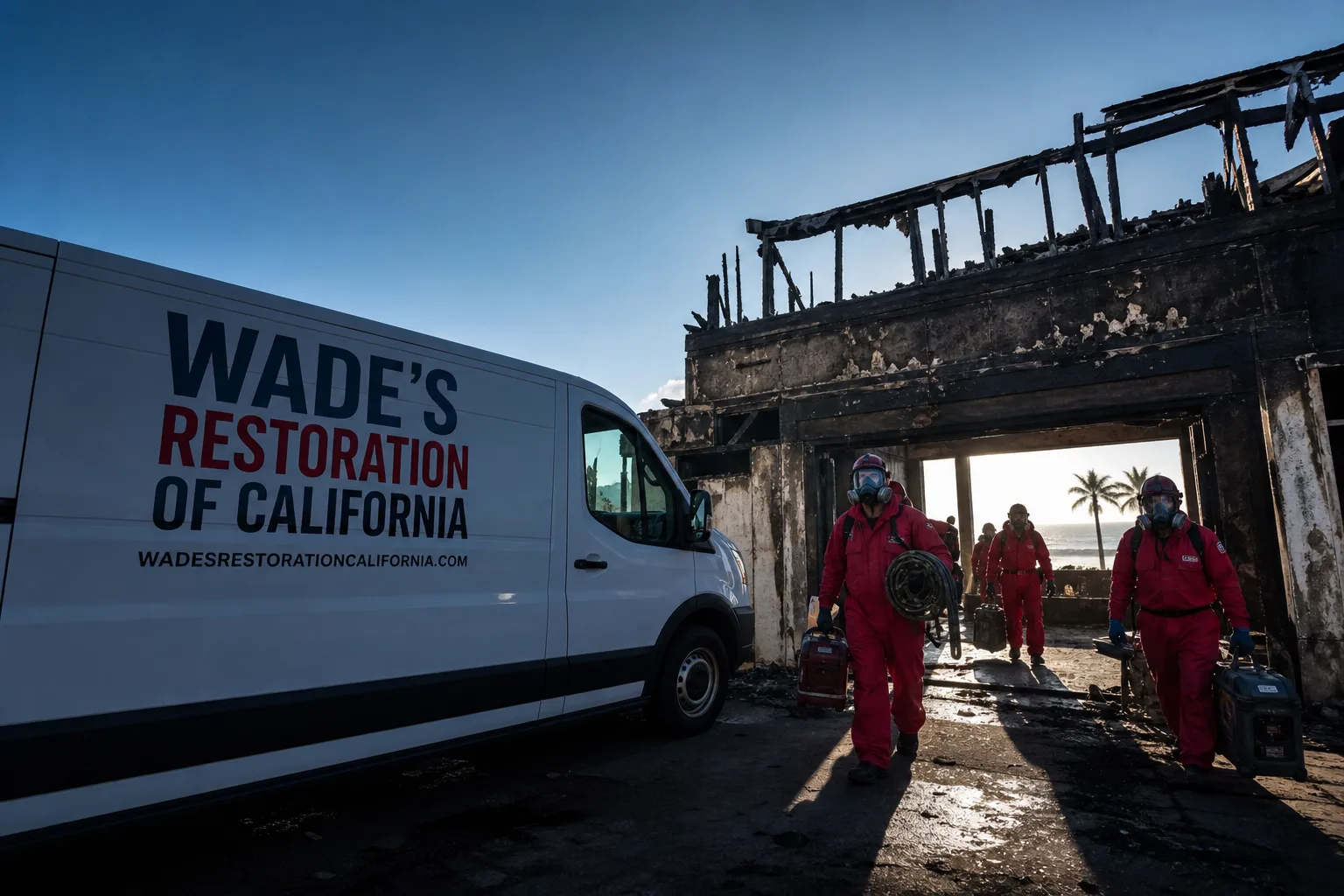
Fast, Reliable Sewage Cleanup Across East Foothills
A sewage backup in East Foothills rarely stays put. The slope sends it downhill into crawl spaces, garages, and the lowest corner of the house, fast. We know because we’ve pulled black water out of 1960s crawl spaces off Toyon Avenue, Alum Rock Avenue, and the hillside streets above McKee Road more times than we can count.
If you’ve got sewage backing up into a tub, a toilet overflowing, or a smell coming from the crawl space that wasn’t there yesterday, call Wade’s Restoration of California at (855) 915-0646. Wade answers his own phone. He’ll tell you what he’d do if it were his house, and he can have a crew at your door within the hour. No voicemail. No answering service. A real person, 24/7.
Why Wade’s Restoration of California Is East Foothills’s Preferred Sewage Cleanup Company
Wade Ferris started this company in 2007 with his name on the truck and his cell number printed on the estimate. That matters in East Foothills, where a handshake at the Alum Rock Village still means something and homeowners want to know the guy doing the work is the guy they’ll run into at the grocery store next week.
We’ve worked on homes from the flat streets near Capitol Avenue up to the ridge lines where the lots get steep and the crawl spaces get tight. Our crews are IICRC-certified and RIA-affiliated, background-checked, and they show up in uniform. But what East Foothills homeowners tell us matters most is that Wade documents everything, hands over daily moisture readings, and deals with the insurance adjuster directly so you’re never the one stuck relaying messages between two sides. Every sewage job is covered by the 90-Day Done Right Promise, in writing. If it’s not right, Wade comes back and makes it right.
Our Sewage Cleanup Services in East Foothills
Sewage cleanup isn’t one job, it’s a category. Here’s what we handle most in the 95127 ZIP, and how it plays out in East Foothills homes specifically.
Sewage Backup Cleanup
Sewage backup in East Foothills usually announces itself the same way: a gurgle in the lowest drain, then dark water rising in the shower pan or laundry basin. In post-war tract homes on the lower slopes, the original cast-iron laterals have been in the ground for sixty-plus years and root intrusion is common. On hillside lots, gravity makes backups worse, because the water doesn’t pool at floor level. It finds the downhill path and runs toward the garage or crawl space. We extract, sanitize, and dry the affected space, then document everything for your insurer. You can read more about how we approach these jobs on our Sewage Cleanup page.
Toilet Overflow Cleanup
A toilet overflow in East Foothills is never just a mop-and-done situation. Toilet water is Category 2 or Category 3 water, depending on what’s in it, and it soaks into the subfloor fast. In 1950s and 1960s tract homes where the bathroom sits over a crawl space, that overflow can migrate through the floor assembly and drip into the crawl space below before you even realize the wax ring failed. We pull the toilet, remove contaminated flooring when needed, and use low-odor botanical antimicrobials to sanitize the framing instead of bleach-heavy products that off-gas into a closed-up house.
Septic Failure Cleanup
A good share of East Foothills homes, especially the hillside customs and the older places on larger lots, run on septic. When a leach field fails or a tank backs up during heavy rain, the sewage doesn’t always come up through the drains. Sometimes it surfaces in the yard, sometimes it backs into the lowest bathroom, and sometimes the odor is the first indicator something has gone wrong underground. We handle the interior cleanup side, and we’ll tell you plainly if the problem is a plumbing fix, a septic pump, or something the county needs to inspect. You won’t get a sales pitch. You’ll get the truth.
Black Water Extraction
Black water, Category 3 water, is the kind that carries human waste, pathogenic bacteria, and the stuff that makes people sick. In East Foothills, we encounter it in low-clearance crawl spaces more than anywhere else. Our techs use a Dri-Eaz Rover for extraction in spaces where a person can’t stand up, then XPOWER and B-Air air movers to dry the subfloor framing. We take moisture readings every single day and hand you the full log when the job’s done. Almost nobody in the trade does that. We do it because Wade would want it done for his own house.
What happens when you call
- 1
A real person answersNo phone trees - you reach a local pro.
- 2
You get an upfront price rangeHonest numbers before anyone is dispatched.
- 3
A background-checked tech heads outLicensed & insured, dispatched right away.
- 4
You approve before work beginsNothing starts until you say go.
Trusted Brands We Service in East Foothills
East Foothills homes weren’t built by one builder, and their plumbing reflects it: original cast iron, 1970s copper, galvanized, early-era ABS. That means a sewage cleanup job here is rarely as simple as pump and dry. We work with what’s there, and we stock parts and drying equipment for the systems these homes actually have. Wade’s crews use professional-grade gear from Dri-Eaz, Phoenix, Injectidry, and XPOWER, and our IICRC and RIA credentials mean the work gets done to the industry’s highest standard, not to whatever a fly-by-night outfit thinks is “good enough.” If an old pipe needs scoping before we dry, we’ll tell you. If the floor has to come out, we’ll show you why before we touch it.
Common Sewage Cleanup Problems We See in East Foothills Homes
- Original galvanized waste lines failing silently. On 1960s hillside homes, soil movement from the Calaveras Fault zone causes pinhole leaks in old galvanized waste pipe. Sewage seeps into crawl spaces or wall cavities long before any visible backup, and by the time the smell surfaces, the contamination has been ongoing for weeks.
- Cracked clay laterals on sloped lots. Stepped and pier-and-grade-beam foundations shift slightly over time. That movement cracks old clay sewer laterals, causing slow exfiltration that saturates the soil and re-enters basements or crawl spaces during atmospheric river events.
- Downhill migration into crawl spaces. Unlike flatland San Jose, where a backup floods the laundry room floor and stays there, an East Foothills backup follows the hill. It runs into the low end of the crawl space and pools under the house, soaking subfloor framing and insulation out of sight.
- Hidden dry rot weeks after the backup. Post-war tract homes in East Foothills often have minimal attic insulation and original venting. Moisture from a sewage backup can wick upward through wall cavities and subfloors, and the dry rot doesn’t show itself for weeks. That’s why daily moisture logs matter, and why we hand them over at the end of every job.
Pricing for Sewage Cleanup in East Foothills, CA
We Also Serve Cities Near East Foothills
We work all through the foothills and the valley below. If you’re in Alum Rock, San Jose, Milpitas, or Communications Hill, you’re still in our service area and you’ll get the same response time, the same written scope, and the same person answering the phone. Check out our Sewage Cleanup in East Foothills coverage for more detail, or just call. If we can’t get to you fast, we’ll tell you that straight.
Serving East Foothills, CA - Our Local Coverage Area
We’re based in the East Foothills area and know this community well. Use the map below to see our service coverage - if you’re nearby, we can almost certainly help.
FAQs - Sewage Cleanup in East Foothills
Why do East Foothills homes built in the 1960s often experience sewage backups during heavy rain, even without a clog?
Because the slope and the old pipe work together against you. Heavy rain saturates the hillside soil, which then shifts slightly under the weight. That movement cracks old clay or cast-iron laterals, or it pushes roots deeper into existing cracks, and the stormwater that fills the sewer line from all directions has nowhere to go but back up into the lowest drain in your house. The backup isn’t always a clog in the pipe, it’s a saturation problem in the ground around it, and flatland San Jose homes rarely deal with that exact failure mode. Call (855) 915-0646 and we’ll scope the line before we start drying, so you know what actually failed.
Can sewage from a hillside home’s main line end up in a neighbor’s downhill crawl space?
It can, though it’s not common. When a hillside lateral cracks and exfiltrates, the sewage moves with groundwater downhill through the soil. If a downhill neighbor has a crawl space with open vents or a low foundation, contaminated groundwater can find its way in, especially during heavy rain when the water table is high. This is a known issue in the steeper parts of the 95127 ZIP, and it’s one reason we always check the downhill drainage pattern when we respond to a neighborhood sewage event. If you suspect a neighbor’s line is affecting your property, call us. We’ll assess it, document it, and coordinate with whoever needs to fix it.
Do older East Foothills homes with original cast-iron pipes need full pipe replacement after a sewage backup?
No. A backup doesn’t automatically mean you need to tear out every foot of original cast iron. In a lot of 1960s tract homes, the pipe under the slab is still solid and the failure is in one section, often where the lateral leaves the foundation. We’ll tell you what we see after we scope it. If the pipe has pinhole leaks from decades of soil movement, you may need to replace the worst sections. But Wade’s not going to sell you a repipe you don’t need. We’ll show you the camera footage and let you decide with real information in hand.
How do you dry a low-clearance crawl space under a 1950s tract home after a sewage spill, when the access is only 18 inches high?
We use equipment built for that exact situation. The Dri-Eaz Rover is a remote-controlled extraction tool that can pull water out of a crawl space where a person can’t get on their knees. Then we place compact air movers, like the XPOWER X-47AT and B-Air Grizzly, to circulate air through the subfloor framing. Those units are small enough to fit in an 18-inch clearance, and they push enough air to dry the framing without us needing to cut open your floor. We take moisture readings daily until the wood is back to Category 1 levels, and we hand you the log.
Is sewage cleanup covered differently in East Foothills compared to flatland San Jose because of the creek and drainage patterns?
Coverage isn’t determined by where you live, it’s determined by your policy language and what caused the backup. But the failure mode in East Foothills, saturated hillside soil causing lateral cracks and infiltration, is something adjusters see more often in the foothills than on the valley floor. Wade deals with the adjuster directly, sends photo documentation of everything we find, and makes sure the claim language reflects what actually happened in your crawl space, not what a generic flatland backup looks like. If your policy has a sewer backup endorsement, that’s where coverage usually comes from. Call (855) 915-0646 and Wade can tell you honestly what your claim is likely to cover before you commit to anything.
Call Wade’s Restoration of California for Sewage Cleanup in East Foothills
If you’ve got sewage where it shouldn’t be, every hour matters. The water keeps moving downhill, the contamination keeps spreading, and the dry rot clock is already ticking. Wade’s Restoration of California has been pulling East Foothills homes out of bad situations since 2007, and we’ve seen everything these hills can throw at a foundation.
Call (855) 915-0646 right now. Wade answers. He’ll tell you what he’d do, give you a straight price over the phone, and have a crew moving within the hour if your situation needs it. Free estimate, no trip charge inside the county, and a 90-Day Done Right Promise in writing. If it’s not done right, Wade makes it right. That’s the deal, and it’s been the deal for 29 years.
Written by Wade Ferris, Owner at Wade’s Restoration of California, serving East Foothills since 2007.