
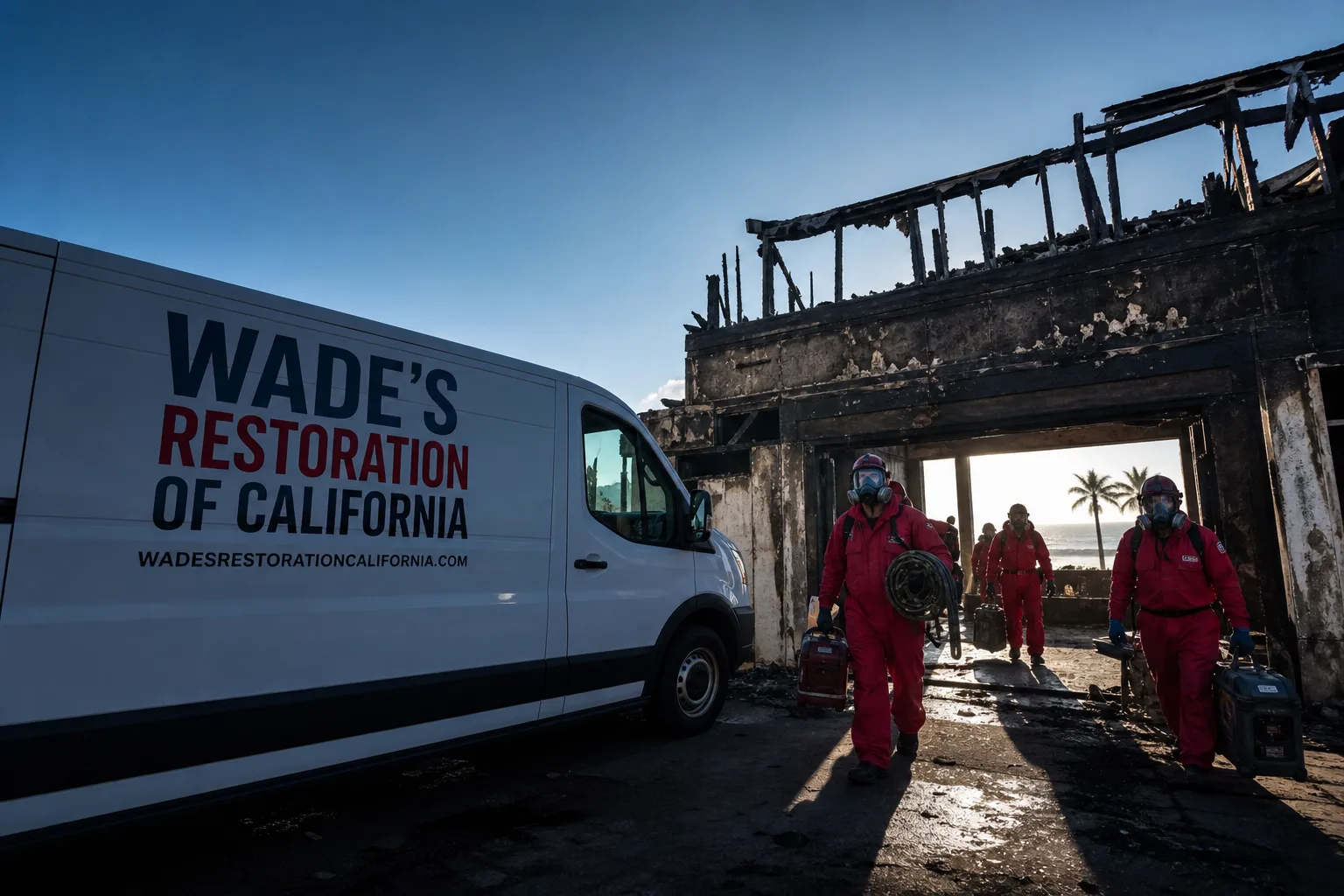
Fast, Reliable Mold Remediation Across Lake Forest
Mold remediation in Lake Forest typically costs $1,500-$4,500 for a contained removal job, and most jobs are fully scoped within 24 hours of the first call. If you smell something musty in a hallway, see discoloration creeping up a baseboard, or just found black spots behind a bathroom vanity, call us at (855) 915-0646. Wade Ferris answers his own phone, and he’ll tell you straight whether you need full remediation or just a targeted cleaning.
Lake Forest homes, especially the wood-frame stucco tract builds from the mid-1970s through the early 1990s, don’t forgive moisture mistakes. A pinhole leak in a galvanized supply line behind a second-story wall can feed mold for months before you ever see it. Add in Santa Ana winds driving rain under eaves and smoke into attic spaces, and you have a mold problem most coastal Orange County cities never face at the same intensity. We know those failure modes. We’ve been pulling wet drywall and sealing crawl spaces in Lake Forest for years, and we know the difference between surface staining and a colony that’s been feeding inside the framing.
Why Wade’s Restoration of California Is Lake Forest’s Preferred Mold Remediation Company
Wade’s Restoration was founded in 2007 by Wade Ferris, and he still runs every job personally. His name is on the truck, his license number is published, and he’ll run into you at the hardware store on a Saturday. That’s the oldest accountability mechanism there is.
Lake Forest homeowners who’ve been burned by national outfits before appreciate the difference. You get a written scope before any work starts. Not a ballpark, not a handshake, a line-by-line written scope. Wade takes moisture readings every single day during a mold job and hands you the full log when the job is done. Almost nobody in this trade does that. You also get the 90-Day Done Right Promise stamped in writing on every mold contract. If it’s not done right, Wade makes it right, no argument.
Calls are answered by a live person 24/7, including Wade himself. He dispatches crews serving Lake Forest from the brand’s Los Angeles office, and background-checked, uniformed technicians arrive with professional-grade equipment from Dri-Eaz, Phoenix, and XPOWER. Wade’s crew holds IICRC certifications and RIA and IFA credentials, so the work meets the industry’s highest standards.
Our Mold Remediation Services in Lake Forest
Mold Inspection & Testing
A proper mold inspection in Lake Forest starts with moisture mapping, not just visual spotting. We use thermal imaging to find cold spots behind walls, moisture meters to trace water migration through framing, and air sampling when the scope calls for it. In Foothill Ranch townhomes especially, hidden mold in shared wall cavities often shows no visible signs inside the unit itself. Inspection typically runs $300-$600 in Lake Forest, and includes a written report you can hand to your insurance adjuster.
Mold Removal
Removal in Lake Forest homes usually means containment, negative air pressure, and physical extraction of contaminated drywall, insulation, or carpet. We set up containment barriers with HEPA-filtered negative air machines from Dri-Eaz and run XPOWER air scrubbers throughout the process. For a typical 10×12 bedroom with moderate mold behind one wall, Lake Forest pricing lands between $1,500 and $3,200 including disposal and antimicrobial treatment.
Black Mold Remediation
Black mold, usually Stachybotrys, grows where moisture has been present for weeks, not days. In Lake Forest, that often means slow leaks from aging galvanized pipes or condensation inside wall cavities. Remediation requires full containment, careful removal, and post-remediation verification. Black mold jobs in Lake Forest typically start around $2,500 and can reach $6,000+ when structural framing must be cleaned and sealed. Wade’s crew handles this with the respect it deserves.
Air Quality Restoration
After any mold job, airborne spore counts must come down to normal background levels. We run HEPA air scrubbers during remediation and take post-job air samples to verify. In Lake Forest, that’s critical after Santa Ana events, because smoke and ash particulates riding the wind can complicate air quality readings. Post-remediation air testing in Lake Forest runs $250-$500 depending on the number of samples.
What happens when you call
- 1
A real person answersNo phone trees - you reach a local pro.
- 2
You get an upfront price rangeHonest numbers before anyone is dispatched.
- 3
A background-checked tech heads outLicensed & insured, dispatched right away.
- 4
You approve before work beginsNothing starts until you say go.
Trusted Brands We Service in Lake Forest
We work on every type of home in Lake Forest, from 1970s single-family ranchers off El Toro Road to attached townhomes near Towne Centre Drive in Foothill Ranch. But the equipment we use matters as much as the structure we’re treating. Wade’s Restoration runs Dri-Eaz dehumidifiers, Phoenix air movers, and XPOWER air scrubbers on every job. IICRC protocols guide our containment setup, and RIA and IFA standards inform our documentation and final verification. That’s not branding. That’s the difference between a job that passes an adjuster’s review and one that gets kicked back.
Common Mold Remediation Problems We See in Lake Forest Homes
- Hidden mold in shared wall cavities. Foothill Ranch townhomes built in the late 1980s and early 1990s share wall cavities between units. A neighbor’s slow leak can migrate mold spores into your drywall without you ever knowing. By the time you smell it, the colony can be extensive.
- Post-Santa Ana soot misdiagnosed as surface mold. Wind-driven smoke from Cleveland National Forest fires pushes into wall cavities and HVAC ductwork. Cleanup crews that treat it like ordinary surface mold leave pyrolysis byproducts embedded in framing, and the smell comes back in weeks.
- Flat-roof failures on 1980s builds. Low-slope roof sections common on 1980s Lake Forest construction fail under intense winter rain. Water pools, the membrane cracks, and moisture seeps into ceiling framing. By the time mold appears on the ceiling, the sheathing above is often already rotted.
- Polybutylene and galvanized pipe pinhole leaks. Homes built between the mid-1970s and mid-1990s often have original supply lines that are now past their service life. Pinhole leaks behind walls feed mold with zero visible evidence until drywall starts crumbling.
Pricing for Mold Remediation in Lake Forest, CA
What moves the number? Square footage of affected material, whether framing is involved, crawl space access difficulty, and whether duct cleaning is required. Santa Ana-driven smoke remediation carries its own documentation burden, which adds labor hours. Call (855) 915-0646 and Wade will give you a straight range over the phone. Estimates are free, and there’s no trip charge inside our own county. Plus, a free second opinion on any written estimate, because Wade wants you to compare.
We Also Serve Cities Near Lake Forest
Wade’s Restoration serves Lake Forest and the surrounding communities, including Foothill Ranch, Portola Hills, Mission Viejo, and Laguna Woods. For more on what we do across the region, see our Mold Remediation services or explore Mold Remediation in Lake Forest in more detail.
Serving Lake Forest, CA - Our Local Coverage Area
We’re based in the Lake Forest area and know this community well. Use the map below to see our service coverage - if you’re nearby, we can almost certainly help.
FAQs - Mold Remediation in Lake Forest
Does mold remediation in Foothill Ranch require different documentation for insurance because of the Very High Fire Hazard Severity Zone?
Yes. Foothill Ranch sits in a Very High Fire Hazard Severity Zone, and insurance carriers require specific photo documentation, material logging, and sometimes cause-of-loss verification for smoke and ash remediation claims. That’s different from standard water-loss mold jobs. Wade’s crew documents every step, coordinates with your adjuster directly, and hands you a complete moisture log and photo record at job’s end. Call (855) 915-0646 if your carrier is asking for documentation you don’t have yet.
After a Santa Ana wind event, how do we know if the musty smell in our Lake Forest home is mold or smoke residue?
Mold smells earthy and persistent, usually strongest near walls, under sinks, or in crawl spaces. Smoke residue from a Santa Ana event smells acrid and spreads through HVAC ducts, often stronger when the heater runs. The only way to know for sure is testing. We can run air samples and surface swabs to tell you exactly what you’re dealing with. If it’s both, which happens often in eastern Lake Forest, the scope changes. Call (855) 915-0646 for a test.
Why do flat or low-slope roofs on 1980s Lake Forest homes so often lead to hidden mold?
Flat and low-slope roofs don’t shed water the way pitched roofs do. When the membrane cracks, water pools, and seeps into sheathing and ceiling framing. The mold grows inside the cavity, invisible from below. By the time staining appears on the ceiling, the roof membrane needs replacement and the framing needs drying, cleaning, or replacement. We treat the mold and the moisture source together, which is the only way it stays gone.
Do shared wall cavities in Foothill Ranch townhomes complicate mold remediation?
They do. Mold in a shared wall cavity can migrate from a neighbor’s unit into yours, and containment requires sealing the entire cavity, not just your side. We use negative-air containment and air scrubbers to keep spores from spreading to the adjoining unit, then verify with post-remediation air testing. If your neighbor had a water loss and you’re smelling mold months later, that’s a shared cavity issue. Call (855) 915-0646 and we’ll inspect it.
What should we expect for mold remediation in a 1970s Lake Forest home with original galvanized pipes?
Expect the mold and the pipe problem to be treated together. Galvanized supply lines from the 1970s are prone to pinhole leaks behind walls. If we remediate the mold but leave the leaking pipe in place, the mold comes back. Wade’s scope will address the mold removal, the containment, the drying, and a recommendation on the plumbing. You won’t be surprised mid-job, because the written scope spells all of it out before work starts.
Why Lake Forest’s Conditions Demand a Different Kind of Mold Remediation
Lake Forest’s Foothill Ranch community sits in a Very High Fire Hazard Severity Zone against Cleveland National Forest. After any Santa Ana wind event, our mold remediation crews routinely find smoke and ash driven deep into wall cavities and HVAC ductwork. Insurance carriers here require documentation protocols that differ from standard water-loss jobs, a requirement coastal Orange County cities like Irvine or Mission Viejo rarely face. That means the scope of a Lake Forest mold job often includes duct cleaning, framing cleaning for pyrolysis byproducts, and detailed photo documentation for the adjuster.
Last October, after a three-day Santa Ana event, we were called to a late-1980s attached townhome off Towne Centre Drive in Foothill Ranch where wind-driven embers had smoldered into the shared wall cavity and left extensive smoke residue. Our techs set up a negative-air containment with a Dri-Eaz HEPA 700, pulled the smoke-damaged drywall, and used an XPOWER air scrubber to clear fine particulate from the adjoining unit’s shared attic before sealing the cavity with an antimicrobial primer. The homeowner’s carrier required full photo documentation of every step before signing off on the claim.
That’s the reality of mold remediation in Lake Forest. It’s not just spores and moisture. It’s smoke chemistry, aging pipe systems, flat-roof failures, and fire-zone insurance requirements stacked on top of each other. A generic mold company from outside the area won’t scope it right. We will.
Call (855) 915-0646 today and talk to Wade directly. He’ll tell you what you’re dealing with, what it’ll cost, and whether you need us at all. No pressure, no runaround.
Written by Wade Ferris, Owner at Wade’s Restoration of California, serving Lake Forest and surrounding communities since 2007.