
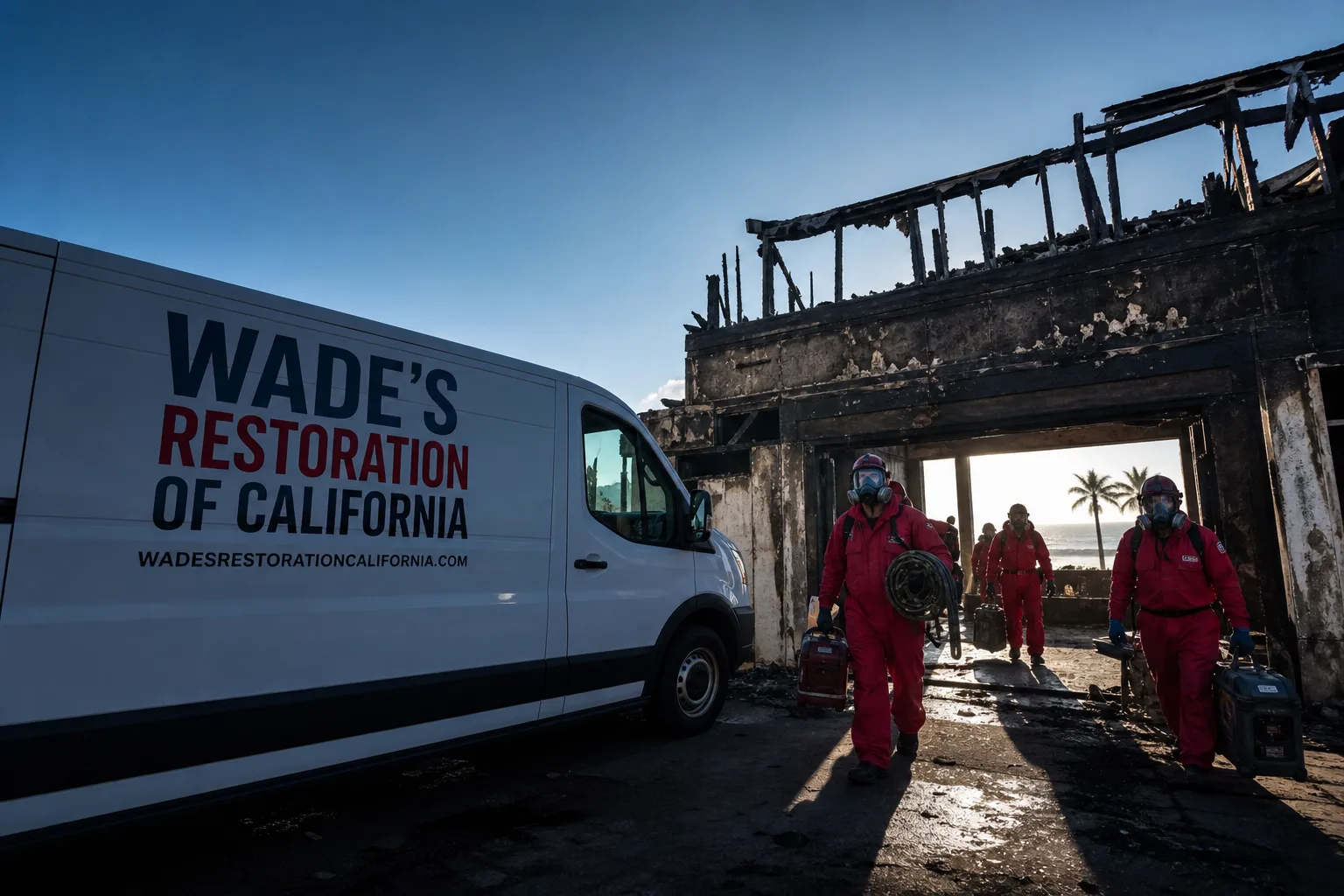
Fast, Reliable Mold Remediation Across Huntington Beach
Mold remediation in Huntington Beach typically runs $1,800 to $6,500 depending on square footage, surface contamination, and whether hidden moisture is feeding the growth. Most jobs can be assessed within 24 to 48 hours, with work starting the same week. Huntington Beach’s marine layer keeps humidity high enough that mold left untreated for even a few weeks spreads behind baseboards and into wall cavities. If you’re seeing black spots, smelling something musty, or watching paint bubble near floor lines, call Wade’s Restoration of California at (855) 915-0646 and Wade will tell you straight what you’re dealing with.
Why Wade’s Restoration of California Is Huntington Beach’s Preferred Mold Remediation Company
Wade Ferris started this company in 2007 and he still answers the phone himself. That’s not a line, it’s how the business runs. When a Huntington Beach homeowner calls at 7 a.m. with mold spreading through a garage, Wade picks up, asks the right questions, and heads out with his crew. No call center, no routing system, no stranger showing up at the door.
Huntington Beach homeowners get something most restoration companies won’t offer: daily moisture readings, logged and handed over at the end of the job. Almost nobody in the trade does this. Wade does it on every Mold Remediation job because he knows the marine layer here means moisture hides in places a quick visual check misses. He also deals with insurance adjusters directly, so you’re never the middleman relaying test results and scope notes between two sides. And every job carries the 90-Day Done Right Promise in writing: if it’s not done right, Wade makes it right. Ask anyone on your street who’s dealt with a national chain that quoted one price over the phone and another at the door. Wade publishes his name, address, and license number. You’ll run into him again at the hardware store. That’s the oldest accountability mechanism there is.
Our Mold Remediation Services in Huntington Beach
Mold Inspection & Testing
Visible mold is the tip of it. In Huntington Beach homes, especially the 1960s slab-on-grade stucco tracts in 92646 and 92647, mold travels behind baseboards and under vapor barriers where the concrete slab traps marine-layer moisture. Wade’s crew runs moisture meters across wall surfaces, checks humidity in wall cavities, and takes air samples when needed. Testing confirms what you’re actually dealing with: some of it’s cosmetic surface growth, some of it’s Stachybotrys (black mold) that requires full containment. You’ll get a written report with numbers, not a vague “looks bad.”
Mold Removal
Mold removal in Huntington Beach means more than wiping surfaces. The marine layer keeps relative humidity at 80-90% on summer mornings and rarely drops below 60-65% even inland. That means spore counts stay high and regrowth happens fast if the moisture source isn’t eliminated. Wade’s crew contains the affected area, removes contaminated drywall and insulation, treats structural framing with antimicrobial agents, and sizes dehumidification equipment aggressively enough for coastal conditions. A set of Dri-Eaz LGR dehumidifiers running for three days in Huntington Beach does what a big-box rental unit can’t do in a week.
Black Mold Remediation
Black mold needs full containment, negative air pressure, and proper PPE. No shortcuts. In Huntington Beach homes near PCH, black mold often shows up after stormwater backups push Category 3 street runoff into garages and ground-floor entries. That water carries sewage, salt, and organic material, and the mold that follows colonizes drywall within days. Wade’s crew sets up containment barriers, runs HEPA air scrubbers, removes the affected material, and verifies clearance with post-remediation air sampling. You get documentation showing the mold is gone, not a pat on the back and a bill.
Air Quality Restoration
After mold is removed, the air inside the house still holds spores for a while. Huntington Beach’s coastal air exchange helps in the fall and winter, but in summer when the marine layer sits overhead for days straight, indoor air turns stagnant. Wade’s team runs HEPA air scrubbers and HEPA vacuums every surface in the contained area, then re-tests. The goal is spore counts inside the house that match the outdoor baseline, not a number that looks good on paper. He’ll hand you the readings.
What happens when you call
- 1
A real person answersNo phone trees - you reach a local pro.
- 2
You get an upfront price rangeHonest numbers before anyone is dispatched.
- 3
A background-checked tech heads outLicensed & insured, dispatched right away.
- 4
You approve before work beginsNothing starts until you say go.
Trusted Brands We Service in Huntington Beach
Wade’s crew works with professional-grade equipment from Dri-Eaz, Phoenix, and Injectidry because those machines hold up under the humidity loads Huntington Beach throws at them. The technicians are IICRC-certified and RIA-affiliated, so the protocols they follow match what the industry actually requires for coastal California homes. When you call about mold in a Huntington Harbour canal home or a tract house in 92647, you get the same standard: real moisture readings, real containment, real documentation.
Common Mold Remediation Problems We See in Huntington Beach Homes
- Slab foundations trapping marine-layer moisture. Homes in 92646 and 92647 built on concrete slabs wick groundwater upward, creating a permanently damp zone behind baseboards and under carpet padding. The mold grows where nobody looks until the smell gives it away.
- Garage mold fed by corroded door hardware. Salt-laden air near the beach attacks garage-door springs, hinges, and fasteners, shedding fine metal particles onto the drywall in attached garages. Combined with 60-65% indoor humidity, that metal dust becomes a nutrient source for mold colonies.
- Stormwater backups along PCH. Flat, low-elevation neighborhoods near Pacific Coast Highway get street runoff pushed into garages and ground-floor entries during winter atmospheric river events. That water is Category 3, and drying it in place without removal means mold returns within weeks.
- Huntington Harbour canal flooding. 92649 homes on compacted fill sit within two to three feet of mean high tide. Storm surge pushes saline water into lower levels, and IICRC protocol requires full removal of saturated drywall, insulation, and affected framing. Inland contractors who don’t run salinity tests miss this completely.
Pricing for Mold Remediation in Huntington Beach, CA
We Also Serve Cities Near Huntington Beach
Wade’s crew works throughout the coastal Orange County area, including Midway City, Fountain Valley, Westminster, and Costa Mesa. If you’re just outside Huntington Beach proper, call the office at (855) 915-0646 and we’ll confirm the service area. We regularly handle Mold Remediation in Huntington Beach and surrounding communities.
Serving Huntington Beach, CA - Our Local Coverage Area
We’re based in the Huntington Beach area and know this community well. Use the map below to see our service coverage - if you’re nearby, we can almost certainly help.
FAQs - Mold Remediation in Huntington Beach
Does mold remediation in Huntington Beach require different dehumidification equipment because of the marine layer?
Yes. Huntington Beach’s marine layer keeps relative humidity at 80-90% on summer mornings and rarely below 60-65% even inland, so evaporative drying is severely suppressed. Standard residential dehumidifiers don’t move enough air. Wade’s crew sizes LGR dehumidifiers (Dri-Eaz and Phoenix units) and runs them longer than an inland job requires. Undersized equipment means the job stalls and secondary mold starts inside the standard 24-hour window. Call (855) 915-0646 and we’ll tell you exactly what your situation calls for.
After canal flooding in Huntington Harbour, can the drywall on my lower level be dried in place?
No. In Huntington Harbour, storm surge water is saline, tidal, and carries contaminants that make it IICRC Category 3. Once saturated, drywall, insulation, and framing cannot be dried in place under any IICRC protocol. Full removal is required, usually up three feet from the water line or higher. Inland adjusters sometimes dispute this scope until a salinity test is run on-site. Wade runs that test and handles the adjuster conversation directly. We responded to a canal-front home on Humboldt Drive where the previous contractor had set up drying equipment on Category 3 water. Our salinity test confirmed the contamination, and we removed the saturated drywall, treated the wood subfloor with an antimicrobial, and ran Dri-Eaz dehumidifiers on the structural framing before rebuilding with moisture-resistant materials.
Why does mold keep returning in my Huntington Beach garage even after the drywall was replaced?
Because the moisture and the nutrient source weren’t both eliminated. In beach-adjacent Huntington Beach zones, corroded garage-door hardware sheds fine metal particles onto the drywall, and persistent 60-65% indoor humidity from the marine layer feeds mold growth on that dust. Replacing drywall without replacing the corroded hardware or controlling the humidity means the mold comes back in months. Wade’s team checks the garage door components, the slab moisture level, and the indoor humidity before any drywall goes up. Call (855) 915-0646 and we’ll figure out what’s actually feeding it.
Is mold testing needed in Huntington Beach if I can see the mold?
Not always, but often yes. If the visible mold is isolated, small, and the moisture source is obvious, remediation can start without air sampling. But in Huntington Beach homes where mold is near HVAC returns or the growth pattern suggests it spread behind walls, testing identifies whether it’s a toxigenic species requiring full containment. Testing also gives you a baseline for post-remediation verification, so you can prove the job was done right. Wade includes testing recommendations in the written scope, never as an add-on surprise after work begins.
How long do I have after a water event in Huntington Beach before mold starts?
About 24 to 48 hours under normal conditions, but Huntington Beach’s humidity compresses that window. With the marine layer keeping humidity at 80% or higher, mold spores can germinate within 24 hours on wet drywall and porous surfaces. The longer the water sits, the deeper the contamination goes and the more material has to be removed. If you’ve had a water event, call (855) 915-0646 immediately. Wade heads out fast, and the faster the drying starts, the less mold remediation you’ll need at all.
Contact Wade’s Restoration of California for Mold Remediation in Huntington Beach
If you’ve got mold, a water event, or a musty smell you can’t trace, call (855) 915-0646. Wade answers his own phone, 24/7, and he’ll tell you honestly what you’re dealing with and what it’ll take to fix it. Free estimates, written scopes, and direct adjuster communication on every job in Huntington Beach. No trip charge inside the county. Senior and veteran discounts always apply.
Written by Wade Ferris, Owner at Wade’s Restoration of California, founded in 2007.