
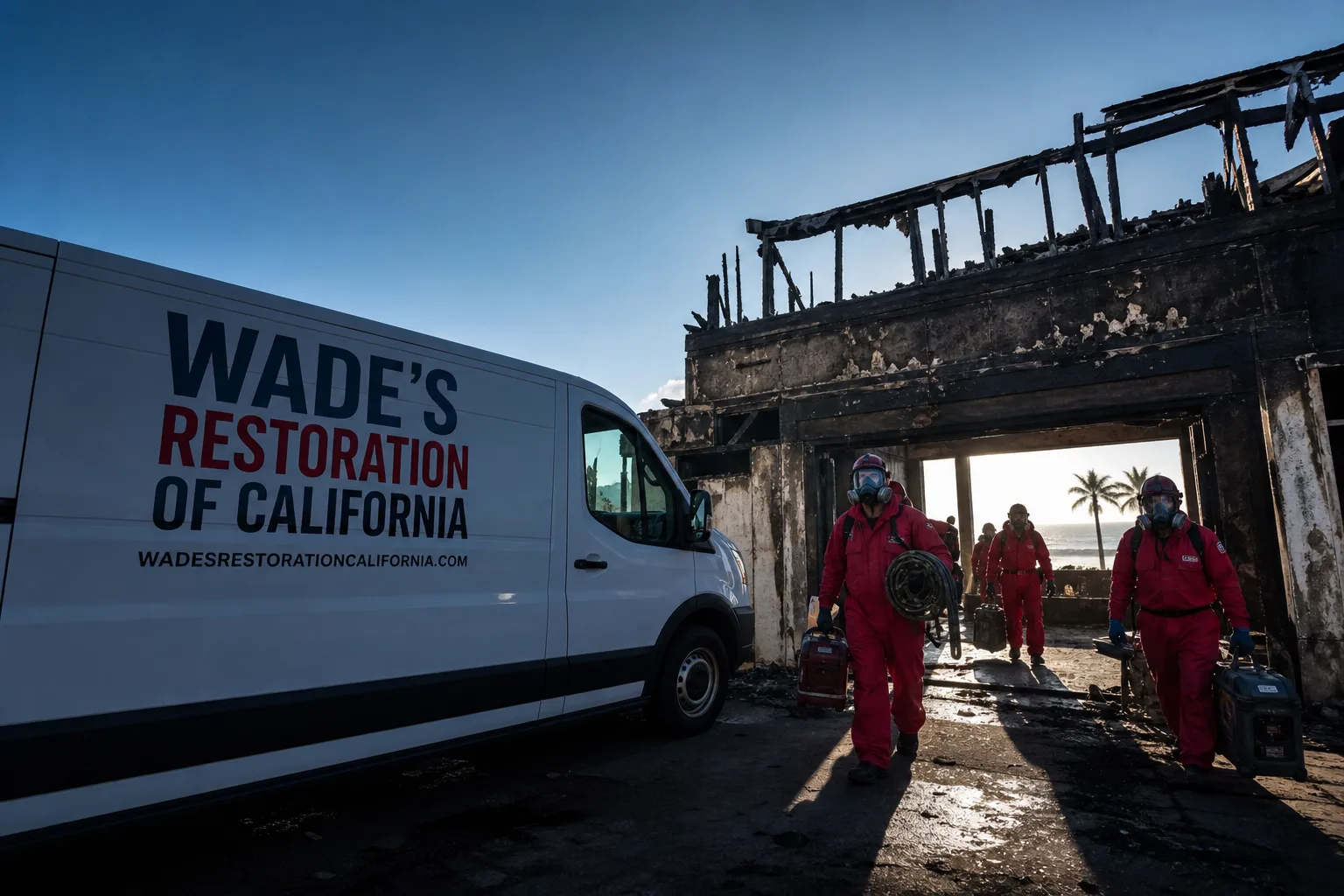
Fast, Reliable Fire & Smoke Damage Restoration Across Long Beach
Fire and smoke damage in Long Beach moves fast. Salt-laden marine air from the Port pushes through 90810, 90806, and 90802, and within 48 hours of a fire, soot that settled on surfaces starts bonding with that moisture and etching permanently into what it touches. The clock runs faster here than it does ten miles inland. If you need Fire & Smoke Damage Restoration in Long Beach, call (855) 915-0646 now. Wade Ferris answers his own phone, and he can have a crew headed your way while you’re still standing in the wet kitchen.
Why Wade’s Restoration of California Is Long Beach’s Preferred Fire & Smoke Damage Restoration Company
Wade Ferris founded this company in 2007 because he got tired of seeing homeowners get quoted one price on the phone and a different number once a national chain’s estimator walked through the door. He publishes his name and address, he answers his own phone at midnight, and if something isn’t done right, he makes it right. That’s not a slogan. It’s the 90-Day Done Right Promise, stamped in writing on every fire, water, and mold restoration contract we take on.
Long Beach customers call us back because our Fire & Smoke Damage Restoration team knows the housing stock here. Wade and his crew have worked 1920s Spanish Colonials off 4th Street, post-war tract homes in 90808 built for Naval Station workers, and Naples Island canalside properties where the foundation is sitting in water year-round. That local knowledge changes how we scope a job. We know which homes have transite pipe and asbestos floor tiles before we open a single wall. We know a board-up on a narrow Belmont Shore gangway can’t block the side window the same way it would on a Signal Hill driveway. And we document everything before demo starts, because we know Long Beach adjusters will ask the hard questions about pre-existing conditions.
Calls are answered by a live person 24/7. Not a call center. Often it’s Wade himself. We’re IICRC-certified, RIA-affiliated, and IFA-recognized, and we run background-checked, uniformed crews with Dri-Eaz and Injectidry equipment that actually dries walls, not just the air.
Our Fire & Smoke Damage Restoration Services in Long Beach
Smoke & Soot Removal
Soot in Long Beach doesn’t sit still. Port-area salt air keeps it damp, and damp soot etches into painted walls, sealed wood, and even appliance finishes within days. In a 90802 duplex off 4th Street, we responded to a kitchen fire that had pulled smoke through a shared wall cavity into the neighbor’s unit. The visible soot was bad enough. What mattered more was what we couldn’t see. Wade’s crew ran Dri-Eaz air scrubbers continuously and mapped the smoke path before touching anything, because scrubbing visible soot off walls without addressing what’s inside the cavity means the staining comes back in three weeks.
Odor Removal & Deodorization
Smoke odor in Long Beach lingers longer than it does in Lakewood or Paramount. That’s not opinion. Elevated coastal humidity keeps smoke particles suspended in porous materials, and on Naples Island the problem compounds because canal water sits at or near foundation level. Odor molecules bind to damp drywall and plaster differently than they do to dry materials. We use thermal fogging and hydroxyl generation, but we sequence it right: dry first, then deodorize. If you fog a wall that’s still holding canal moisture, the odor returns and you’ve paid twice for the same room.
Emergency Board-Up & Tarping
A fire-damaged home in Long Beach is often a 1920s bungalow with balloon-framed walls, which means fire and smoke travel vertically through stud bays that run from the crawlspace to the attic uninterrupted. Boarding up a window is not just about keeping people out. It’s about keeping port-area fog and marine air from drifting into open cavities and re-contaminating insulation we haven’t removed yet. On narrow alley-load lots in 90802 and 90804, Wade’s crew stages trucks one at a time and seals every opening tight before we leave for the night. A gap in a side window facing a gangway is a recontamination problem by morning.
Contents Cleaning & Pack-Out
Before we pack out anything from a Long Beach fire job, we document prior conditions. That’s the rule. Homes built before 1933 in 90802, 90804, and 90805 often have pre-existing moisture staining, efflorescence on stem walls, and mold behind walls that was there long before the fire. If we don’t photograph and log that before packing out smoke-damaged contents, the adjuster has every reason to argue the damage predates the loss. We photograph, we log, and we hand you the full documentation. Then we clean, pack, and store your contents with the same documentation standard.
What happens when you call
- 1
A real person answersNo phone trees - you reach a local pro.
- 2
You get an upfront price rangeHonest numbers before anyone is dispatched.
- 3
A background-checked tech heads outLicensed & insured, dispatched right away.
- 4
You approve before work beginsNothing starts until you say go.
Trusted Brands We Service in Long Beach
Wade’s crew works with the equipment we’d want in our own homes after a fire. We run Dri-Eaz air scrubbers and dehumidifiers, Injectidry wall-drying systems for cavity drying in those 1920s balloon-framed walls, and B-Air and XPOWER air movers. We stock filters, HEPA cartridges, and odor-control supplies locally, which matters when you need a job finished before the marine layer rolls back in. Our IICRC certification means the work is done to an industry standard, not whatever the guy with the cheapest truck thinks looks fine.
Common Fire & Smoke Damage Restoration Problems We See in Long Beach Homes
- Salt air re-contaminates cleaned surfaces. Port-area marine air pushing through 90810 and 90806 carries fine particulates that bond with soot residue left in wall cavities. If soot removal stops at visible surfaces, dark staining reappears within weeks. The fix is cavity cleaning and sealing, not just surface scrubbing.
- Naples Island moisture traps smoke odor. Canal-front homes on 90803 sit with foundation-level moisture year-round. Smoke particles bind to damp plaster and drywall, and no amount of surface deodorizing addresses what’s trapped in the wall system. The moisture issue has to be handled or the odor never leaves.
- Pre-1933 building materials trigger hazmat protocols. Many 90802 and 90804 homes rebuilt or patched after the 1933 Long Beach earthquake contain asbestos floor tiles, transite pipe, and old blown-in insulation. Open a wall on demo day without abatement in place and you’ve created a bigger problem than the fire did.
- Attached homes share smoke paths. Long Beach’s dense bungalow districts mean many fires in duplexes and attached units pull smoke through shared walls and common attics. Cleaning one unit and not the neighbor’s cavity means the smell comes back, and now you’re chasing it in a room you thought was done.
Pricing for Fire & Smoke Damage Restoration in Long Beach, CA
We Also Serve Cities Near Long Beach
Wade’s Restoration of California serves Long Beach and the surrounding communities including Signal Hill, Lakewood, Carson, and Compton. If you’re in one of those cities and need Fire & Smoke Damage Restoration in Long Beach level service, call (855) 915-0646 and Wade will send a crew your way. Same documentation, same 90-Day Done Right Promise, same owner answering the phone.
Serving Long Beach, CA - Our Local Coverage Area
We’re based in the Long Beach area and know this community well. Use the map below to see our service coverage - if you’re nearby, we can almost certainly help.
FAQs - Fire & Smoke Damage Restoration in Long Beach
Does fire damage restoration in Long Beach require special hazmat protocols for homes built before 1933?
Yes. Homes built or rebuilt after the 1933 Long Beach earthquake frequently contain asbestos-laden floor tiles, transite pipe, and old blown-in insulation. Any demolition work in those homes requires hazmat containment before structural repair begins. Wade’s crew identifies and test for these materials before opening walls, and we build abatement into the scope so you’re never surprised by a change order mid-job.
Why does smoke odor linger longer after a fire in Naples Island homes compared to inland Long Beach?
Naples Island homes on 90803 sit with canal water at or near foundation level year-round. The persistent sub-slab moisture creates a condition where smoke particles bind to damp building materials and resist standard deodorizing. You have to address the moisture source, or thermal fogging and hydroxyl treatment won’t hold. That’s the step almost nobody mentions, and it’s the step that makes the difference between a home that still smells like smoke in March and one that doesn’t.
How does the coastal marine layer affect the timeline for fire and smoke damage cleanup in Long Beach?
The marine layer keeps relative humidity elevated through spring and early summer, which prevents water-damaged materials from drying naturally and gives soot more time to bond with surfaces. The window for successful mitigation is shorter in Long Beach than in inland cities. If cleanup is delayed, you’re compounding smoke damage with secondary moisture problems. Wade’s crew arrives with drying equipment on the first truck, not the second.
What should I document before starting fire damage cleanup in a Belmont Shore or Naples Island home?
Photograph and log any pre-existing conditions: efflorescence on stem walls, prior mold staining, water marks on baseboards, anything that shows moisture was present before the fire. Adjusters in Long Beach routinely dispute whether damage predates the reported loss, especially on canal-front homes where moisture is a perpetual condition. Wade’s crew documents everything before demo begins and hands you the full log, so the claim doesn’t stall on a technicality.
Can smoke damage spread between attached homes in Long Beach’s dense 1920s bungalow districts?
Yes, and it does. Fires in duplexes and attached units pull smoke through shared wall cavities, common attics, and even under sill plates in balloon-framed construction. If you only clean the unit where the fire started, the neighbor’s cavity re-contaminates your side within weeks. The fix is cavity inspection and sealing on both sides of the shared wall, which is why we scope attached homes differently than detached ones.
Written by Wade Ferris, Owner at Wade’s Restoration of California, serving Long Beach since 2007.